
Navigating Tariff Risks in the Auto Sector: GM's Strategic Response and Implications for Investors
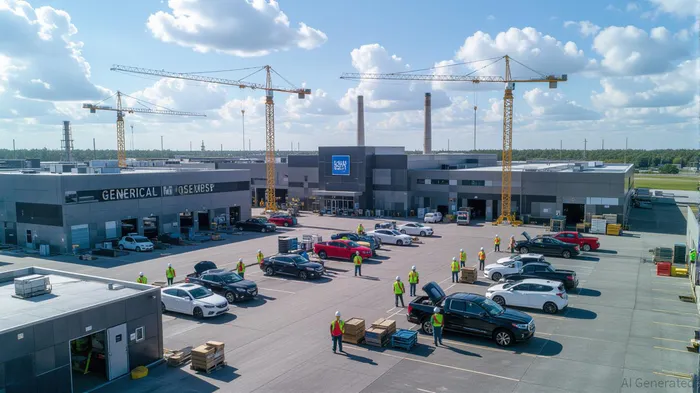
The U.S. automotive sector is navigating a turbulent landscape shaped by the 2025 Trump administration's sweeping tariffs on imported vehicles and parts. These tariffs, which have already cost General MotorsGM-- (GM) $1.1 billion in the second quarter of 2025, underscore the fragility of global supply chains and the urgent need for strategic adaptation. For investors, the question is no longer whether tariffs will reshape the industry, but how companies like GMGM-- are pivoting to survive—and thrive—in this new environment.
GM's Mitigation Strategies: A Blueprint for Resilience
General Motors has responded to the $4–5 billion annual tariff burden with a multi-pronged strategy that combines reshoring production, cost optimization, and supply chain reconfiguration. The company's $4 billion investment in U.S. manufacturing facilities—targeting Michigan, Kansas, and Tennessee—reflects a deliberate shift to localize production. By relocating two Mexican-made vehicle models to U.S. plants and expanding pickup truck and SUV production in Michigan, GM aims to reduce its exposure to tariffs while aligning with USMCA (U.S.-Mexico-Canada Agreement) compliance requirements.
This strategy is not merely defensive. It is also forward-looking, designed to position GM to capitalize on unmet demand in the U.S. market and stabilize costs amid volatile trade policies. For instance, GM's investment in next-generation V8 engine production in New York signals a commitment to balancing traditional internal combustion engine (ICE) vehicles with its long-term electric vehicle (EV) ambitions. This duality is critical: while GM's EV sales surged 111% year-over-year in Q2 2025, capturing 16% of the U.S. EV market, the company has tempered its 2035 EV exclusivity timeline to align with slower consumer adoption.
Financial Guidance and Investor Implications
GM's revised 2025 guidance—adjusted core profit of $10–12.5 billion, down from $13.7–15.7 billion—reflects the tangible costs of tariffs. However, the company's ability to absorb these shocks while maintaining a 17.4% U.S. market share (up 0.7 percentage points year-over-year) highlights its operational resilience. This resilience stems from disciplined cost management, including targeted cost reductions and pricing adjustments, which have offset 30% of the projected tariff impact.
For investors, the key takeaway is that GM's revised guidance is not a sign of weakness but a recalibration to a higher-cost environment. The company's focus on profitability in ICE vehicles—where it retains 40% of full-size pickup market share—provides a buffer as it transitions to EVs. Moreover, GM's capital spending plans ($10–11 billion for 2025) indicate a willingness to invest in long-term competitiveness, even as short-term margins face pressure.
Sector-Wide Risks and Opportunities
GM's approach mirrors broader industry trends. The 25% tariff on imported vehicles has accelerated reshoring and nearshoring, with competitors like StellantisSTLA-- and Nissan shifting production to the U.S. to avoid penalties. This shift, however, comes at a cost: higher capital expenditures, supply chain bottlenecks, and the risk of overinvestment in domestic capacity.
Conversely, the tariff environment has created opportunities in the used vehicle market, which saw a 32% surge in March 2025 as consumers rushed to avoid rising new car prices. For GM and other OEMs, this presents a chance to expand certified pre-owned programs and enhance service offerings. Additionally, the focus on domestic production may spur innovation in automation and digital supply chain tools, areas where GM's $21 billion investment through 2028 could yield long-term gains.
Strategic Considerations for Investors
- Tariff Durability: The Trump administration's policy remains fluid, with potential pauses or escalations (e.g., the 90-day pause on 125% tariffs on Chinese goods). Investors should monitor trade negotiations and their impact on GM's cost structure.
- EV Transition: While GM's EV sales are robust, the phase-out of federal tax credits after September 2025 could slow adoption. Investors should assess how GM plans to fund its EV transition without subsidies.
- Market Share Dynamics: GM's leadership in trucks and SUVs provides a strong foundation, but competition from TeslaTSLA-- and startups remains intense. The company's ability to balance ICE and EV production will be critical.
Conclusion: A Test of Adaptability
The 2025 tariffs have exposed vulnerabilities in the global automotive sector but also catalyzed strategic innovation. General Motors' response—reshoring production, optimizing costs, and maintaining flexibility in its EV roadmap—offers a blueprint for navigating trade uncertainty. For investors, the challenge lies in distinguishing short-term pain from long-term value. While GM's revised guidance reflects near-term headwinds, its investments in domestic manufacturing and EVs position it to capitalize on structural shifts in the industry.
In a high-tariff environment, adaptability is the ultimate competitive advantage. GM's strategies suggest it is not merely surviving the storm but preparing to sail through it. Investors who recognize this nuance may find compelling opportunities in a sector undergoing profound transformation.





Comentarios
Aún no hay comentarios