
Navigating Tariff Refund Market Dynamics: Legal Uncertainty and Risk-Adjusted Returns in a Policy-Driven Trade Environment
The global trade landscape has entered a period of profound uncertainty, driven by the interplay of legal challenges to U.S. tariff policies and the evolving mechanisms for refunding collected duties. For investors, this environment demands a nuanced understanding of how policy-driven volatility translates into risk-adjusted returns. The recent legal scrutiny of tariffs imposed under the International Emergency Economic Powers Act (IEEPA) and the potential for massive refunds-estimated at $750 billion to $1 trillion-highlight the stakes involved. This analysis explores the implications of these dynamics, drawing on historical precedents and contemporary policy shifts to frame a forward-looking strategy for investors.
Legal Challenges and Refund Mechanisms: A Double-Edged Sword
The U.S. Supreme Court's evaluation of the IEEPA's authority to justify broad import tariffs has created a regulatory limbo. If the court rules against the executive's power, importers may seek refunds via post-summary corrections or administrative protests under 19 U.S.C. § 1514 according to legal analysis. However, downstream parties-such as consumers or businesses indirectly bearing tariff costs-face complex recovery hurdles shaped by contractual obligations as legal experts note. This legal ambiguity introduces a dual risk: immediate cash-flow pressures for businesses and prolonged uncertainty for investors.
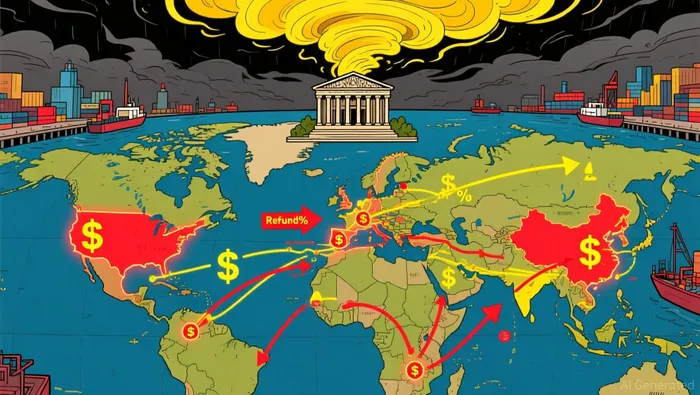 The potential scale of refunds is staggering. According to a report by the San Francisco Federal Reserve, tariff increases have historically led to short-term demand shocks, with unemployment rising slightly and inflation falling initially, followed by a rebound in economic activity and inflation as supply-side adjustments take hold. For investors, this means that while refunds could alleviate some financial burdens, the path to realization is fraught with procedural delays and legal bottlenecks.
Global Protectionism and Investor Implications
The Trump administration's tariff policies have not only reshaped domestic trade but also intensified global protectionist trends. The World Trade Organization reported that the value of global imports affected by new tariffs surged fourfold between mid-October 2024 and mid-October 2025. This escalation has triggered retaliatory measures from key trading partners, including Canada and China, complicating supply chains and amplifying market volatility.
Investors must now factor in the compounding risks of trade wars and policy reversals. For instance, the U.S.-China truce to reduce some tariffs contrasts with ongoing threats of new restrictions, creating a fragmented and unpredictable regulatory environment. Such shifts demand dynamic risk models that account for both the likelihood of policy changes and their sector-specific impacts.
Historical Precedents: Lessons from the Smoot-Hawley Tariff Act
History offers cautionary tales. The Smoot-Hawley Tariff Act (SHTA) of the 1930s, which triggered a wave of retaliatory tariffs and deepened the Great Depression, illustrates how legal and policy uncertainty can destabilize markets. During the SHTA's 18-month debate, the U.S. stock market fell 43%, with firms experiencing 30–40 basis point declines on event dates. Volatility spiked as investors grappled with uncertainty over profitability. When the RTAA repealed SHTA in 1934, markets rebounded modestly but never fully recovered from the earlier losses according to economic research.
This historical episode underscores a critical insight: legal uncertainty in trade policy amplifies risk premiums and distorts market returns. For today's investors, the parallels are clear. The current legal challenges to IEEPA tariffs mirror the SHTA's political turbulence, suggesting that prolonged uncertainty could erode investor confidence and depress risk-adjusted returns.
Strategic Considerations for Investors
To navigate this high-stakes environment, investors must adopt strategies that balance prudence with agility. First, scenario analysis should be central to risk modeling. For example, if the Supreme Court invalidates IEEPA tariffs, importers could recover up to $1 trillion, but downstream recovery complexities may limit the actual value of refunds. Conversely, if tariffs are upheld, businesses may face sustained cost pressures, particularly small enterprises that have already incurred over $100 billion in tariff-related expenses.
Second, diversification across geographies and sectors is essential. Sectors heavily exposed to U.S. imports-such as manufacturing and retail-are particularly vulnerable to tariff fluctuations, while those with diversified supply chains may fare better according to Deloitte analysis. Additionally, investors should monitor contractual arrangements to anticipate how tariff costs might be allocated or refunded, as these terms will shape recovery outcomes.
Finally, policy engagement cannot be overlooked. The proposed $2,000 consumer dividend by President Trump, though requiring Congressional approval, highlights the political dimensions of tariff refunds. Investors must stay attuned to legislative developments and advocate for transparent, equitable refund mechanisms that minimize market distortions.
Conclusion
The tariff refund market is a microcosm of the broader challenges facing investors in a policy-driven trade environment. Legal uncertainty, global protectionism, and historical precedents all point to a landscape where risk-adjusted returns hinge on adaptability and foresight. By integrating scenario-based modeling, geographic diversification, and active policy monitoring, investors can mitigate the downsides of volatility while capitalizing on potential opportunities. In this high-stakes arena, the ability to navigate uncertainty is not just an advantage-it is a necessity.







Comentarios
Aún no hay comentarios