
Navigating U.S. Tariff Policy Uncertainty: Strategic Investment Adjustments for 2026
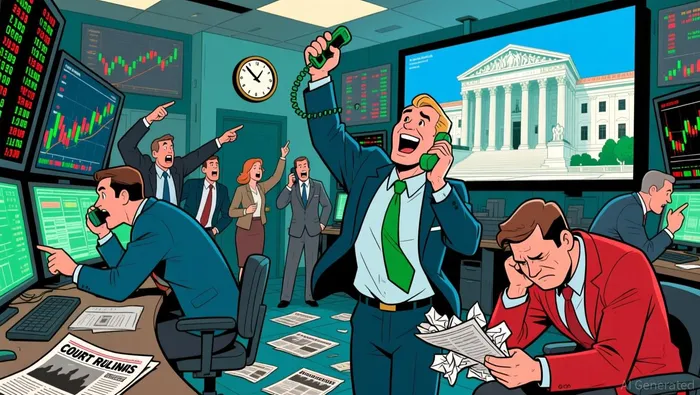
The U.S. Supreme Court's impending decision on the legality of President Donald Trump's IEEPA-based tariffs has become a pivotal inflection point for global markets. With the ruling delayed until January 14, 2026, investors and corporate leaders are recalibrating strategies to mitigate risks and capitalize on potential outcomes. This analysis examines the legal, economic, and sector-specific implications of the case, offering actionable insights for 2026.
Legal Uncertainty and Market Implications
The Supreme Court's deliberation over whether Trump's use of IEEPA to justify tariffs constitutes an overreach of executive power has far-reaching consequences. According to a Bloomberg report, the justices' hesitation to issue a ruling on January 8-postponing it to January 14-reflects the complexity of balancing presidential emergency authority against constitutional checks. If the Court upholds the tariffs, it could embolden future administrations to bypass Congress on major policies, eroding the major questions doctrine. Conversely, a ruling against the tariffs would invalidate billions in collected duties and force refunds for importers, creating immediate fiscal headwinds for the Treasury.
Legal scholars and financial analysts alike emphasize that the outcome will reshape trade policy frameworks. As stated by the Brennan Center, the case tests whether IEEPA, traditionally reserved for conflict-related sanctions, can legally justify broad tariff measures. This uncertainty has already spurred businesses like Costco to sue for refunds, anticipating a potential reversal.
Sector-Specific Impacts and Investor Strategies
The economic toll of Trump's tariffs is unevenly distributed across sectors. For instance, the automotive industry has seen a -0.1% GDP decline due to import restrictions, while the pharmaceutical sector faces a 100% tariff on branded drugs unless companies build U.S. manufacturing facilities. J.P. Morgan notes that while large biopharma firms may weather these costs, smaller importers and consumers bear the brunt.
Investors are adopting diverse strategies to navigate this volatility. A 2026 Global Trade Report by Thomson Reuters reveals that 39% of organizations now absorb tariff costs-a threefold increase from the prior year-to preserve profitability amid uncertainty. Technology adoption is also surging, with 40% of trade departments exploring AI and blockchain for supply chain optimization. Meanwhile, cross-functional collaboration between trade, finance, and operations teams has become critical to align risk mitigation efforts.
Actionable Investment Adjustments for 2026
Given the binary nature of the Supreme Court's potential rulings, sector rotation and hedging strategies are essential. If the Court invalidates the tariffs, import-heavy sectors like consumer staples and consumer discretionary could see a tailwind. For example, Costco and Bunge Global SA have already gained traction amid tariff uncertainty, and further relief could amplify their margins. Conversely, materials and energy sectors-highly sensitive to steel and aluminum tariffs-may face reduced pressures if the levies are struck down.
Conversely, a ruling upholding the tariffs would likely favor domestic producers in materials and commodities but could trigger a short-term market selloff, particularly if Trump reiterates his expansive use of emergency powers. In this scenario, defensive sectors like healthcare and utilities-less exposed to trade policy shifts-may outperform. Additionally, small-cap stocks have shown resilience in 2026, with investors betting on liquidity from the Federal Reserve and potential economic boosts from tariff relief.
Wells Fargo & Co. estimates that a pro-business ruling could boost S&P 500 EBIT by 2.4% in 2026, driven by reduced supply chain costs. However, fiscal risks remain, as tariff revenue declines could push Treasury yields higher and necessitate alternative legal pathways for protectionist measures.
Conclusion
The Supreme Court's decision on Trump's tariffs represents a defining moment for global trade and investment. Traders' low confidence in the administration's legal standing-evidenced by market positioning and legal challenges-signals a shifting risk landscape. Investors must remain agile, leveraging sector rotation, technology adoption, and cross-functional collaboration to navigate potential outcomes. As the January 14 ruling approaches, proactive positioning will be key to capitalizing on volatility and securing long-term resilience.







Comentarios
Aún no hay comentarios