
Navigating the Tariff-Driven Turbulence: Strategic Opportunities in a Retreating Tech Bull Market
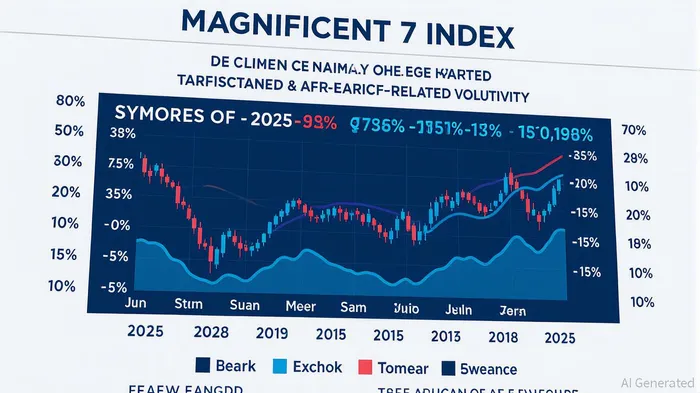
The global investment landscape in 2025 is marked by a profound recalibration. The Magnificent 7 (Mag 7) stocks, once the bedrock of growth-oriented portfolios, now face a secular rotation as macroeconomic pressures, tariff-driven uncertainties, and shifting investor sentiment converge. This shift is not merely cyclical but structural, demanding a rethinking of portfolio construction and risk management.
The Mag 7’s Mixed Fortunes and the Case for Rotation
The Mag 7’s collective underperformance—down 14.5% year-to-date—contrasts sharply with the S&P 500’s broader decline, underscoring their outsized influence on market dynamics [5]. While NVIDIANVDA-- and Meta PlatformsMETA-- (META) have defied the trend with gains of 19.2% and 23.1%, respectively, AppleAAPL-- (AAPL) and TeslaTSLA-- (TSLA) have lagged, with AAPLAAPL-- down 16.1% and TSLATSLA-- exhibiting weak relative strength [2]. This divergence signals a fragmentation within the group, driven by divergent earnings trajectories and valuation pressures. The BofA fund manager survey reveals that “Long Magnificent 7” is now the most crowded trade, with 45% of participants citing it as overexposed [1]. Such concentration risks amplify the need for diversification.
Tariff Uncertainties and the Rebalancing Imperative
The Trump administration’s 2025 tariff policies—averaging 18.6%, the highest since 1933—have introduced volatility into global supply chains and asset prices [5]. These tariffs, coupled with retaliatory measures from China, the EU, and Japan, have disrupted trade flows and elevated stagflation risks. For investors, this environment necessitates a strategic rebalancing. The S&P 500’s 4.8% drop on April 3, 2025, following tariff announcements, underscores the fragility of portfolios overly reliant on U.S. tech stocks [6].
The rotation out of the Mag 7 is not arbitrary. Value sectors—financials, energy, and industrials—are outperforming, with the Russell 1000 Value index up 1.9% year-to-date [2]. International equities, particularly in the MSCIMSCI-- EAFE index, have surged 11%, reflecting a search for undervalued opportunities amid U.S. market concentration [2]. Defensive sectors like utilities and healthcare are also gaining traction, offering resilience in a high-rate environment [5].
Strategic Rebalancing: Diversification and Active Management
The rebalancing imperative extends beyond sectoral shifts. Investors must address three key dimensions:
1. Geographic Diversification: Non-U.S. markets, including the UK, Germany, and China, are offering attractive entry points as global trade tensions ease [5].
2. Factor Rotation: Active ETFs focused on low-volatility equities (e.g., iShares MSCI USA Min Vol Factor ETF) and value stocks are capturing sentiment shifts [2].
3. Defensive Positioning: Core bonds and minimum volatility strategies are critical for risk-averse portfolios, particularly as traditional correlations between stocks and bonds weaken [1].
The Federal Reserve’s dovish pivot and anticipated rate cuts further tilt the playing field. Small-cap stocks, which rallied as investors anticipated liquidity improvements, highlight the potential for earnings surprises in less-crowded segments [3].
The Road Ahead: Balancing Growth and Resilience
While the Mag 7’s structural advantages in AI and cloud computing remain intact, their high valuations and exposure to global demand make them vulnerable to macroeconomic shocks [4]. A balanced approach—selectively retaining exposure to resilient Mag 7 names like NVIDIA while diversifying into value sectors and international markets—offers a path forward.
The long-term outlook hinges on trade policy clarity and the pace of global economic rebalancing. If tariffs recede, the U.S. market could see a rebound in growth stocks. However, the immediate priority is to hedge against volatility through tactical rebalancing, leveraging tools like active ETFs and liquid alternatives [2].
In this era of de-globalization and geopolitical uncertainty, the key to navigating the tariff-driven turbulence lies in agility. Investors must embrace a dual mandate: preserving capital through defensive positioning while capturing growth in undervalued sectors and regions. The Mag 7’s retreat is not the end of the tech bull market but a pivot toward a more diversified and resilient global economy.
Source:
[1] "Long Magnificent 7" once again world's most crowded trade, [https://www.reuters.com/business/long-magnificent-7-once-again-worlds-most-crowded-trade-bofa-survey-finds-2025-08-11/]
[2] The 2025 Stock Market Rotation: What it Means for Investors, [https://www.finsyn.com/the-2025-stock-market-rotation-what-it-means-for-investors/]
[3] Small caps rally as Magnificent 7 stocks roll over in market rotation, [https://www.cnbc.com/2025/08/13/small-cap-rally-magnificent-seven-megacap-tech-slide.html]
[4] Asset Management Mid-Year Outlook 2025: A Halftime, [https://am.gs.com/en-ch/advisors/insights/article/asset-management-mid-year-outlook]
[5] The U.S. Dollar's Rebalancing: Opportunities in a De-Globalizing World, [https://www.ainvest.com/news/dollar-rebalancing-opportunities-de-globalizing-world-2509/]
[6] Where We Stand: The Fiscal, Economic and Distributional Effects of All US Tariffs Enacted in 2025 Through April, [https://budgetlab.yale.edu/research/where-we-stand-fiscal-economic-and-distributional-effects-all-us-tariffs-enacted-2025-through-april]





Comentarios
Aún no hay comentarios