
Navigating the Tariff Crossroads: How US-China Deadlines Shape Maritime Logistics' Future
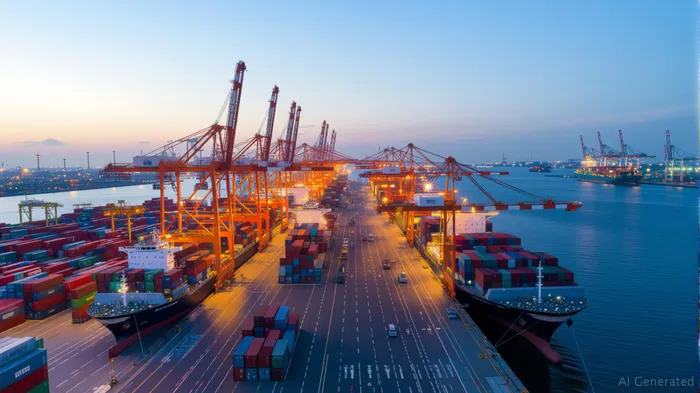
The July/August 2025 deadlines for US-China trade tariffs mark a pivotal inflection pointIPCX-- for global supply chains. With tariffs on Chinese goods averaging 55%—a blend of Section 301, Section 232 steel-related duties, and fentanyl tariffs—the outcome of ongoing negotiations will determine whether maritime logistics firms like Maersk thrive through resolution-driven agility or escalation-fueled premium pricing. Investors must position now to capitalize on this binary outcome scenario.
The Binary Tariff Crossroads
The August 12 deadline for the US-China truce and the July 9 deadline for worldwide reciprocal tariffs create two distinct paths:
- Resolution Optimism: A framework deal extending the 10% tariff truce, coupled with reduced Section 232 steel duties, would trigger a wave of nearshoring and re-shoring investments. Companies would restructure supply chains to diversify away from China, favoring logistics providers with agile networks and transshipment capabilities.
- Tariff Escalation: If deadlines pass without extension, tariffs could spike to 145% on Chinese goods, locking in prolonged trade friction. This would sustain premium pricing power for ocean carriers as companies grapple with higher costs and delayed reconfiguration.
Maersk: The Barometer of Tariff Dynamics
Maersk's 21% effective tariff rate—a weighted average reflecting its exposure to US-China trade—highlights the sector's vulnerability. Yet its stock's recent volatility underscores its dual positioning:
- Q2 2025 Performance: Maersk's shares fell 12% in April–May amid tariff uncertainty but rebounded 7% post-truce talks in June. This swing mirrors broader investor sentiment tied to resolution prospects.
- Network Resilience: Maersk's global footprint and transshipment hubs (e.g., in Southeast Asia) allow it to reroute cargo around tariffs, making it a prime beneficiary of either scenario.
Scenario 1: Resolution Drives Nearshoring Agility
If the US and China extend the truce and reduce steel tariffs:
- Supply Chain Shifts: Companies will accelerate nearshoring to Mexico, Vietnam, and the EU, boosting demand for short-haul trans-Pacific and trans-Atlantic routes.
- Winner: Maersk (MAERSK-B.CO) and CMA CGM (CMPC.PA) gain from their flexible networks and digital supply chain tools.
- Equity Valuation: Logistics firms with strong balance sheets and IT infrastructure will see multiple expansions, as earnings stabilize and margins improve.
Scenario 2: Escalation Fuels Premium Pricing
If tariffs escalate:
- Prolonged Premium Rates: Shippers will absorb tariffs to avoid disruptions, keeping spot rates elevated.
- Winner: Hapag-Lloyd (HLAG.DE) and Evergreen Marine (2603.TW) benefit from fixed-rate contracts tied to inflation.
- Equity Valuation: Carriers with high contracted revenue exposure (e.g., >80% of 2025 bookings) will see stable cash flows, insulating them from volume declines.
The Legal Wildcard: IEEPA Tariffs' Fate
The US Court of International Trade's May 2025 ruling that IEEPA tariffs are unlawful—now stayed pending appeal—adds uncertainty. If overturned by the Supreme Court in 2026:
- Refund Risks: Carriers may face claims for overcharged tariffs, pressuring free cash flow.
- Strategic Play: Investors should prioritize firms with low exposure to IEEPA-linked contracts (e.g., Maersk's diversified portfolio).
Investment Strategy: Position Ahead of Resolution
- Buy Maersk: Its 12.5x EV/EBITDA multiple is undervalued relative to its peers. A resolution-driven rebound could push it to 15x.
- Hedging with Options: Use call options on maritime ETFs (e.g., SEA) to capture upside in either scenario.
- Avoid Single-Region Exposure: Steer clear of carriers overly reliant on China-US routes (e.g., COSCO Shipping (1919.HK)), which face disproportionate tariff headwinds.
Conclusion
The July/August deadlines are a binary catalyst for maritime logistics equities. Investors should overweight Maersk and agile peers now, as either scenario—resolution or escalation—will reward preparedness. With tariffs at historic highs and global trade in flux, the next few months will define the sector's trajectory for years to come.
Position for resilience—act before the crossroads decide.







Comentarios
Aún no hay comentarios