
Navigating the Tariff Crossfire: How to Protect and Profit in Trump's Trade War
The escalating trade war under the Trump administration has created a seismic shift in global supply chains, with tariffs now acting as both a financial weapon and a catalyst for corporate adaptation. As reciprocal tariffs loom over tech and consumer discretionary sectors, investors must dissect which companies can weather the storm—and which might thrive in the chaos. The key lies in identifying defensive resilience (companies insulated from tariff shocks) and opportunistic plays (those poised to capitalize on market dislocation).
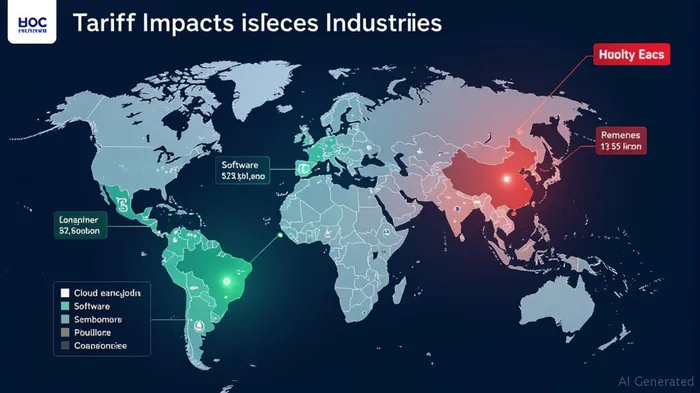
The Defensive Playbook: Companies That Thrive in Chaos
The most resilient companies are those with diversified supply chains, pricing power, or exposure to domestic demand. Let's break down the sectors:
Tech Sector: Cloud and Software as the New Safe Havens
While hardware manufacturers like AppleAAPL-- (AAPL) and semiconductor firms such as IntelINTC-- (INTC) face headwinds—34% tariffs on Chinese imports and potential 25% levies on semiconductors—cloud infrastructure and software giants are insulated. These companies rely less on physical exports and more on recurring revenue streams.
Why They Win:
- Microsoft (MSFT): Its Azure cloud platform and enterprise software dominate global markets, with pricing power to offset rising costs.
- Adobe (ADBE): Subscription-based software models allow it to pass costs to customers without sacrificing margins.
- Salesforce (CRM): Enterprise software adoption is a secular trend, unaffected by trade squabbles.
Consumer Discretionary: Essential Retailers Over Tariff-Exposed Brands
The sector bifurcates between necessity-driven giants and import-reliant retailers.
Defensive Picks:
- Walmart (WMT): A domestic retail staple with strong pricing power and minimal reliance on foreign-manufactured goods.
- Costco (COST): Its membership model and focus on U.S. suppliers insulate it from consumer discretionary volatility.
Risky Plays:
- Amazon (AMZN): While its cloud division (AWS) is a defensive asset, its e-commerce segment faces higher costs due to tariffs on imported goods.
- Nike (NKE): Over 90% of its production occurs in Vietnam and China, directly exposed to 20%–46% tariffs.
The Opportunistic Edge: Betting on Volatility
Market volatility creates opportunities for investors to buy undervalued assets in sectors facing temporary headwinds.
Tech: Semiconductor Makers as a Contrarian Play
While tariffs threaten semiconductor firms, a selective approach can yield rewards. Companies with U.S. manufacturing or critical national security roles may gain favor.
Why Now?
- The U.S. government might exclude defense contractors like Raytheon (RTX) from tariffs, even as broader semiconductor tariffs loom.
- Firms with R&D in advanced chips (e.g., NVIDIA (NVDA)) could benefit from a push to onshore production.
Consumer Discretionary: The “Staycation” Economy
Rising import costs could fuel demand for domestic leisure.
Winners:
- Domestic travel companies like Hilton (HLT) or Airbnb (ABNB), as Americans shift spending from imported goods to local experiences.
Risks to Avoid: Tariff-Exposed and Commodity-Linked Firms
- Export-Heavy Tech: Firms reliant on Chinese or Taiwanese semiconductors (e.g., Advanced Micro Devices (AMD)) face margin compression.
- Copper-Dependent Sectors: Mining stocks like Freeport-McMoRan (FCX) are vulnerable, as tariffs on critical minerals and construction slowdowns crimp demand.
- Global Brands: Luxury goods companies (e.g., LVMH) and auto manufacturers (e.g., General Motors (GM), hit by steel tariffs) face rising costs and retaliatory duties abroad.
Actionable Portfolio Shifts
- Rotate into Cloud and Software: Increase allocations to MSFTMSFT--, ADBEADBE--, and CRMCRM--.
- Hedge with Domestic Consumer Staples: Add WMTWMT-- and COST to portfolios.
- Take a Contrarian Stance on Semiconductors: Buy dips in TXNTXN-- and NVDANVDA--, but avoid pure-play China plays like SMIC.
- Avoid Commodity Plays: Reduce exposure to copper and steel stocks until tariffs abate.
The trade war's endgame remains uncertain, but investors can mitigate risk by prioritizing companies with global pricing power and domestic demand anchors. In this era of manufactured volatility, the winners will be those who adapt—and the losers will be those who cling to outdated supply chain models.
The market's next move may hinge on the August tariff deadlines. Stay vigilant—and stay diversified.





Comentarios
Aún no hay comentarios