
Navigating the Tariff Crossfire: EU-U.S. Trade Tensions and Strategic Supply Chain Resilience
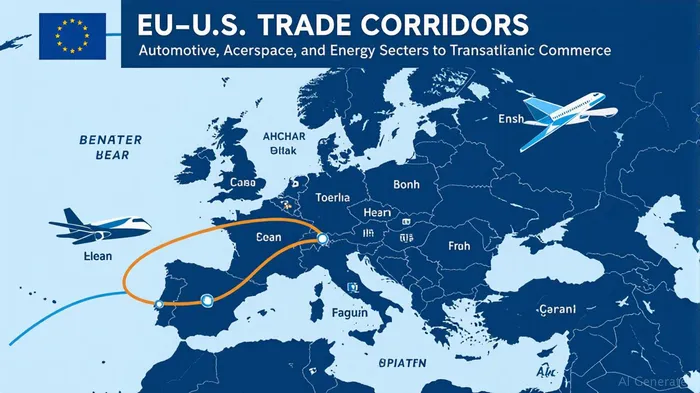
The escalating EU-U.S. trade dispute, set to intensify with reciprocal tariffs slated for August 2025, has created both risks and opportunities for investors. With automotive, aerospace, and energy sectors at the epicenter of tariff-related volatility, companies are scrambling to mitigate costs and fortify supply chains. This article dissects the geopolitical chessboard, evaluates sector-specific vulnerabilities, and identifies actionable strategies for investors seeking to navigate—or capitalize on—the turbulence.
The Current Tariff Landscape: A Volatile Playing Field
The EU and U.S. are locked in a high-stakes standoff, with the EU delaying retaliatory tariffs until August 1, 2025, while the U.S. maintains a 20% baseline rate on most EU imports. Key highlights include:
- Automotive: U.S. tariffs of 25% on non-USMCA-compliant vehicles have driven car prices up by 13.5% in the U.S.
- Aerospace: EU retaliatory tariffs target $8 billion of U.S. goods, including aerospace components, though UK-based manufacturers benefit from exemptions under WTO rules.
- Energy: The EU remains the largest buyer of U.S. LNGLNG--, but transshipped Chinese goods (e.g., via Vietnam) face 40% tariffs, complicating global supply chains.
The legal front adds uncertainty: a federal stay on tariffs is pending appeal, with oral arguments set for July 31. Investors must weigh the risk of sudden policy shifts against long-term sectoral trends.
Sectoral Impacts: Winners and Losers in the Tariff Wars
Automotive: A Crossroads of Disruption
The automotive sector faces a dual threat: U.S. tariffs on EU-made vehicles and retaliatory measures targeting U.S. auto exports. TeslaTSLA--, with its U.S.-centric production and focus on battery supply chain localization, may outperform rivals like Volkswagen, which relies on European manufacturing. Investors should prioritize firms with:
- Geographic diversification (e.g., North American factories for U.S. sales).
- Tariff-exempt components (e.g., U.S.-made batteries or Canadian steel).
Aerospace: Navigating Exemptions and Alliances
The aerospace sector is a case study in strategic resilience. BoeingBA--, with its U.S. government ties, may leverage exemptions for U.S.-EU collaborative projects, while Airbus faces retaliatory tariffs. However, companies with cross-border supply chains (e.g., Rolls-Royce's U.K.-U.S. engine partnerships) could thrive under the WTO's civil aircraft agreement.
Energy: Geopolitical Leverage and Liquidity
The EU's dependence on U.S. LNG and the U.S. need for EU pharmaceuticals create mutual vulnerabilities. Investors should monitor companies like Cheniere EnergyLNG-- (LNG), which benefits from EU demand, while hedging against broader inflation risks through commodities like aluminum ().
Mitigation Strategies: Building Supply Chain Resilience
Localization and Nearshoring:
Companies are shifting production closer to end markets to avoid tariffs. For example, automotive firms may expand U.S. factories or use Mexico's USMCA exemptions.Diversification:
Reducing reliance on single regions. Technology firms like AppleAAPL-- (AAPL) have already started sourcing components from Southeast Asia to mitigate China-U.S. tensions, a model applicable here.Leveraging Exemptions:
The WTO's civil aircraft agreement and U.S.-UK trade carve-outs highlight the value of sector-specific legal expertise. Firms with in-house trade compliance teams or partnerships with governments will gain an edge.Strategic Partnerships:
Joint ventures between EU and U.S. firms (e.g., Boeing-Airbus collaborations) can split costs and navigate tariffs through shared supply chains.
Investment Opportunities and Risks
- Buy:
- Logistics Leaders: Companies like FedExFDX-- (FDX) or DHL (DHLG.Y) benefit from increased transatlantic trade complexity.
Tariff-Resistant Sectors: Healthcare (e.g., Roche (RHHBY)) and tech (e.g., MicrosoftMSFT-- (MSFT)) face fewer direct tariff impacts.
Avoid:
- High-Tariff Exposed Sectors: EU steel producers (e.g., ArcelorMittalMT-- (MT)) and U.S. automakers reliant on EU parts.
Geopolitical Bets: Avoid overexposure to single-country equities until the July 9 negotiation deadline passes.
Hedge:
Use options on ETFs like the iShares MSCIMSCI-- EMU ETF (EZU) or SPDR S&P 500 ETF (SPY) to mitigate volatility.
Conclusion: The Prize Lies in Preparedness
The EU-U.S. trade dispute is a marathon, not a sprint. Investors who prioritize firms with adaptive supply chains, geographic flexibility, and legal agility will outperform in this environment. While the July 9 deadline offers a near-term catalyst, the long-term success of transatlantic trade hinges on sector-specific solutions—making now the time to position portfolios for resilience.





Comentarios
Aún no hay comentarios