
Navigating the Storm: Strategic Risk Mitigation in DeFi Amid Escalating Cyber Threats
The Escalating Cybersecurity Crisis in DeFi
The decentralized finance (DeFi) sector has entered a new era of risk. In 2025, crypto hacks surged past $3.1 billion in losses, a CoinMarketCap report found. Access-control flaws remain the dominant threat, accounting for 59% of these losses, while AI-powered exploits have surged by 1,025% year-over-year, primarily targeting insecure APIs, according to a BlockTelegraph analysis. The February 2025 Bybit hack-stealing $1.5 billion-exposed systemic vulnerabilities, and the Cetus protocol's $223 million heist in 15 minutes marked one of the worst quarters for DeFi security since 2023.
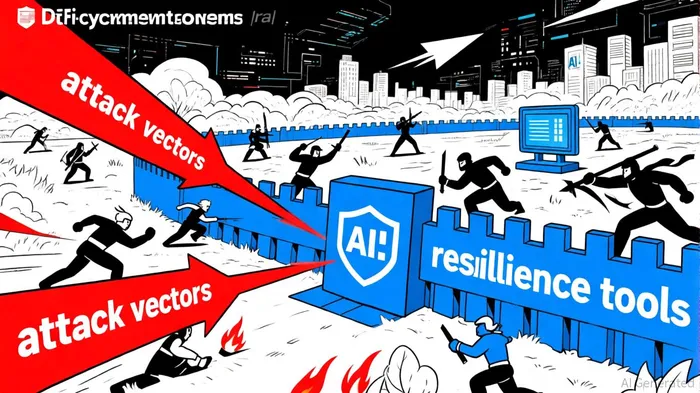
Despite these setbacks, DeFi's infrastructure has matured significantly. Since 2020, exploit losses have dropped by 90%, and lending protocols now maintain daily loss rates at just 0.00128%, a Coindesk report found. However, attackers are pivoting to operational weaknesses: private key compromises now account for 20% of incidents, the Coindesk report notes, and phishing attacks have spiked by 40%, often via fake exchange sites, according to a CoinPedia report and a Kroll analysis. The rise of real-world asset (RWA) projects-bridging on-chain and off-chain systems-has further expanded the attack surface, the CoinPedia piece and Kroll analysis add.
Shifting Attack Vectors and Investor Sentiment
Q3 2025 revealed a troubling trend: while overall exploit losses fell by 37%, wallet and operational attacks surged, with September alone recording a record number of million-dollar breaches. Hackers are increasingly bypassing smart-contract vulnerabilities to target user wallets, exchanges, and governance systems. For instance, the April 2025 $92.5 million DeFi breach highlighted how even minor governance flaws can erode trust, as detailed in a CryptoRobotics report.
Investor confidence remains a mixed bag. On one hand, platforms are adopting zero-knowledge proofs, decentralized key management, and AI-driven anomaly detection to rebuild trust, the Coindesk report notes. On the other, high-profile breaches have led experts to question the risk-adjusted returns of DeFi investments, as an AnalyticsInsight piece argues. The challenge lies in balancing innovation with security-a tension that will define the sector's next phase.
Strategic Risk Mitigation: Building a Resilient Portfolio
For investors, the key to navigating this landscape lies in strategic risk mitigation and portfolio diversification. Here's how to approach it:
Prioritize Protocols with Proven Security Frameworks
Platforms like EthereumETH-- and XRPXRP-- continue to dominate due to their robust infrastructure and institutional adoption. Ethereum's smart-contract dominance and XRP's role in global finance make them less susceptible to operational attacks. Meanwhile, emerging platforms like Blazpay ($BLAZ) are leveraging AI automation and gamified rewards to enhance user security and engagement.Diversify Across Attack-Resistant Sectors
Avoid overexposure to protocols with unproven governance models. Instead, allocate capital to projects with transparent on-chain audit trails, multi-signature wallets, and cross-chain interoperability features-the Coindesk report highlights these defensive characteristics. For example, DeFi lending protocols have reduced security risks by 98.4% since 2020, making them a safer bet than high-risk RWA projects.Adopt AI-Driven Risk Management Tools
Investors should integrate AI-powered tools for real-time anomaly detection and phishing prevention. Platforms using decentralized key management and zero-knowledge proofs (e.g., ZcashZEC--, Aztec) offer enhanced privacy and resilience, according to the Coindesk findings.Stay Informed on Emerging Threats
Q4 2025 has seen a rise in AI-powered deepfakes and oracle manipulation attacks. Investors must monitor threat intelligence reports and adjust strategies accordingly.
The Path Forward: Security as a Competitive Advantage
While the DeFi sector faces unprecedented challenges, it also has the tools to evolve. The 90% reduction in exploit losses since 2020, highlighted by the Coindesk report, proves that innovation can outpace threats. However, investors must remain vigilant. A "security-first" mindset-prioritizing protocols with transparent governance, AI-driven defenses, and user-centric design-will be critical to long-term resilience.
As the crypto ecosystem matures, those who adapt to the new threat landscape will not only survive but thrive. The future of DeFi belongs to those who treat security not as an afterthought, but as the foundation of trust.






Comentarios
Aún no hay comentarios