
Navigating the Storm: How Political Rhetoric Shapes Green Energy Investment Risk in 2025
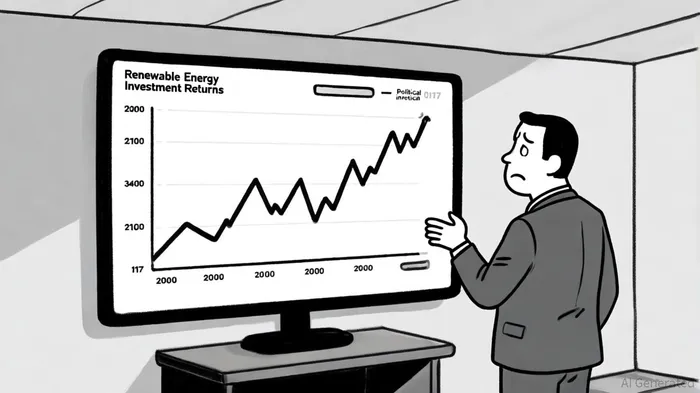
Let's cut to the chase: climate policy uncertainty is the new wildcard in green energy investing. For every solar panel installed or wind turbine erected, there's a shadow cast by political rhetoric that can either supercharge returns or turn a promising project into a stranded asset. The data is clear—when governments flip-flop on climate commitments, investors get spooked. According to a report by the International Energy Agency (IEA), climate policy uncertainty can inflate investment risks for power companies by up to 40% of construction costs and 10% of electricity price surcharges for end-users [1]. That's not just noise; it's a seismic shift in risk calculus.
Take the U.S. as a case study. When the Trump administration withdrew from the Paris Agreement in 2017, renewable energy firms saw their average TOPSIS scores—a measure of financial performance—plummet by 7.4% [2]. Conversely, under Obama's reengagement with the pact, the same firms gained 3.7% [2]. Here's the rub: Political rhetoric doesn't just shape headlines; it rewrites the rules of the game for investors.
The 2024 U.S. presidential election has added another layer of volatility. A potential Trump victory could trigger a rollback of the Inflation Reduction Act's (IRA) $369 billion clean energy incentives, while a Biden-like continuation would cement a decade-long tailwind for renewables [3]. Meanwhile, far-right gains in the EU elections—particularly in Germany and Italy—threaten to pivot energy policies toward fossil fuels or nuclear energy, slowing green investment [3].
But let's not paint the picture too bleakly. Uncertainty isn't all bad. Research shows that policy instability can stimulate innovation in renewables as firms pivot to technologies less vulnerable to regulatory shifts [4]. For example, solar and wind have outperformed biofuels in recent years, partly because their deployment is less sensitive to oil price swings [5]. The key is to distinguish between sectors that can weather political storms and those that can't.
What's the takeaway for investors? First, diversify across geographies. While U.S. and EU markets remain politically volatile, BRICS nations are showing resilience. Despite political risks, countries like India and Brazil are doubling down on renewables, driven by economic growth and R&D investments [6]. Second, hedge against policy reversals by prioritizing companies with strong balance sheets and diversified revenue streams. The IRA's tax credits and subsidies are a lifeline, but they're not a guarantee—especially if the next administration decides to burn them.
Finally, don't underestimate the power of government effectiveness. Germany's Energiewende policy, which has created 0.3 million green jobs, proves that consistent regulatory frameworks can turn uncertainty into opportunity [6]. The U.S. needs to follow suit—but until then, investors must treat climate policy like a weather vane, constantly adjusting to the next political gust.
Bottom line: Green energy is a long-term bet, but political rhetoric is a short-term wildcard. The winners in 2025 will be those who can ride the turbulence, not those who wait for the storm to pass.







Comentarios
Aún no hay comentarios