
Navigating the Storm: Political and Economic Risks in AI Infrastructure Expansion and Data Center Investment Resilience
The rapid expansion of artificial intelligence (AI) infrastructure, particularly hyperscale data centers, has become a cornerstone of U.S. technological strategy. However, this growth is increasingly entangled in a web of political and economic risks, driven by conflicting regulatory frameworks and energy demands. As the Trump Administration consolidates federal authority over AI governance, investors must weigh the implications of regulatory headwinds and the sector's resilience amid shifting policy landscapes.
Political Risks: Federal Overreach and State-Level Pushback
President Trump's Executive Order 14179, titled Ensuring a National Policy Framework for Artificial Intelligence, represents a direct challenge to state-level AI regulations.
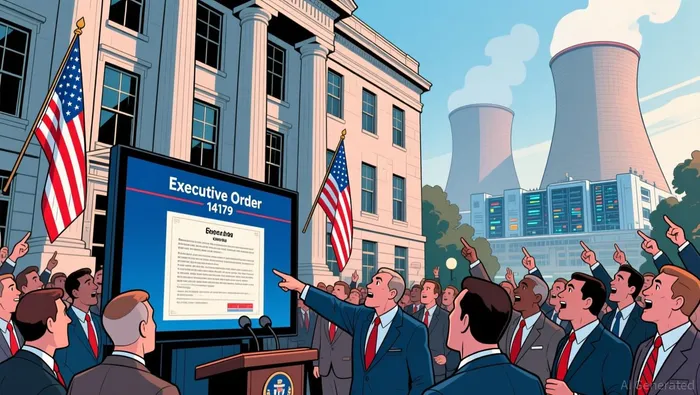
The order mandates the creation of an AI Litigation Task Force within the Department of Justice (DOJ) to contest state laws deemed inconsistent with federal priorities, such as those requiring AI models to alter "truthful outputs" or embed ideological bias according to White House sources. By framing these laws as unconstitutional under the First Amendment or as impediments to interstate commerce, the administration seeks to centralize control over AI governance according to legal experts.
This federal push has sparked a legal and political showdown. For instance, states like Colorado, which have enacted algorithmic discrimination laws, now face potential litigation or funding cuts under programs like the Broadband Equity Access and Deployment (BEAD) initiative according to state legal analysis. While the order explicitly preserves state authority in areas like child safety and data center infrastructure, the ambiguity of these carveouts creates regulatory uncertainty for companies operating in states with robust AI laws according to Cooley's legal review. Investors must monitor how the DOJ's Task Force prioritizes cases and whether states will resist federal preemption through judicial or legislative means.
Economic Risks: Energy Consumption and Compliance Costs
The economic risks of AI infrastructure expansion are equally pressing. Data centers, which already consumed 4.4% of U.S. electricity in 2023, are projected to account for 6.7–12% of total consumption by 2028 according to energy policy analysis. Executive Order 14318, which streamlines permitting for data center energy projects, aims to address this by accelerating access to electricity generation and transmission infrastructure according to White & Case analysis. However, the reliance on federal lands and brownfield sites for development raises environmental and community opposition risks, potentially delaying projects despite regulatory fast-tracking according to bipartisan policy analysis.
Compliance costs are also evolving. While the administration's permitting reforms reduce some regulatory burdens-such as expediting environmental reviews under the Clean Air Act-new federal standards for AI infrastructure could impose unforeseen costs. For example, the Clean Cloud Act of 2025 mandates data collection from data centers and their suppliers, creating administrative overhead for operators according to environmental policy analysis. Additionally, the threat of funding cuts for states with conflicting AI laws may force companies to navigate a dual compliance framework, increasing operational complexity.
Investment Resilience: Opportunities Amid Uncertainty
Despite these risks, the data center sector remains a critical component of the U.S. AI strategy. The administration's emphasis on "rapid buildout" of infrastructure, coupled with financial incentives like grants and tax breaks, positions the sector for growth according to White House policy documents. Hyperscale operators that align with federal priorities-such as those leveraging renewable energy or federal lands-may benefit from reduced permitting delays and lower capital costs.
However, resilience hinges on adaptability. Companies must diversify their energy portfolios to mitigate rising electricity demands and invest in compliance technologies to navigate evolving federal-state dynamics. For investors, this means prioritizing firms with agile supply chains and strong lobbying capabilities to influence regulatory outcomes.
Conclusion
The intersection of AI infrastructure expansion and regulatory conflict presents both challenges and opportunities. While Executive Orders 14179 and 14318 signal a federal push for streamlined AI development, the sector's success will depend on its ability to navigate legal uncertainties and energy constraints. Investors who closely monitor policy shifts and prioritize resilience in their portfolios may find themselves well-positioned to capitalize on the AI-driven economy-provided they can weather the storm.







Comentarios
Aún no hay comentarios