
Navigating Soybean Market Volatility: Strategic Positioning for Agricultural Traders Amid Chinese Procurement Uncertainty
Trade Dynamics and Tariff Barriers
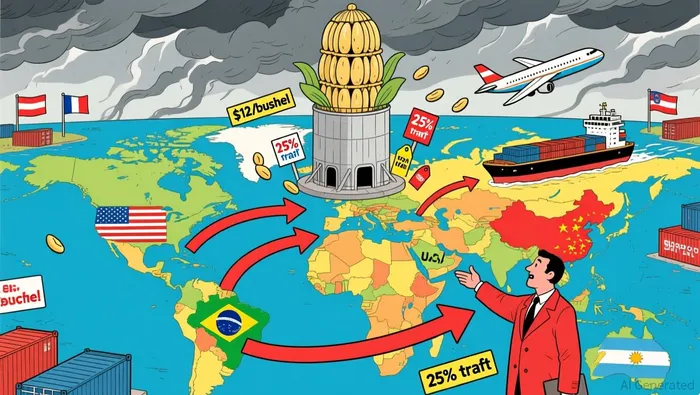
China's procurement plans for U.S. soybeans remain a focal point of speculation. The White House has asserted that China intends to purchase at least 12 million metric tons of U.S. soybeans by year-end 2025 and 25 million tons annually for the next three years, according to a COFCO held soybean procurement signing ceremony, association official tells US-China forum. However, Beijing has not confirmed these figures, leaving traders in limbo. Meanwhile, Chinese importers have pivoted to Brazil and Argentina, where soybean prices have dropped following the U.S.-China trade truce. Brazilian soybeans now face a 3% tariff in China, compared to 13% for U.S. imports, according to Soybeans Retreat Amid China Buying Uncertainty, making them a more attractive option. This shift has pushed U.S. soybean futures to hover near $11 per bushel, reflecting market skepticism about the scale of U.S. exports, according to Agricultural Markets Brace for Impact as Soybean and Wheat Prices Tumble Amidst China's Shifting Demand.
The U.S. government shutdown has further muddied the waters by disrupting USDA export reporting, limiting transparency in trade flows, according to Soybeans Retreat Amid China Buying Uncertainty. This lack of clarity has forced traders to rely on alternative data sources and strategic hedging to navigate the uncertainty.
Tactical Positioning: Hedging, Diversification, and Supply Chain Adjustments
Agricultural traders are adopting a multi-pronged approach to manage risks. Hedging strategies include diversifying sourcing to include lower-cost suppliers like Brazil and Argentina. Multinational firms such as Archer Daniels MidlandADM-- (ADM) and BungeBG-- (BG) are leveraging their global networks to pivot between suppliers, capitalizing on price differentials, according to Agricultural Markets Brace for Impact as Soybean and Wheat Prices Tumble Amidst China's Shifting Demand. In contrast, U.S.-based operations and smaller grain elevators face reduced demand and profit erosion if trade tensions persist, according to the same report.
Diversification is also evident in portfolio adjustments. Companies like IMCD NV (IMCDY) have intensified cost-effectiveness measures, including digital tools and operational optimization, to counter pricing pressures from Chinese suppliers, according to IMCD NV (IMCDY) Q3 2025 Earnings Call Highlights: Strategic Acquisitions and Resilient Segments. Meanwhile, Chinese importers are strategically balancing politically motivated commitments to U.S. soybeans with commercially driven purchases from South America, according to the same report.
Supply chain adjustments are reshaping logistics. As China's reliance on Brazilian soybeans grows-accounting for 79% of its sales during January-October 2025-transportation sectors are recalibrating freight volumes, according to China seen using soybeans as leverage in trade rift with US. This shift underscores a broader restructuring of global agricultural trade, with China actively diversifying its import sources to reduce dependency on any single supplier, according to Agricultural Markets Brace for Impact as Soybean and Wheat Prices Tumble Amidst China's Shifting Demand.
Implications for Investors
For investors, the soybean market's volatility presents both risks and opportunities. Firms with diversified supply chains, such as ADM and Bunge, are better positioned to weather procurement uncertainties. Conversely, U.S. exporters reliant on China may face prolonged headwinds unless tariffs are adjusted. The transportation and logistics sectors, particularly rail and port operators, could also see reduced demand if U.S. soybean exports stagnate, according to Agricultural Markets Brace for Impact as Soybean and Wheat Prices Tumble Amidst China's Shifting Demand.
Market analysts suggest that China may begin procuring U.S. soybeans in late December or early January 2025 as South American supplies dwindle, according to China seen using soybeans as leverage in trade rift with US. However, until official confirmation arrives, traders will remain cautious.
Conclusion
The soybean market's trajectory in 2025 hinges on China's procurement decisions and the resolution of U.S.-China trade tensions. Traders who prioritize flexibility, diversification, and strategic hedging are likely to outperform in this environment. Investors should monitor tariff developments and procurement confirmations, as these will determine the next phase of market dynamics.





Comentarios
Aún no hay comentarios