
Navigating the Skies: FAA Protocols, Airport Disruptions, and Investment Risks in U.S. Aviation
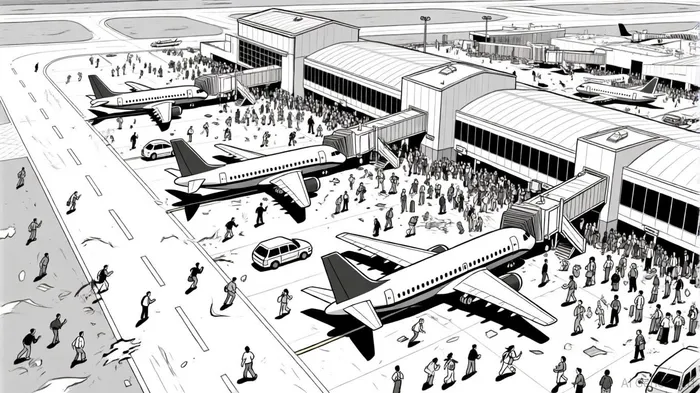
The U.S. aviation sector is at a crossroads, balancing the need for modernization with the realities of aging infrastructure and operational fragility. Recent disruptions at Hartsfield-Jackson Atlanta International Airport-America's busiest hub-serve as a stark reminder of the risks embedded in the system. From a gasoline-like odor prompting evacuations to runway equipment failures and severe weather, these incidents underscore the critical interplay between FAA safety protocols, infrastructure resilience, and financial performance for airlines and airports. For investors, the question is no longer if disruptions will occur, but how to assess their frequency, severity, and long-term implications.
The Atlanta Case Study: A Microcosm of Systemic Vulnerabilities
Hartsfield-Jackson's recent ground stops and delays highlight the fragility of even the most robust aviation networks. In May 2025, a runway equipment issue forced a 90-minute ground stop, causing over 700 flight delays and 470 cancellations for Delta Air LinesDAL-- alone, according to Fox 5 Atlanta. By June, a hailstorm exacerbated the chaos, grounding 100 DeltaDAL-- planes and triggering $25M–$50M in operational costs, per MarketBeat. These events, compounded by staffing shortages during the 2025 government shutdown, as reported by CBS News, reveal a system stretched thin by aging technology and underfunded modernization efforts.
The FAA's response-ground stops, evacuations, and delayed recovery-was necessary for safety but came at a steep cost. For Delta, the May disruptions led to a 41% year-to-date stock decline, while the June hailstorm triggered a 2.8% intraday drop, according to MarketBeat. These market reactions reflect investor concerns about operational resilience and the airline's ability to manage compounding risks.
FAA Protocols: A Double-Edged Sword
The FAA's 2024 Reauthorization Act aims to address these vulnerabilities, allocating $2.89 billion for airport infrastructure grants and $66.7 billion for safety programs, according to an AAAE regulatory alert. While these investments are critical for modernizing air traffic control and runway systems, they also impose compliance costs on airlines. For instance, the Act mandates automatic refunds for delayed flights and triples penalties for consumer violations, increasing operational overhead, according to Morgan Lewis.
However, the FAA's own challenges-such as the delayed NextGen program, which has only achieved 16% of its projected benefits despite $15 billion in spending-highlight the agency's limited capacity to enforce efficiency, as Reuters reports. This creates a paradox: while safety protocols are essential, their implementation can exacerbate short-term volatility, as seen in Delta's stock performance post-disruption.
Investment Implications: Balancing Risk and Resilience
For investors, the key lies in evaluating how airlines and airports adapt to these dual pressures. Delta's recent Q3 2025 earnings-despite operational setbacks-showcased resilience, with adjusted EPS of $1.71 and a 5–6% post-earnings stock surge, as shown in the earnings transcript. Analysts remain cautiously optimistic, assigning a "Buy" rating and a $66.21 price target, according to MarketBeat. Yet, the airline's withdrawal of 2025 guidance due to trade tensions and capacity adjustments signals lingering uncertainties, according to Morgan Lewis.
Historical backtesting of Delta's earnings-beat events from 2022 to 2025 reveals mixed signals for investors. While the Q3 2025 result drove a short-term stock surge, the broader pattern shows limited consistency: nine quarterly beats yielded average 1- to 5-day excess returns of +0.6% to –0.0%, with no statistically significant edge. Medium-term performance (30 trading days) trended slightly negative relative to benchmarks, and win rates oscillated around 45%–55%, as shown in the Delta earnings backtest. This suggests that while positive surprises can drive temporary optimism, they do not guarantee sustained outperformance.
Airports, meanwhile, face revenue risks from prolonged disruptions. A study on shock events found that operational outages reduce air travel demand and strain passenger satisfaction, with ripple effects across the industry, according to a ScienceDirect study. This underscores the importance of infrastructure projects like microgrids and FAA grant-funded upgrades in mitigating future risks, as the study notes.
The Road Ahead: Strategic Considerations for Investors
- Airlines with Strong Balance Sheets: Companies like Delta and Alaska Airlines, which have prioritized deleveraging and premium service offerings, are better positioned to weather disruptions, according to Morgan Lewis.
- Airport Operators with Modernization Plans: Airports investing in power resilience and NextGen-compatible infrastructure (e.g., Hartsfield-Jackson's $15B five-year plan) are likely to outperform peers, as noted in the AAAE regulatory alert.
- FAA Reauthorization Timelines: Monitor progress on the Airspace Modernization Office and GAO recommendations, as delays could prolong operational inefficiencies, per the GAO report.
In conclusion, the aviation sector's future hinges on its ability to balance safety, modernization, and profitability. While FAA protocols are non-negotiable, their financial and operational costs demand careful scrutiny. For investors, the Atlanta disruptions are a wake-up call: resilience is not just about avoiding ground stops-it's about building systems that can recover swiftly when the skies turn turbulent.





Comentarios
Aún no hay comentarios