
Navigating Short-Term Momentum in the DAX Index: Tactical Positioning for Near-Term Gains
The DAX index, Germany's benchmark equity gauge, has exhibited a compelling mix of resilience and volatility in late 2025, presenting both opportunities and risks for tactical investors. While the broader German economy struggles with weak GDP growth and structural challenges, the DAX has defied expectations, driven by its constituents' global exposure and favorable monetary conditions. For traders seeking near-term gains, understanding the interplay of technical indicators, macroeconomic dynamics, and market sentiment is critical.
Technical Indicators: A Mixed Signal
The DAX's technical profile as of September 28, 2025, reveals a tug-of-war between bullish and bearish forces. The Relative Strength Index (RSI) stands at 49.74, hovering in neutral territory, according to Moneycontrol's technical analysis. However, the Moving Average Convergence Divergence (MACD) at -98.20 signals bearish momentum, with the indicator below its signal line and zero level, based on the same Moneycontrol data. This divergence hints at potential downward pressure, particularly if the index fails to hold above its immediate support at 23,400. Conversely, the Stochastic Oscillator at 57.71 indicates a bullish bias, as it resides in the overbought range of 55–80, again per the same Moneycontrol analysis.
Historical context adds nuance to this signal. A backtest of buying the DAX on MACD Death Cross events and holding for 30 trading days from 2022 to 2025 reveals underwhelming performance: an average loss of 1.3% per trade, with total returns declining 26.4% over the period. The strategy's Sharpe ratio of -0.40 underscores its risk-adjusted underperformance, while the 34% maximum drawdown highlights the volatility of such signals. These findings suggest that while the MACD may flag bearish momentum, historical attempts to act on it have yielded mixed results.
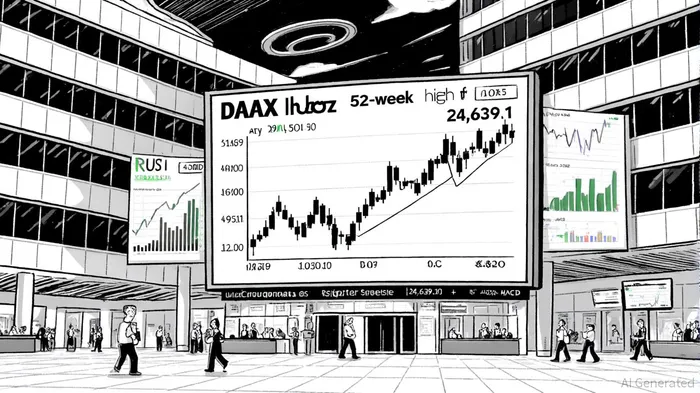
From a broader perspective, the DAX remains within a rising trend channel, with a 52-week high of 24,639.1 in July 2025 and a 52-week low of 18,489.91, according to Boerse Stuttgart data. Key resistance levels at 24,400 and 24,700 could act as psychological barriers for further gains, while a breakdown below 23,400 may trigger a test of 22,396, as noted in a SolideCN analysis. Traders should monitor volume patterns at these levels: a surge in volume on a breakout above 24,400 could validate bullish momentum, whereas a sharp decline in volume below 23,400 might signal weak conviction in the downtrend, per Yahoo Finance historical data.
Economic Fundamentals: Global Exposure vs. Domestic Weakness
The DAX's decoupling from Germany's domestic economy remains a defining feature of its performance. Despite the Bundesbank projecting GDP growth of just 0.2% in 2025, as reported in a CNBC report, the index has surged 16% year-to-date through September, outperforming many European and U.S. peers according to Yelza research. This disconnect stems from the index's composition: approximately 80% of revenue for DAX constituents like SAP, Siemens, and Deutsche Telekom comes from international markets, per an InsiderFinance analysis. Global demand for industrial machinery, enterprise software, and telecommunications services has insulated these firms from Germany's domestic malaise, while favorable ECBXEC-- policies and easing inflation have provided additional tailwinds, as highlighted in a KappaSignal forecast.
However, risks loom. U.S.-China trade tensions, potential U.S. tariffs on European goods, and geopolitical instability in energy markets could disrupt this momentum, according to the WEF outlook. For instance, the automotive and manufacturing sectors—still critical to Germany's economy—remain vulnerable to supply chain shocks and shifting trade dynamics, as discussed in a Morningstar analysis. Tactical investors must weigh these risks against the DAX's current valuation, which remains attractively priced relative to the S&P 500 in a recent FXStreet analysis.
Tactical Positioning: Balancing Bullish and Bearish Scenarios
For near-term gains, a nuanced approach is warranted. If the DAX holds above 23,400, buyers may enter long positions with a target at 24,400, using the 23,600 level as a stop-loss, as suggested in the earlier SolideCN analysis. Conversely, a breakdown below 23,400 could justify short-term bearish bets, with 22,396 as a potential downside target noted in the Yahoo Finance historical data. Given the mixed technical signals, hedging strategies—such as buying put options or using inverse ETFs—could mitigate risk in a volatile environment, as observed in a separate KappaSignal analysis.
Investors should also consider sector rotation within the DAX. While globalized giants like Siemens and SAP drive the index, mid-cap MDAX stocks in renewable energy and digital infrastructure may offer untapped growth amid Germany's push for domestic reform, according to an FXEmpire forecast.
Conclusion: A Calculated Path Forward
The DAX's short-term trajectory hinges on its ability to navigate key support/resistance levels and external macroeconomic shocks. While technical indicators suggest a neutral-to-bearish bias in the near term, the index's global orientation and ECB-driven liquidity provide a floor for recovery. Tactical positioning requires vigilance: holding long-term positions for 1–6 months while using short-term options to capitalize on volatility could optimize returns, per the Yahoo Finance historical data. As always, combining technical analysis with macroeconomic foresight will be key to navigating this complex landscape.
Backtest details: buy on MACD Death Cross, hold 30 trading days, 2022–2025; average loss per trade -1.3%, cumulative -26.4%, Sharpe -0.40, max drawdown 34%.







Comentarios
Aún no hay comentarios