
Navigating the September Market Lull: Tactical Positioning for Earnings Storm and Government Shutdown Risk
As September 2025 draws to a close, investors face a dual challenge: the looming Q3 earnings storm and the heightened risk of a government shutdown. While equity markets have rallied to record highs, the S&P 500's 7.9% year-over-year earnings growth and the Russell 2000's multi-year outperformance suggest a resilient backdrop, according to a Nasdaq Q3 review. However, the Federal Reserve's 25-basis-point rate cut and expectations of further easing have created a fragile equilibrium, one that could be disrupted by political uncertainty and delayed economic data releases, according to a GDS Wealth review.
Tactical Positioning: Balancing Defense and Offense
The current market environment demands a nuanced approach. Historically, government shutdowns have introduced short-term volatility but rarely dented long-term fundamentals. For instance, the S&P 500 gained 10.3% during the 35-day 2018–2019 shutdown, driven by dovish Fed policy and strong corporate earnings, according to a Fool analysis. Investors should prioritize defensive positioning in sectors insulated from political noise, such as Utilities and Healthcare, which have historically outperformed during shutdowns, per a YCharts shutdown analysis.
Conversely, offensive opportunities lie in Technology and Materials, which have benefited from AI-driven demand and infrastructure spending. The Nasdaq-100's record highs underscore this trend, with semiconductors and renewable energy firms leading the charge. However, small-cap stocks, while resilient, require closer scrutiny due to their heightened sensitivity to liquidity constraints, according to a Capital Advisors update.
Sector Rotation: Lessons from History
Government shutdowns often trigger sector rotation patterns. For example, government services contractors like CACI InternationalCACI-- and Booz Allen Hamilton surged 3.28% on the first day of the 2025 shutdown, as investors anticipated catch-up spending post-resolution, YCharts reported. In contrast, Financials and Small-Cap ETFs underperformed, with the latter declining 0.89% amid economic uncertainty, YCharts also noted.
Defensive sectors such as Healthcare and Utilities have shown consistent strength, with Healthcare ETFs rising 3.09% and Utilities ETFs up 0.96% during the 2025 shutdown. This aligns with historical trends, where these sectors have acted as safe havens during periods of political instability, as the Fool analysis found. Meanwhile, Financials face headwinds, as delayed economic data and regulatory approvals create uncertainty for banks and insurers, according to a MarketMinute report.
Risk Management: Preparing for the Unknown
While the VIX remains subdued at 17–18, analysts caution that prolonged shutdowns could trigger volatility spikes. Historical data shows that the S&P 500 has averaged 1.2% returns one month post-shutdown but faced a 4.5% decline 100 days after the 2018 shutdown, according to a CNBC analysis. Investors should hedge against this risk by allocating to gold, which has surged to its best annual performance since 1979 amid inflationary pressures and geopolitical tensions, as noted in the Nasdaq Q3 review.
Additionally, monitoring the Fed's policy trajectory is critical. The central bank's dovish stance has buoyed markets, but a steeper-than-expected labor market downturn could force a reassessment. According to Morgan Stanley estimates, the economy could see a 0.1% GDP drag per week of shutdown, compounding existing economic pressures.
Conclusion: Staying the Course
The September market lull offers a rare window to refine tactical positioning ahead of the earnings storm. By leveraging historical sector rotation patterns and maintaining a balanced portfolio, investors can navigate near-term volatility while capitalizing on long-term opportunities. As the shutdown looms, patience and discipline will remain paramount-history suggests that markets tend to recover swiftly once political uncertainty resolves, according to a Landmark Wealth analysis.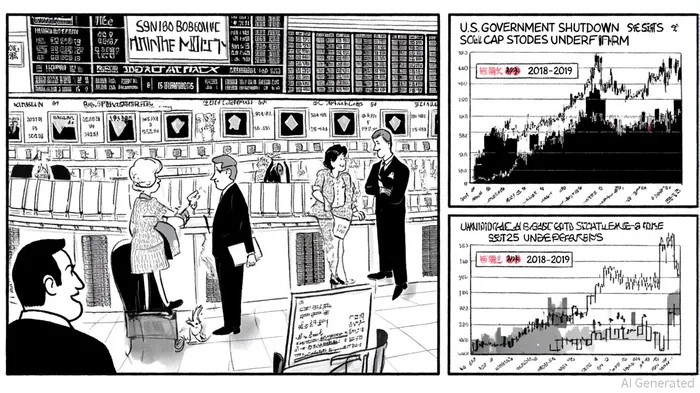





Comentarios
Aún no hay comentarios