
Navigating Sector Rotations in Response to U.S. Michigan Consumer Sentiment Fluctuations
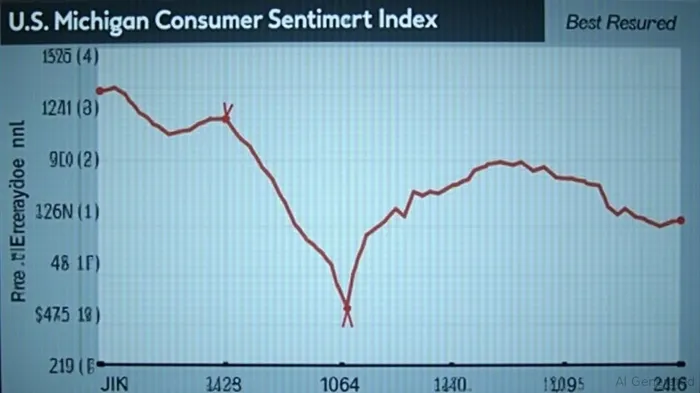
The U.S. Michigan Consumer Sentiment Index (UMCSENT) has long served as a barometer for economic optimism and a leading indicator for equity market behavior. In July 2025, the index rose to 61.7, marking a 1.65% increase from June and the highest level since February 2025. This modest improvement, however, masks a broader narrative of cautious optimism and lingering inflationary concerns. For investors, the UMCSENT's trajectory—and its interplay with sector performance—offers critical insights into capital allocation strategies in a shifting macroeconomic landscape.
The Dual Forces of Consumer Sentiment
The UMCSENT's July reading reflects divergent trends within its subcomponents. The Current Economic Conditions subindex surged 4.9% to 68.0, its highest since February 2025, signaling improved perceptions of employment, income, and spending. This aligns with historical patterns where such gains typically drive outperformance in cyclical sectors like consumer finance, energy, and durable goods. However, the Consumer Expectations subindex dipped 0.7% to 57.7, underscoring persistent uncertainty about the economy's long-term trajectory.
Inflation expectations remain a wildcard. While one-year inflation expectations fell to 4.5% and long-run expectations to 3.4%, both figures are still elevated compared to the December 2024 post-election low. This duality—improving current conditions but muted long-term optimism—creates a mixed environment for equity markets. Investors must weigh near-term demand for goods and services against the risk of inflation reaccelerating or Federal Reserve policy delays.
Sector Rotation: Historical Patterns and 2025 Realities
Historical data reveals a consistent pattern: rising consumer sentiment correlates with capital inflows into cyclical sectors and outflows from defensive ones. For instance, in June 2025, a 10.5-point surge in the UMCSENT triggered a 3.2% intraday gain in the Consumer Finance ETF (XLF) and a 2.1% drop in the Biotechnology ETF (IBB). This inverse relationship is not coincidental—it reflects shifting risk appetite. When consumers feel confident, they spend more on durable goods and services, boosting sectors like automotive, home improvement, and logistics. Conversely, during periods of pessimism, investors retreat to defensive plays such as utilities, healthcare, and consumer staples.
The Energy sector, while not explicitly detailed in recent UMCSENT-linked analyses, is indirectly influenced by consumer behavior. Rising sentiment often correlates with increased travel and industrial activity, driving demand for oil and gas. However, the sector's performance also hinges on geopolitical factors and supply chain dynamics, which can override sentiment-driven trends.
Strategic Implications for Equity Portfolios
Given the current UMCSENT dynamics, investors should adopt a sector rotation strategy that prioritizes cyclical and trade-related industries while hedging against macroeconomic volatility.
- Overweight Cyclical Sectors:
- Consumer Finance (XLF): Improved credit utilization and loan demand align with rising consumer confidence.
- Energy (XLE): A weaker U.S. dollar and potential Fed rate delays could boost commodity prices.
- Durable Goods (XHS): Housing and automotive sectors benefit from improved economic conditions.
Logistics and E-commerce Infrastructure (IYT): The 5% rise in the Current Economic Conditions subindex historically predicts 8–12% outperformance in these sectors over the next three months.
Underweight Defensive Sectors:
- Biotechnology (IBB): Suffers from capital outflows as investors favor growth-oriented cyclical plays.
Consumer Staples (XLP): Non-essential spending remains constrained among younger demographics, who increasingly prioritize experiences over goods.
Hedge Against Inflationary Risks:
- Maintain exposure to inflation-protected assets such as Treasury Inflation-Protected Securities (TIPS) and commodities.
- Monitor the August 2025 UMCSENT release (consensus forecast: 61.5), which could signal whether sentiment stabilizes or deteriorates.
The Fed's Role and Policy Uncertainty
The Federal Reserve's response to UMCSENT trends will shape sector performance. A stronger-than-expected August reading could delay rate cuts, favoring Consumer Finance and Trade-Related Sectors while disadvantaging Rate-Sensitive Industries like Biotechnology. Conversely, a weaker-than-expected reading may accelerate cuts, boosting Defensive Sectors and Interest-Sensitive Assets. Investors should closely monitor the Fed's policy signals, particularly the September 2025 FOMC meeting, to adjust allocations accordingly.
Conclusion: Aligning with the “Value Now” Consumer
The U.S. Michigan Consumer Sentiment Index underscores a pivotal shift in consumer behavior: the rise of the “value now” consumer, who prioritizes experiences, sustainability, and essential goods over non-essential spending. This trend favors sectors like leisure travel (e.g., Expedia Group), electric vehicles (e.g., Tesla), and essential retail. However, it also presents challenges for luxury fashion and non-essential retail, which must adapt to evolving demand.
For equity portfolios, the key lies in strategic sector rotation—overweighting resilient, inflation-protected industries while underweighting those vulnerable to macroeconomic headwinds. As the UMCSENT continues to signal shifting consumer confidence, investors who act decisively will be well-positioned to capitalize on the next phase of market dynamics.







Comentarios
Aún no hay comentarios