
Navigating Sector Rotation in the S&P 500: Momentum Shifts and Macro Signals in 2025
The S&P 500's sector dynamics in 2025 have been shaped by a volatile mix of macroeconomic signals, trade policy uncertainty, and shifting investor sentiment. As global tariffs and Federal Reserve policy recalibrate, investors are recalibrating their allocations, favoring sectors with defensive resilience or growth potential while avoiding cyclical laggards. This analysis unpacks the drivers of recent momentum shifts and their implications for portfolio strategy.
Macroeconomic Signals and Sector Tilts
Recent macroeconomic data underscores a fragmented landscape. While inflation has eased to 2.5%–3.0% annually, lingering pressures in energy, food, and vehicles keep the Fed in a "meeting-by-meeting" policy mode, according to a CME Group analysis. Meanwhile, trade policy uncertainty-exemplified by the U.S. global tariff policy introduced in April 2025-has amplified volatility, prompting investors to adopt sector tilts and hedging strategies, as noted in a Q3 2025 market update. For instance, Information Technology and Communication Services have surged, with the former exceeding 88% of EPS estimates in Q4 2023 and the latter posting 96.3% year-over-year growth, driven by AI-driven demand and platform monetization, according to S&P Global earnings data.
Conversely, sectors like Real Estate and Utilities have struggled. Real Estate faces headwinds from a weak commercial property market, while Utilities lagged in revenue beats, reflecting regulatory and operational challenges, as reported in S&P Global earnings data. Energy, though buoyed by high oil prices, remains vulnerable to global demand shifts, exemplifying the duality of macroeconomic risks noted in the Q3 2025 market update.
Investor Sentiment and Strategic Adjustments
Investor sentiment has further amplified sector rotation. Charles Schwab's April 2025 outlook assigned a "Marketperform" rating to all sectors, reflecting cautious optimism amid policy ambiguity in the CME GroupCME-- analysis. Financials, for example, gained traction due to attractive valuations (forward PEG ratio of 1.56 for XLF), while Health Care (XLV) remains undervalued on paper but faces regulatory headwinds, according to an S&P 500 sector indices review. Energy's forward PEG of 1.66 highlights its cyclical nature, with investors balancing near-term gains against long-term demand uncertainty, as also noted in the S&P 500 sector indices review.
The technology sector's dominance-accounting for 40% of the S&P 500's market cap-has introduced concentration risks. Surging CAPEX for AI infrastructure has eroded free cash flow, raising concerns about sustainability in the CME Group analysis. This has led to a rise in sector-specific hedging tools, such as index futures and options, as investors seek to mitigate overexposure.
Strategic Implications for 2025
The Q3 2025 market update reveals a nuanced outlook. The S&P 500 gained 8.1% year-to-date, supported by strong corporate earnings and modest economic growth. However, risks persist: potential rate hikes, geopolitical tensions, and a fragile housing market could trigger volatility. Sectors like Health Care and Energy are poised to benefit from geopolitical and regulatory shifts, while Technology's growth potential remains tied to AI's commercialization trajectory, as discussed in the S&P 500 & Dow Q3 outlook.
Investors should prioritize flexibility. Defensive sectors such as Health Care and Utilities offer stability, while cyclical plays like Energy require careful timing. Given the Fed's projected rate cuts (targeting below 3% by late 2026), a gradual shift toward growth-oriented sectors may gain traction, a possibility highlighted in the CME Group analysis.
Conclusion
Sector rotation in 2025 reflects a tug-of-war between macroeconomic resilience and policy-driven uncertainty. While Technology and Communication Services lead the charge, investors must remain vigilant against concentration risks and macroeconomic headwinds. By leveraging sector-specific tools and maintaining a balanced approach, portfolios can navigate the evolving landscape with agility.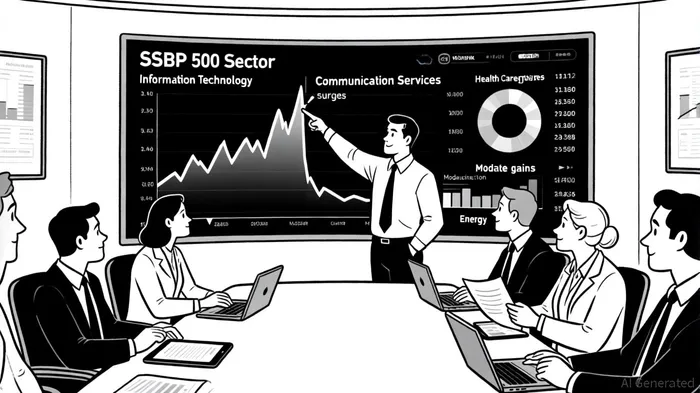





Comentarios
Aún no hay comentarios