
Navigating Sector Divergence: The Impact of Government Reopening and AI Valuation Concerns on Market Direction
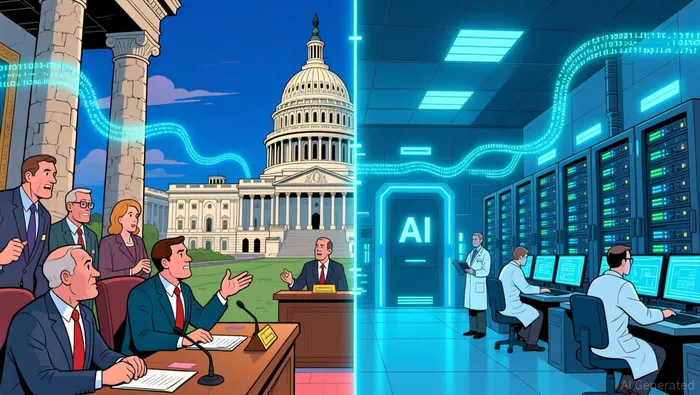
The Government Reopening: A Short-Term Balm, Long-Term Uncertainty
The 800,000 furloughed federal workers and disrupted supply chains have returned to normalcy, but the economic scars of the two-month shutdown linger. Economists estimate the shutdown shaved 0.8% off Q3 GDP, equivalent to $55 billion in lost activity, according to an ABC News report. While the reopening has stabilized consumer spending and air travel, it has done little to address the underlying fiscal tensions between political factions. President Trump's framing of the deal as a "win against Democrats" underscores the fragility of consensus, raising questions about future government shutdowns and their ripple effects on markets, as reported by a Forbes piece.
For investors, this volatility highlights the importance of defensive positioning. Sectors like utilities and consumer staples, which historically perform well during political uncertainty, may offer ballast. Yet the broader market's focus on AI and tech-driven growth suggests that investors are not entirely retreating from risk.
AI Valuation Dynamics: Consolidation and Contradictions
The AI sector's third-quarter performance reveals a market at a crossroads. Venture funding for AI is on track to double 2024's record $108 billion, driven by massive rounds for infrastructure leaders like Anthropic ($13B) and OpenAI ($8.3B), according to a CB Insights report. However, the 22% drop in AI-related deals signals a shift toward consolidation, with 172 M&A transactions in Q3-the second-highest on record. Workday's $1.1B acquisition of Sana Labs exemplifies the sector's focus on integrating AI capabilities into enterprise software ecosystems, as noted in the same CB Insights report.
Yet not all AI stocks are thriving. C3.ai, a once-high-flying AI software company, has seen its shares plummet 55% this year despite a strong balance sheet, according to a GuruFocus report. The company's exploration of a potential sale and CEO departure underscore the sector's fragility. Conversely, Oracle (ORCL) has benefited from AI-driven data center contracts, with its "remaining performance obligations" surging, as reported by a Chronicle report. This divergence underscores the need for investors to distinguish between AI "winners" with scalable infrastructure and "losers" burdened by high costs and unproven business models.
Strategic Portfolio Positioning: Balancing Growth and Defense
The key to navigating this environment lies in a dual strategy: capitalizing on AI's long-term potential while hedging against macroeconomic risks. For growth-oriented investors, the AI sector's concentration in infrastructure players offers compelling opportunities. Anthropic and OpenAI's ability to secure multi-billion-dollar funding rounds reflects the sector's demand for foundational models, which could become the next generation of cloud computing platforms, as noted in the CB Insights report. However, these bets require patience and a tolerance for volatility, as evidenced by BigBear.ai's (BBAI) 12% stock surge despite a 20% revenue decline, as reported by a CryptoRank article.
On the defensive side, the government reopening's mixed impact on markets suggests a need for diversification. While the S&P 500's 8.0% year-over-year earnings growth is encouraging, as reported by the Chronicle report, sectors like energy and discretionary consumer goods remain vulnerable to policy shifts. HighPeak Energy (HPK) and DoorDash (DASH) serve as cautionary tales, having faced investor backlash after missing earnings forecasts, as reported by the Chronicle report.
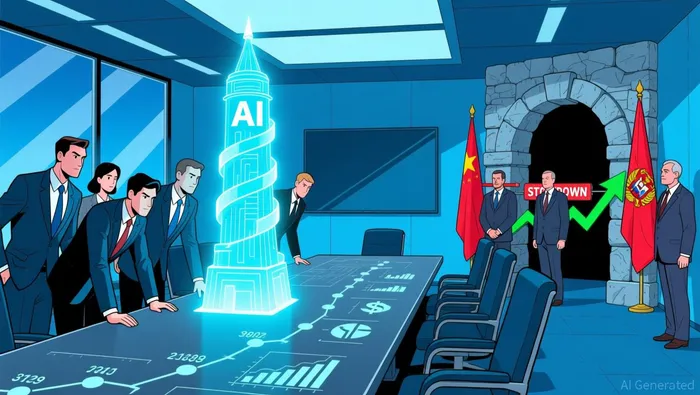
Conclusion: A Market of Contrasts
The interplay between government policy and technological innovation has created a market of contrasts. While the reopening has provided temporary relief, the AI sector's valuation pressures and political uncertainties demand a nuanced approach. Investors must balance exposure to high-growth AI infrastructure with defensive sectors that can weather policy-driven volatility. As the fourth quarter unfolds, the ability to navigate these divergent signals will separate those who thrive from those who merely survive.






Comentarios
Aún no hay comentarios