
Navigating the SEC's 2025 Crypto Token Classification Framework and Its Impact on Investment Opportunities
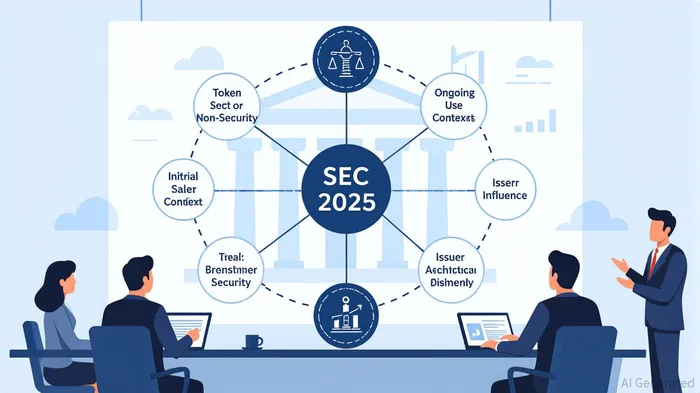
The U.S. Securities and Exchange Commission’s (SEC) 2025 Crypto Token Classification Framework marks a pivotal shift in how digital assets are evaluated under securities law. By refining the Howey test and introducing a three-pronged framework, the SEC has created a clearer, albeit complex, roadmap for distinguishing between securities and non-securities in the crypto space. This evolution not only reshapes risk profiles for investors but also redefines compliance strategies for token issuers and the long-term value potential of decentralized utility tokens.
The SEC’s 2025 Framework: A Closer Look
The updated Howey test now emphasizes four key criteria: investment of money, expectation of profit, common enterprise, and reliance on the efforts of others. A critical innovation is the focus on "reasonable expectation of profit"—if token buyers anticipate gains from a centralized team’s efforts, the token is likely a security [1]. The three-pronged framework further sharpens this analysis by evaluating:
1. Initial Sale Context: Whether the token is marketed as an investment vehicle.
2. Ongoing Use: Whether the token serves functional utility on a decentralized network.
3. Issuer Influence: The degree of control retained by the founding team or foundation [1].
Tokens like Ether (ETH) post-Merge and stablecoins with transparent reserves are explicitly excluded from securities classification due to their decentralized operations and lack of profit-centric marketing [1]. Conversely, tokens tied to governance rights or revenue-sharing models—where centralized teams retain significant influence—remain under scrutiny [1].
Implications for Investment Risk and Compliance
The framework’s emphasis on decentralization and utility has profound implications for risk assessment. For investors, tokens classified as non-securities (e.g., ETH, Solana) present lower regulatory risk and greater institutional adoption potential. These tokens are increasingly seen as foundational infrastructure for blockchain ecosystems, enabling applications like staking derivatives and real-world asset (RWA) tokenization [2].
Compliance strategies for issuers now hinge on three pillars:
- Decentralization: Projects must demonstrate minimal centralized control to avoid securities liability.
- Utility-First Design: Tokens must prioritize functional use cases over speculative value.
- Transparent Marketing: Profit-driven language in whitepapers or promotional materials now carries legal weight [1].
This shift has pushed projects like EthereumETH-- to further decentralize governance and operational decision-making, aligning with the SEC’s criteria for non-securities [1].
Value Creation in Utility-Driven Tokens
The framework’s clarity has also unlocked new avenues for value creation. Utility tokens with structured tokenomics—such as deflationary mechanisms or staking rewards tied to network security—are gaining traction as long-term investments. For example, Remittix (RTX), a token designed for cross-border remittances, leverages deflationary mechanics and real-world use cases to mitigate volatility and attract institutional capital [2].
Conversely, high-risk assets like meme coins face heightened scrutiny. Their lack of governance frameworks and reliance on speculative hype make them prime candidates for securities enforcement, deterring institutional participation [2].
Case Studies and Industry Reactions
The SEC’s guidance has already influenced market dynamics. Ethereum’s post-Merge transition to a proof-of-stake model, coupled with its decentralized governance, has solidified its status as a non-security, enabling broader adoption in institutional portfolios [1]. Meanwhile, projects like SolanaSOL-- have doubled down on utility-driven applications, such as decentralized finance (DeFi) platforms and NFT marketplaces, to align with the SEC’s criteria [1].
However, challenges persist. The line between utility and investment remains blurred for tokens with hybrid models. For instance, governance tokens that also enable protocol revenue-sharing may still face regulatory pushback, even if their primary function is decentralized network management [1].
Conclusion
The SEC’s 2025 framework represents a significant step toward harmonizing crypto innovation with securities law. By prioritizing economic realities over technicalities, the agency has provided a flexible yet rigorous framework for evaluating tokens. For investors, this means a clearer path to identifying low-risk, utility-driven assets while avoiding speculative traps. For issuers, compliance now demands a strategic focus on decentralization and transparency. As the industry adapts, the framework’s success will depend on its ability to evolve alongside technological advancements—a challenge the SEC’s "Project Crypto" initiative aims to address [3].
Source:
[1] SEC's 2025 guidance: What tokens are (and aren’t) securities [https://cointelegraph.com/explained/secs-2025-guidance-what-tokens-are-and-arent-securities]
[2] Meme Coins vs. Utility Tokens: Navigating the 2025 Crypto Divergence [https://www.ainvest.com/news/meme-coins-utility-tokens-navigating-2025-crypto-divergence-2508]
[3] US Crypto Policy Tracker Regulatory Developments [https://www.lw.com/en/us-crypto-policy-tracker/regulatory-developments]







Comentarios
Aún no hay comentarios