
Navigating Rocket Lab's Volatility: A Strategic Entry Point in the Space Economy?
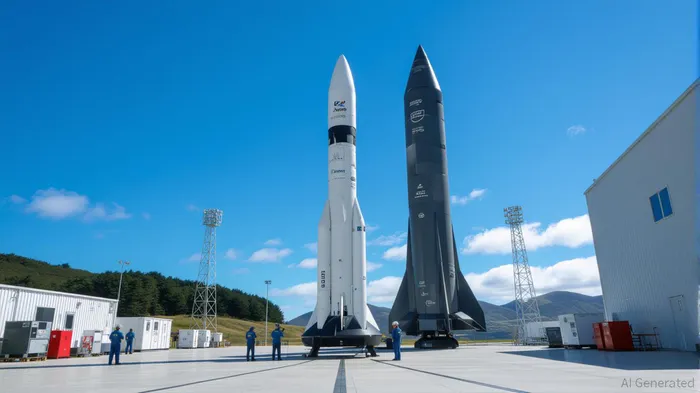
The space economy is no longer a speculative frontier; it is a $570 billion industry in 2023, projected to surge to $1–3 trillion by 2040. Amid this transformation, Rocket LabRKLB-- (RKLB) has emerged as a pivotal player, leveraging its Electron rocket's rapid launch cadence and the development of its Neutron vehicle to secure a niche in the commercialization of low-Earth orbit. Yet, its stock has swung wildly in recent months, with a 94.66% gain in July 2025 followed by a pullback amid mixed Q2 earnings guidance. For long-term investors, the question is clear: does this correction signal a strategic entry point in a sector poised for exponential growth, or is it a cautionary tale of overvaluation?
The Fundamentals: Growth, Guidance, and Geopolitical Tailwinds
Rocket Lab's Q2 2025 earnings report revealed a revenue increase of 32.1% year-over-year to $123 million, driven by a $87 million contribution from its Space Systems segment. While the company reported a loss of $0.07 per share (beating estimates), its order backlog of $1.067 billion—60% from satellite systems—signals robust demand. Strategic wins, such as its inclusion in the U.S. Department of Defense's National Security Space Launch program and a $5 million task order to demonstrate mission success, underscore its growing institutional credibility.
However, the Q2 guidance—$130–140 million in revenue, below the $137.5 million consensus—spooked investors. The midpoint of this range suggests a slowdown in growth momentum, compounded by an adjusted EBITDA loss of $28–30 million. Analysts' mixed reactions highlight a tension: while Rocket Lab's revenue trajectory is impressive, its path to profitability remains uncertain, particularly as it invests heavily in the Neutron rocket and acquires GEOST LLC for $275 million to expand satellite capabilities.
Valuation and Volatility: A High-Stakes Proposition
Rocket Lab's valuation metrics are a double-edged sword. Its stock trades at a 730% premium to estimated fair value ($84.15) and a 41x price-to-sales ratio, reflecting investor optimism about its long-term potential. Yet, this optimism is tempered by a beta coefficient of 2.66, making it one of the most volatile stocks in the S&P 500. The recent 32% weekly surge—fueled by analyst upgrades from CitiC-- and Bank of AmericaBAC-- to $50 per share—has pushed its market cap to $23.7 billion, a figure that hinges on execution risks in rocket development and satellite deployment.
The company's earnings outlook is equally polarizing. Analysts project a 61.23% annual earnings growth, but this assumes successful scaling of the Neutron rocket and sustained demand for its services. The risk of insider selling and competition from SpaceX's Starship program further complicates the narrative.
Historically, Rocket Lab's stock has shown a strong positive response to earnings beats. Since 2022, the stock has delivered a 12.87% maximum return on day 32 following a beat, with a 50% win rate across 3-day, 10-day, and 30-day horizons. These results suggest that while short-term volatility is inevitable, the market tends to reward the company's ability to exceed expectations. For example, a 3-day win rate of 50% indicates that investors who held after a beat historically enjoyed positive returns in the near term, while the 30-day win rate implies sustained momentum for those with a medium-term outlook. This pattern reinforces the argument that Rocket Lab's earnings surprises—like its recent Q2 beat—can serve as catalysts for re-rating, even amid broader uncertainty.
Macro Trends and Strategic Positioning
The broader aerospace sector is undergoing a tectonic shift. Government spending on satellite constellations, hypersonic testing, and space-based defense systems is accelerating, with Rocket Lab securing $1.45 billion in U.S. defense contracts. Its acquisition of GEOST LLC—a satellite payload developer—positions it to capture downstream revenue in the satellite lifecycle, moving beyond launch services to end-to-end solutions.
Meanwhile, the global space economy's growth is being driven by commercial players, with Rocket Lab's 16 successful 2024 launches (a 60% year-over-year increase) demonstrating operational reliability. Its inclusion in the Russell 1000 Index in June 2025 attracted $200 billion in passive fund inflows, a tailwind that could stabilize its volatility.
Is the Correction an Opportunity?
The current correction, with shares down 8.17% from their July 17 peak, may reflect overreaction to Q2 guidance rather than a fundamental shift. Rocket Lab's revenue growth, strategic acquisitions, and government partnerships remain intact. The key question for investors is whether the market is discounting near-term losses too heavily, given the sector's long-term trajectory.
For long-term investors, the calculus hinges on three factors:
1. Execution Risk: Can Rocket Lab maintain its launch cadence and deliver the Neutron rocket on schedule?
2. Valuation Rationality: Is the 41x sales multiple justified by its market-leading position in small satellite deployment and government contracts?
3. Sector Momentum: Will the space economy's $1–3 trillion growth potential materialize, or is it a speculative bubble?
Conclusion: Balancing Optimism and Caution
Rocket Lab's stock is a high-risk, high-reward proposition. The recent correction, while painful for short-term traders, may offer a chance to buy into a company that is shaping the future of commercial spaceflight. However, investors must weigh the company's unproven path to profitability against its strategic advantages in a sector with immense long-term potential.
For those with a multi-year horizon, Rocket Lab's current valuation—despite its volatility—appears justified by its role in the space economy's expansion. The key is to approach it as a satellite in a diversified portfolio, not the sole focus. As the sector matures, Rocket Lab's ability to execute on its Neutron and satellite systems will determine whether this correction proves to be a golden opportunity or a costly lesson.
"""





Comentarios
Aún no hay comentarios