
Navigating the Return of Volatility: Strategic Hedging in an Era of Disinflation and Geopolitical Uncertainty
The Disinflationary Tailwinds from China
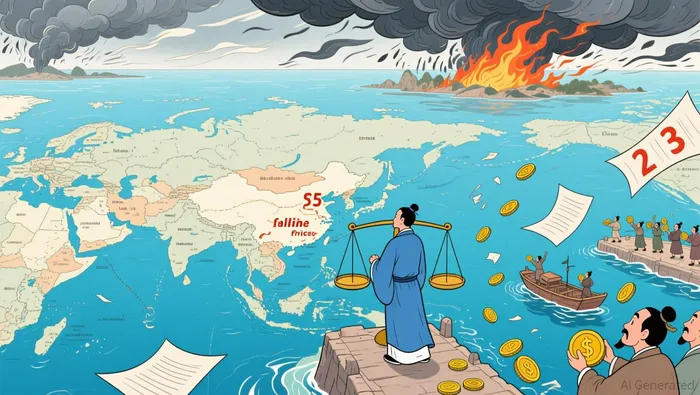
China's economic slowdown has been more severe than official data suggests. According to a Bloomberg analysis, 51 out of 67 everyday goods and services tracked between 2023 and 2025 showed price declines, with industrial materials and consumer goods hit hardest. This deflationary spiral has created a lopsided economy where falling prices erode business margins and consumer confidence, leading to weaker demand and a self-reinforcing cycle of economic contraction. The IMF projects that China's consumer inflation will average zero over the next decade, the second-lowest among nearly 200 economies.
The global implications are profound. Cheap Chinese exports are depressing prices worldwide, straining trade relationships and forcing central banks to recalibrate their inflation-fighting strategies. For multinational corporations, the impact is tangible: AppleAAPL--, StarbucksSBUX--, and Volkswagen have all reported significant sales declines in China. Meanwhile, the Bank of Korea has warned that China's deflation could "export" to its trading partners, creating a ripple effect across global supply chains.
Quantitative Hedging in a Regulated Environment
Quantitative strategies in China have faced a perfect storm in 2024. A Reuters report notes that quantQNT-- funds tracking the small-cap CSI 1000 Index lost 14% in the first half of the year, exacerbated by the February "quant quake"-a market crash triggered by algorithmic herding. Regulatory crackdowns followed, with the China Securities Regulatory Commission (CSRC) restricting short-selling and high-frequency trading, and leveraged strategies. By June 2024, the number of quant funds managing over 10 billion yuan had dropped from 32 to 30, signaling a reshuffling of the industry.
Post-2024 regulations have further constrained flexibility. The CSRC's , effective October 2024, introduced stricter reporting requirements and definitions of "abnormal trading" behaviors, such as excessive order cancellations. These measures, combined with a shift toward fundamentals-based models, have forced funds like Siyuan Quant to pivot toward high-tech sectors aligned with national economic goals.
Hedging Geopolitical Risks: Models and Implementation
Geopolitical risks are compounding the challenges of a disinflationary environment. A study by Zhu et al. (2025) used a TVP-VAR-SV model to analyze financial stress connectedness in China's banking, securities, and energy markets, finding that global geopolitical risk (GPR) significantly amplifies cross-market turbulence. For example, traditional energy stocks in China-such as those in oil and gas-have shown resilience during geopolitical crises, while ESG and carbon markets have faltered.
To hedge these risks, investors are turning to dynamic models that incorporate GPR assessments. One approach involves relative value arbitrage between sectors with divergent exposures. For instance, during periods of heightened geopolitical tension, energy firms with strategic reserves (e.g., CNPC or Sinopec) may outperform ESG-focused peers. Similarly, rare metals-critical for green technology-require tailored hedging due to their sensitivity to geopolitical supply chain disruptions according to research.
Strategic Recommendations for Investors
- Sector Rotation: Prioritize industries less exposed to China's deflationary pressures, such as high-tech manufacturing or services. Avoid sectors reliant on Chinese consumer demand, like luxury goods or automotive.
- Geopolitical Risk-Linked Instruments: Use derivatives tied to geopolitical risk indices (e.g., GPR futures) to hedge against volatility in energy and commodity markets.
- Regulatory Adaptation: Align strategies with China's post-2024 regulatory framework by focusing on fundamentals-based models and avoiding high-frequency trading.
- Diversified Portfolios: Allocate to markets outside China's immediate influence, such as Southeast Asia or the Middle East, to mitigate overexposure to its deflationary tailwinds.
Conclusion
The interplay of disinflation and geopolitical risk demands a recalibration of hedging strategies. China's deflationary trends are not just a domestic issue but a global force reshaping trade, investment, and regulatory priorities. For quantitative investors, the path forward lies in adapting to a world where algorithmic agility is tempered by regulatory caution and geopolitical uncertainty. The tools exist-what remains is the discipline to apply them.







Comentarios
Aún no hay comentarios