
Navigating Retail Sector Resilience: Systemic Risk and Sector Rotation Opportunities in 2025
The U.S. retail sector in 2025 is navigating a perfect storm of macroeconomic headwinds and structural shifts, with over 48 retail bankruptcies reported in 2024 alone-a 41% increase from 2023, according to Hilco Global. Hilco Global. Companies like Forever 21, Joann, and Rite Aid have become emblematic of a broader crisis driven by inflation, rising interest rates, and the relentless rise of e-commerce, as reported by Credit & Collection News. Credit & Collection News. Yet, amid this turmoil, systemic risks remain largely contained, and resilient sub-sectors are emerging as fertile ground for strategic investment.
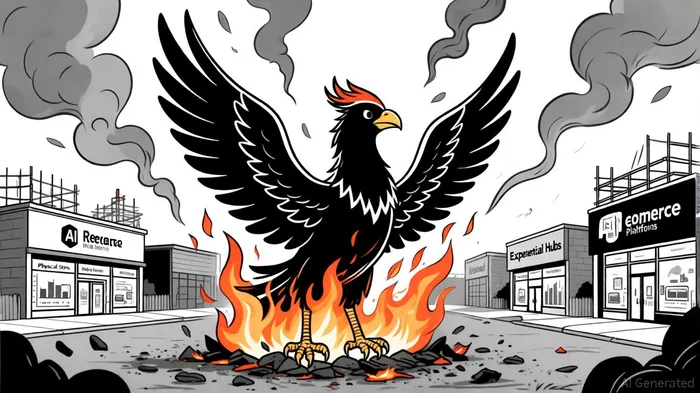
Systemic Risk: Contained but Not Negligible
While the retail sector's distress has raised alarms, the broader financial system has so far avoided destabilization. Default rates on leveraged loans and high-yield bonds remain below pre-crisis levels, Hilco Global's analysis shows, and the ripple effects-such as commercial real estate vacancies and regional economic strain-are localized rather than systemic. For instance, mall-based retailers and specialty stores face acute pressure, but discount retailers like Aldi and big-box chains like Macy'sM-- have maintained stability by prioritizing value-driven strategies, as Deloitte's Q2 2025 analysis observes. Deloitte's Q2 2025 analysis.
However, the interconnectedness of retail and consumer health cannot be ignored. The collapse of Rite Aid and Joann, for example, has led to 19,000 job losses and a surge in surplus inventory, creating both challenges and opportunities in the closeout market, The Bacon Magazine reports. The Bacon Magazine. As Deloitte Insights notes, the "retail apocalypse" is evolving into a "retail reinvention," with survivors adapting through hybrid models that blend physical and digital experiences. Deloitte Insights.
Sector Rotation Strategies: Where Resilience Meets Opportunity
Investors seeking to capitalize on this dynamic landscape must adopt a dual focus: mitigating systemic risks while identifying sub-sectors poised for growth.
Modernized Supply Chains and AI Integration
Retailers leveraging AI for demand forecasting and inventory optimization are outperforming peers. EY's analysis highlights that 60% of retailers using AI report improved operational efficiency. EY. For example, Macy's and Williams Sonoma have reduced reliance on imports and reshaped production to domestic hubs, preserving margins amid tariff pressures, a point underscored in Deloitte's Q2 2025 analysis.Discount and Experiential Retail
Discount retailers like Aldi and Dollar General are thriving as consumers prioritize value, Deloitte's Q2 report shows. Meanwhile, experiential retail-where physical stores double as service hubs-is gaining traction. EY and the World Retail Congress emphasize the need for retailers to repurpose spaces into community-centric locations, blending convenience with engagement.Asset-Based Lenders and Restructuring Opportunities
Asset-based lenders (ABLs) are uniquely positioned to profit from the 2025 bankruptcy cycle. Hilco Global notes that regions like California, New York, and Texas-where 70% of retail filings are concentrated-offer opportunities for strategic asset redeployment. Out-of-court restructurings, such as liability management transactions, are also gaining favor as a faster alternative to Chapter 11, according to Forbes. Forbes.
Systemic Risk Containment: A Path Forward
The Federal Reserve's projected rate cuts in the second half of 2025 may alleviate some pressure, but the path to recovery remains uneven. PwC's restructuring outlook emphasizes that companies with weak operating cash flows will continue to face strain, particularly in labor-intensive sectors like casual dining and healthcare. PwC's restructuring outlook. However, proactive risk management-such as scenario planning for tariffs and supply chain disruptions-can buffer against volatility, as detailed in the RETHINK report on resilient retail ecosystems. RETHINK report.
For investors, the key lies in balancing defensive and offensive strategies. Defensive allocations in utilities and healthcare offer stability, while offensive bets on AI-driven retail and renewable energy align with long-term growth trends, as outlined by AI Signals. AI Signals.
Conclusion
The 2025 retail sector is a study in contrasts: a landscape scarred by bankruptcies yet brimming with innovation. By focusing on systemic risk containment through modernized supply chains and AI, and rotating into resilient sub-sectors like discount retail and experiential commerce, investors can navigate the crisis with both caution and confidence. As the sector evolves, the winners will be those who recognize that resilience is not about avoiding disruption but adapting to it.





Comentarios
Aún no hay comentarios