
Navigating Regulatory Uncertainty: High-Utility Altcoins Like DeepSnitch AI as Asymmetric Bets in 2025
The 2025 cryptocurrency regulatory landscape has undergone a seismic shift, with U.S. policymakers adopting a pro-innovation stance that has reshaped market dynamics. The rescission of SEC Staff Accounting Bulletin 121 and the passage of the GENIUS Act-mandating transparency for stablecoin reserves-have catalyzed institutional participation in altcoins, while the Federal Reserve's accommodative monetary policy has indirectly fueled demand for digital assets. However, this regulatory clarity has not eliminated volatility; altcoins remain 30% more volatile than BitcoinBTC-- and EthereumETH--, reflecting their sensitivity to macroeconomic and regulatory transitions. In this environment, high-utility altcoins like DeepSnitch AI are emerging as asymmetric bets, leveraging real-world applications and regulatory resilience to navigate uncertainty.
Regulatory Tailwinds and Altcoin Volatility
The U.S. regulatory framework in 2025 has prioritized innovation over restriction. President Trump's Executive Order on digital financial technology explicitly discouraged the creation of a U.S. CBDC and emphasized blockchain's role in expanding financial access. Concurrently, the SEC and CFTC have adopted a more balanced approach, with the latter's Commissioner Pham advocating for innovation in commodities markets. These shifts have created a fertile ground for altcoins, particularly those with tangible utility. For instance, Ethereum's dominance in stablecoin and DeFi ecosystems has been amplified by regulatory support for blockchain-based financial services.
Yet, volatility persists. Altcoins like SolanaSOL-- (SOL) experienced a 14% correction in late 2025 amid macroeconomic uncertainty, underscoring their fragility compared to Bitcoin's relative stability according to Q3 2025 financial insights. This volatility is not inherently negative; it reflects the sector's nascent stage and the potential for outsized returns in projects that align with regulatory and macroeconomic tailwinds.
DeepSnitch AI: A Case Study in Asymmetric Utility
DeepSnitch AI (DSNT) exemplifies the asymmetric potential of high-utility altcoins. Priced at $0.02477 as of late 2025, the project has raised over $585,000 in its presale, with early investors seeing a 50% price surge. Its value proposition lies in AI-driven tools designed to mitigate market uncertainty:
- SnitchFeed: Tracks social sentiment and whale activity in real time.
- SnitchScan: Screens tokens for rug-pull risks.
- AuditSnitch: Analyzes smart contract vulnerabilities.
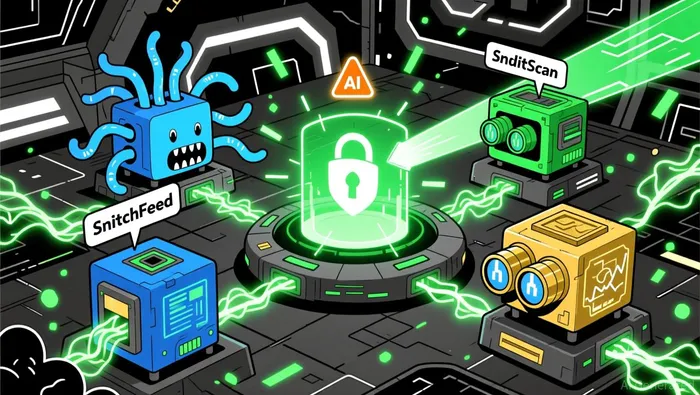
These tools address critical pain points in a market plagued by scams and volatility. Notably, DeepSnitch AI has undergone audits by Coinsult and SolidProof, two industry-leading firms, ensuring its smart contracts lack critical vulnerabilities. This third-party validation is rare in the altcoin space and enhances its regulatory resilience, particularly as U.S. federal banking agencies increasingly scrutinize AI applications.
Strategic Positioning in a Regulatory-Volatile Market
DeepSnitch AI's utility-driven model contrasts sharply with speculative projects like BlockDAG, which face selling pressure risks due to prolonged presales. While projects such as TURBO rely on AI hype without tangible use cases, DeepSnitch AI's tools are already operational. This differentiation is critical in a market where regulatory scrutiny remains a concern.
Moreover, the project benefits from the GENIUS Act's legitimization of stablecoins, which are integral to its Telegram-based analytics platform. By aligning with regulatory priorities, DeepSnitch AI positions itself as a bridge between innovation and compliance, attracting both retail and institutional investors. Early whispers of Tier 1 exchange listings further underscore its growing credibility as reported in industry updates.
Risk Profile and Comparative Analysis
While DeepSnitch AI lacks specific regulatory certifications according to tokenomics analysis, its focus on real-world utility and third-party audits mitigates some risks. Established tokens like SUISUI-- and NEAR ProtocolNEAR--, though stable, offer limited 100x potential due to their larger market caps as noted in market analysis. In contrast, DeepSnitch AI's low entry price and early-stage deployment create a favorable risk-reward asymmetry, particularly in a Fed-driven environment.
Conclusion: The Asymmetric Edge in 2025
The 2025 regulatory landscape has created a dichotomy: while macroeconomic and policy shifts heighten volatility, they also amplify opportunities for projects with defensible utility. DeepSnitch AI's AI-powered tools, third-party audits, and alignment with regulatory priorities position it as a compelling asymmetric bet. For investors seeking exposure to innovation without sacrificing risk management, such high-utility altcoins represent a strategic counterbalance to the sector's inherent volatility.






Comentarios
Aún no hay comentarios