
Navigating Regulatory Risks in Hosted Bitcoin Mining: A Strategic Investor's Guide
The U.S. Securities and Exchange Commission's (SEC) evolving stance on BitcoinBTC-- mining and the application of the Howey Test to third-party mining models has created a complex regulatory landscape for investors. While proof-of-work (PoW) mining itself has been largely exempted from securities law scrutiny, hosted mining services-where third parties manage infrastructure and operations-remain a gray area. This article dissects the implications of recent SEC enforcement actions and Howey Test applications, offering a roadmap for investors to assess risks and opportunities in this dynamic sector.
The SEC's Stance on PoW Mining: A Clarification
In March 2025, the SEC's Division of Corporation Finance issued a landmark statement clarifying that PoW mining activities, including solo and pooled mining, do not constitute the offer or sale of securities under the Howey Test. The agency emphasized that miners earn rewards through their own computational efforts, not from the managerial or entrepreneurial efforts of third parties according to the statement. This distinction is critical: the SEC explicitly defined "Covered Crypto Assets" as those intrinsically tied to public, permissionless networks like Bitcoin, where rewards are payments for services rendered to secure the network according to the SEC's guidance.
This regulatory clarity has provided a degree of certainty for miners operating under PoW consensus mechanisms. However, the SEC's guidance does not extend to PoS networks, which remain under active scrutiny. For investors, this bifurcation underscores the importance of differentiating between consensus models when evaluating exposure to regulatory risk.
Howey Test and Third-Party Mining Services: A Case Study
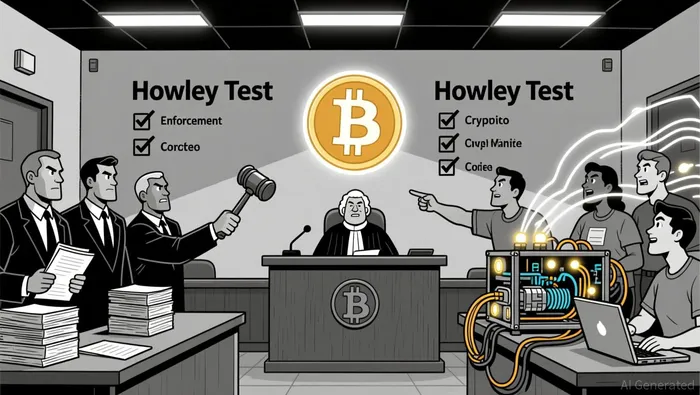
The Howey Test-which defines a security as an investment of money in a common enterprise with the expectation of profit derived from the efforts of others-remains central to the SEC's enforcement strategy. Recent cases highlight how this framework applies to hosted mining services.
In Q3 2025, the SEC filed a lawsuit against Danh C Vo, founder of VBit, alleging that his firm's hosted mining service constituted an unregistered securities offering. The SEC argued that customers purchasing hosting agreements were investing in VBit's operations, relying on the company to generate profits through mining-a structure that met the Howey Test's criteria. This case illustrates a key risk for third-party mining models: if investors are perceived to be passively relying on a company's managerial efforts rather than actively contributing to the mining process, the arrangement could trigger securities law obligations.
The SEC's analysis hinges on four factors:
1. Investment of money: Customers pay for hosting services.
2. Enterprise: The mining operation is a centralized endeavor.
3. Expectation of profit: Investors anticipate returns from Bitcoin's price appreciation or mining rewards.
4. Profits derived from others' efforts: If the company controls infrastructure and operations, profits may be tied to its performance.
For hosted mining services, the critical question is whether the operator's role involves entrepreneurial or managerial efforts essential to the enterprise's success. The SEC's staff has clarified that solo and pooled mining do not meet this threshold, as miners' rewards are directly tied to their own computational contributions. However, third-party models that abstract technical complexity and centralize control may inadvertently align with Howey's fourth prong.
Strategic Considerations for Investors
- Due Diligence on Third-Party Models: Investors must scrutinize the structure of hosted mining services. If a provider manages infrastructure, guarantees returns, or pools resources without clear operational transparency, the arrangement could attract SEC scrutiny. The VBit case serves as a cautionary tale.
- Regulatory Tail Risks: While PoW mining is currently exempt, the SEC's focus on PoS and staking activities suggests that future enforcement actions could expand the definition of "common enterprise". Investors should monitor developments in these areas, particularly as tokenized assets and decentralized finance (DeFi) protocols evolve.
- Geographic Diversification: The SEC's enforcement actions are concentrated in the U.S., but global mining operations may face varying regulatory environments. Investors should consider jurisdictional risks when allocating capital.
- Leverage No-Action Letters and Guidance: The SEC's recent no-action letters, such as those for DePIN token distributions, indicate a willingness to provide clarity for projects that avoid securities law pitfalls. Investors should prioritize operators that align with these frameworks.
Conclusion
The SEC's March 2025 statement on PoW mining has provided a degree of regulatory clarity, but hosted mining services remain a high-risk segment. Investors must navigate the Howey Test's nuances, distinguishing between decentralized mining operations and centralized models that resemble securities offerings. As enforcement actions like the VBit case demonstrate, the line between a service and a security is thin-and the SEC is actively policing it. For strategic investors, the path forward lies in rigorous due diligence, a deep understanding of consensus mechanisms, and a proactive approach to regulatory trends.







Comentarios
Aún no hay comentarios