
Navigating Regulatory Crossroads: UniCredit's Banco BPM Battle and Strategic Opportunities for Investors
The ongoing legal and regulatory showdown between UniCredit and Italy's financial authorities over the Banco BPM takeover has become a pivotal test of corporate resilience and regulatory rigor. For investors, this clash offers a rare opportunity to assess risk-reward dynamics in a sector ripe for consolidation. While uncertainty lingers, the interplay of legal maneuvering, strategic intent, and European regulatory oversight points to a potential inflection point for UniCredit's valuation.
Regulatory Risks: A High-Stakes Balancing Act
UniCredit's challenge to Italy's “golden power” conditions—requiring the bank to exit Russian operations and maintain Banco BPM's loan-to-deposit ratio for five years—frames the core of this dispute. The Italian government's invocation of national security concerns, while legally defensible, has drawn scrutiny from the European Commission, which is now reviewing the use of such powers. This adds a transnational dimension to the case, as Brussels could impose constraints on Italy's regulatory overreach.
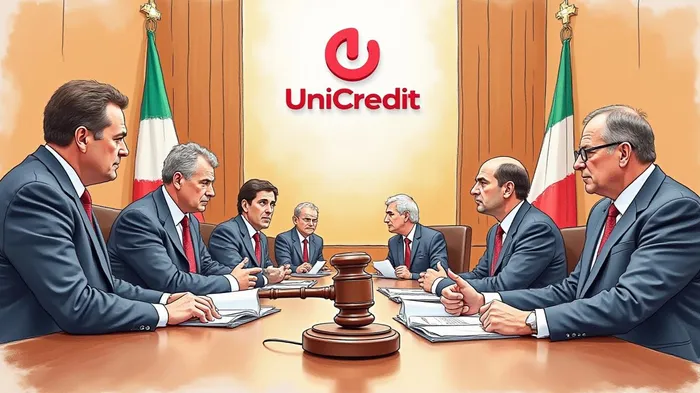
The suspension of UniCredit's bid by Consob, Italy's markets regulator, further complicates matters. While the 30-day suspension grants UniCredit breathing room to negotiate, the broader question remains: Can the bank secure terms that align regulatory demands with its strategic goals? The answer hinges on two factors:
1. Legal Outcomes: The pending appeals in Rome's administrative court will determine whether UniCredit can operate Banco BPM without onerous restrictions.
2. European Commission Review: A ruling against excessive use of golden powers could weaken Italy's position, favoring UniCredit's case.
The stock's recent volatility reflects investor anxiety over regulatory uncertainty. A resolution in UniCredit's favor could catalyze a rebound, while a loss might prolong stagnation.
Strategic Valuation: Unlocking Synergies or Missing the Boat?
UniCredit's bid for Banco BPM is not merely a defensive move—it's a bold play to solidify its position in Italy's fragmented banking sector. Banco BPM's strong retail presence and cost-efficient operations could enhance UniCredit's profitability, especially as the latter seeks to reduce its loan book and focus on fee-based income.
However, the imposed conditions threaten to dilute these synergies. Maintaining Banco BPM's loan-to-deposit ratio for five years could limit UniCredit's ability to optimize capital allocation, while exiting Russian operations—though strategically prudent—adds short-term operational hurdles. The waiver of the Anima acquisition condition signals UniCredit's commitment to the deal, but its ultimate decision to proceed will depend on regulatory clarity.
Investors must weigh two scenarios:
- Scenario 1 (Favorable Outcome): If UniCredit wins the legal battle or negotiates softened terms, the combined entity could realize €1 billion in annual synergies by 遑?2027, boosting earnings and valuation multiples.
- Scenario 2 (Unfavorable Outcome): A protracted stalemate or outright rejection could force UniCredit to walk away, leaving shareholders with missed upside and a diluted strategic agenda.
Investment Implications: A Call for Disciplined Opportunism
The current impasse creates a compelling entry point for investors willing to bet on UniCredit's long-term prospects. Key catalysts include:
1. Legal Resolution: A ruling in UniCredit's favor by Q3 2025 could unlock a 15–20% stock rebound.
2. Regulatory Compromise: Even if terms are adjusted, the merger's core benefits—scale and cost efficiency—remain intact.
3. Sector Consolidation: Italy's banking sector is consolidating, and UniCredit's success here could set a precedent for future deals.
At a P/E of 8.5x versus the sector average of 11x, UniCredit trades at a discount that already prices in regulatory risks. A positive resolution could narrow this gap, delivering both absolute returns and relative outperformance.
Final Analysis: Act Now, but With Precision
The Banco BPM battle is more than a legal skirmish—it's a defining moment for UniCredit's leadership and Italy's banking landscape. For investors, the calculus is clear: the risks are elevated, but the asymmetric reward—potentially a 30%+ uplift if the merger proceeds favorably—justifies a measured position.
Consider gradually accumulating shares while awaiting legal clarity, with a focus on dollar-cost averaging. Pair this with a short position in Italian banking ETFs (e.g., XIT) to hedge against sector-wide volatility. Monitor Consob's next moves and the European Commission's findings closely—these will be the ultimate triggers for valuation realignment.
The regulatory crossroads ahead may be fraught, but for the bold, the path to profit is still visible.
This analysis emphasizes the importance of timing and risk management. Investors should consult with a financial advisor before making decisions.







Comentarios
Aún no hay comentarios