
Navigating Low Rates: Strategic Yield Optimization in Income-Generating ETFs
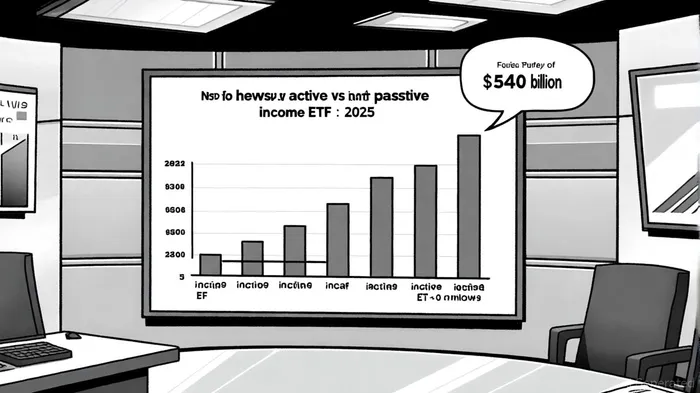
In 2025, the low-interest-rate environment has reshaped the landscape for income-focused investors, with active management emerging as a dominant force in yield optimization. According to Morningstar's midyear review, income-generating ETFs have attracted $540 billion in new assets in the first half of 2025 alone, surpassing the total from the same period in 2024. This surge reflects a strategic shift toward active strategies, which now outnumber passive ETFs, driven by demand for tax-efficient tools like covered call and buffer ETFs, the MorningstarMORN-- review adds.
The Rise of Active Management in Fixed Income
Traditional passive strategies, once the bedrock of income portfolios, are being outpaced by active fixed income ETFs. According to iShares data, 53% of Q1 2025 inflows into fixed income ETFs flowed to active strategies, despite these representing only 23% of total assets in the category. This trend underscores investor confidence in active managers' ability to adapt to shifting rate environments and geopolitical risks. For instance, the iShares Flexible Income Active ETF (BINC) has attracted $1.7 billion in net new assets by dynamically rotating across sectors such as high yield, emerging market debt, and securitized assets, according to BlackRock's fall outlook. BINC's global diversification-only 38.5% U.S.-based exposure-reduces single-country risk, a critical advantage in volatile markets, BlackRockBLK-- notes.
Similarly, the PIMCO Multisector Bond Active ETF (PYLD) has repositioned its portfolio by reducing government bond exposure to 16.4% and increasing allocations to securitized fixed income, offering a 5.95% yield while maintaining 28.5% triple-A-rated holdings. These examples highlight how active managers exploit inefficiencies in the fixed income market through security selection, sector rotation, and yield curve positioning, as the Morningstar review and industry commentary explain.
Yield Optimization: Balancing Risk and Return
In a low-rate environment, optimizing yield requires a delicate balance between income generation and risk mitigation. BlackRock's fixed-income outlook emphasizes that investors are increasingly prioritizing income over duration, targeting the 3- to 7-year segment of the yield curve to balance yield and duration risk. Active ETFs like T. Rowe Price's Total Return ETF (TOTR) and Ultra Short-Term Bond ETF (TBUX) exemplify this approach, adapting to potential rate cuts while maintaining credit quality, as BlackRock's earlier commentary on strategy implementation noted.
Municipal bonds have also gained traction as resilient income sources. Their tax-exempt yields and insulation from global trade shocks make them attractive diversifiers, particularly in an era of geopolitical uncertainty, the fixed-income outlook observes. Meanwhile, European fixed income is being repositioned as a stabilizer, offering liquidity and stability amid tariff-related risks, according to the same BlackRock perspective.
The Role of Central Bank Policies
Central bank policies continue to shape the income ETF landscape. The Federal Reserve's post-COVID independence has led to a reemergence of fixed income risks, necessitating active risk management, BlackRock's fall outlook explains. For example, BlackRock notes that historically high yields at the front end of the curve-such as in short-term corporate bonds-offer attractive returns with minimal duration risk. This dynamic has fueled demand for ETFs like the iShares iBoxx $ Investment Grade Corporate Bond ETF (LQD), which provides steady income with relatively low risk, as industry analyses have shown.
Conclusion: A Strategic Imperative
As 2025 unfolds, income-generating ETFs are proving their mettle in a low-rate world. Active management, sector agility, and global diversification are no longer optional-they are strategic imperatives. Investors who embrace these principles can harness yield from diversified sectors while navigating macroeconomic uncertainties. The coming months will likely see further innovation in active strategies, as managers continue to refine their approaches to optimize returns in an evolving landscape.







Comentarios
Aún no hay comentarios