
Navigating Rate Uncertainty in 2025: Resilient Sectors and Strategic Asset Allocation
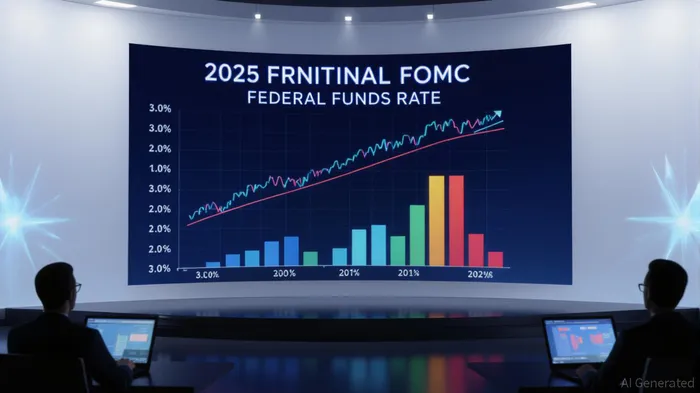
The economic landscape of 2025 is defined by a delicate balancing act: central banks are cautiously easing monetary policy amid persistent inflation, while investors grapple with policy uncertainty and divergent asset correlations. The Federal Reserve's September 2025 projections highlight a projected federal funds rate of 3.6% for the year, with a gradual decline to 3.0% in the long run, reflecting a measured approach to rate cuts as inflation eases from 3.0% to 2.0% by 2028 [1]. This environment, coupled with geopolitical risks and the anticipated return of pro-business policies under a potential Trump administration, demands a strategic reevaluation of asset allocation.
Macroeconomic Stability and Policy Ambiguity
The FOMC's outlook underscores a “gradual” path for rate reductions, with GDP growth projected at 1.6% in 2025 before modestly rising to 1.9% by 2027 [1]. While this suggests a stable but subdued growth trajectory, the persistence of services-sector inflation and the risk of trade fragmentation—highlighted by the OECD as a potential drag on global output—introduce volatility [2]. For investors, the key challenge lies in navigating this ambiguity while capitalizing on sectors and asset classes that thrive in a low-rate, inflation-adjusted world.
Resilient Sectors and Strategic Asset Classes
1. Fixed Income: Short-Duration and Active Management
With the Fed signaling rate cuts, fixed-income investors are advised to extend duration in bond portfolios to capture capital appreciation from falling yields. However, caution is warranted: the 3- to 7-year segment of the yield curve remains favored due to concerns over long-end volatility [1]. BlackRockBLK-- notes that short-duration instruments offer a buffer against rate hikes, while active management is critical to avoid riskier credit segments [1].
2. Equities: AI-Driven Growth and International Diversification
U.S. equities remain a cornerstone of 2025 portfolios, particularly growth stocks tied to artificial intelligence and capital expenditure momentum. The anticipated Trump administration's pro-business policies could further amplify returns in technology and industrials. Meanwhile, international equities are gaining traction as a weaker dollar and global AI adoption create opportunities in Europe and Asia-Pacific markets [1].
3. Real Assets: Real Estate and Commodities
The CBRECBRE-- Global Investor Intentions Survey reveals strong demand for real estate in multifamily, industrial, and logistics sectors, driven by demographic trends and e-commerce growth [2]. U.S. investors are prioritizing value-add opportunities, while European and Asian counterparts are drawn to markets with improving leasing activity. Commodities, particularly gold, are also seen as hedges against macroeconomic uncertainty, with BlackRock noting their role in diversifying traditional portfolios [1].
4. Alternatives: Liquid Alternatives and Digital Assets
Investor sentiment is shifting toward liquid alternatives and digital assets to mitigate diverging correlations between stocks and bonds. These assets offer non-correlated returns and inflation protection, aligning with the OECD's warning about the risks of trade fragmentation [2].
Navigating the Uncertainty: A Strategic Framework
- Diversification Across Geographies and Sectors: The Natixis Individual Investor Survey highlights a 35% belief in the market's continued rally, underscoring the need for diversified exposure to balance retail caution [3].
- Income Generation and Capital Preservation: Core bonds and investment-grade credit remain defensive, while private credit offers higher yields in a low-rate environment [1].
- Active Risk Management: With policy shifts and trade barriers looming, active management is essential to adjust allocations dynamically.
Conclusion
The 2025 investment landscape demands a nuanced approach to rate uncertainty. By prioritizing resilient sectors like AI-driven equities, real estate, and commodities, while leveraging fixed-income strategies and alternatives, investors can navigate policy ambiguity and capitalize on emerging opportunities. As central banks tread cautiously and global growth moderates, adaptability and active management will be paramount.





Comentarios
Aún no hay comentarios