
Navigating the Post-Recessionary Crypto and Gold Opportunity in a Dovish Fed Environment
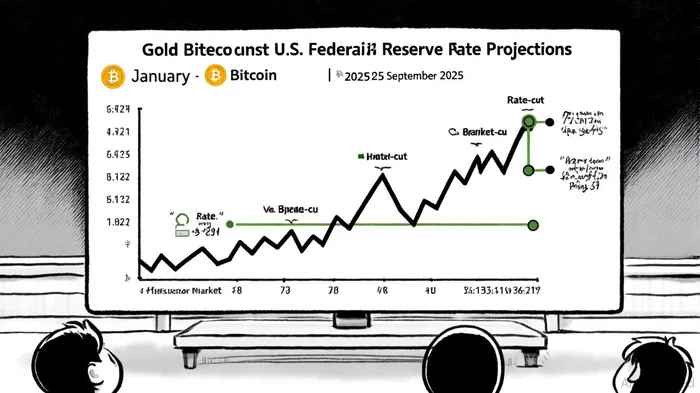
The U.S. labor market has entered a period of cautious recalibration, with August 2025 data revealing a 4.3% unemployment rate—the highest since October 2021[1]. This rise, coupled with a mere 22,000 nonfarm payroll additions (far below the forecasted 75,000)[2], signals a cooling labor market. Sectors like healthcare and social assistance added jobs, but declines in federal government, wholesale trade, and manufacturing underscore structural fragility[3]. These trends, compounded by ongoing tariff uncertainties, have pushed the Federal Reserve toward a dovish stance, with markets now pricing in 2.5 rate cuts by year-end[1].
The Fed's Dovish Pivot and Inflationary Pressures
The Federal Reserve has maintained its target federal funds rate at 4.25–4.50% since early 2025, adopting a wait-and-see approach amid elevated inflation and economic uncertainty[1]. While the July 2025 meeting saw two dissenting votes for a 0.25% rate cut, Chair Jerome Powell emphasized the need for “macroeconomic clarity” before adjusting policy[1]. However, weaker-than-expected labor data has shifted market expectations: as of September 2025, an 87% probability of a 0.25% rate cut is priced in, with 2.5 cuts anticipated across the remaining meetings[1].
This dovish pivot is critical for inflation-hedging assets. Historically, gold has thrived in low-rate environments. From 2000 to 2025, gold outperformed the S&P 500 with a 7.8% annualized return compared to 7% for the index[3]. In 2025 alone, gold surged nearly 30% as central bank buying and rate-cut expectations drove demand[1]. Its negative correlation with equities further enhances its appeal as a diversifier during economic volatility[4].
Bitcoin's Role in a Dovish Regime
Bitcoin's performance in dovish environments is less predictable but increasingly relevant. A 2025 study suggests BitcoinBTC-- can outperform gold in liquidity-driven markets, though its volatility limits its safe-haven status[4]. The U.S. money supply (M2) hit a record $22.02 trillion in 2025[5], a metric that historically supports asset prices. However, investor caution—evident in high money market fund holdings—suggests deployment into riskier assets like Bitcoin may hinge on further rate cuts and macroeconomic stability[5].
Strategic Positioning for Investors
The interplay of dovish policy and inflationary pressures creates a compelling case for allocating to gold and Bitcoin. Gold's historical resilience and inverse relationship with the U.S. dollar[2] make it a natural hedge against rate cuts and currency devaluation. Meanwhile, Bitcoin's potential to benefit from liquidity injections—despite its volatility—offers asymmetric upside in a low-rate world.
Conclusion
As the Fed navigates a fragile labor market and inflationary headwinds, investors are increasingly turning to traditional and digital safe havens. Gold's proven track record and Bitcoin's liquidity-driven potential position both as strategic assets in a dovish regime. While gold offers stability, Bitcoin introduces a speculative edge—both reflecting the market's demand for inflation protection in an era of monetary easing.






Comentarios
Aún no hay comentarios