
Navigating Political Uncertainty: Defensive Investing Strategies for a U.S. Government Shutdown Scenario
The U.S. government shutdown remains a looming risk as fiscal negotiations stall, with potential implications for market stability and economic momentum. While historical precedents suggest that shutdowns often trigger short-term volatility, their broader economic impact hinges on duration, policy context, and investor sentiment. For investors, the key lies in adopting defensive strategies that mitigate downside risks while capitalizing on sector-specific resilience.
Historical Market Reactions: Volatility and Resilience
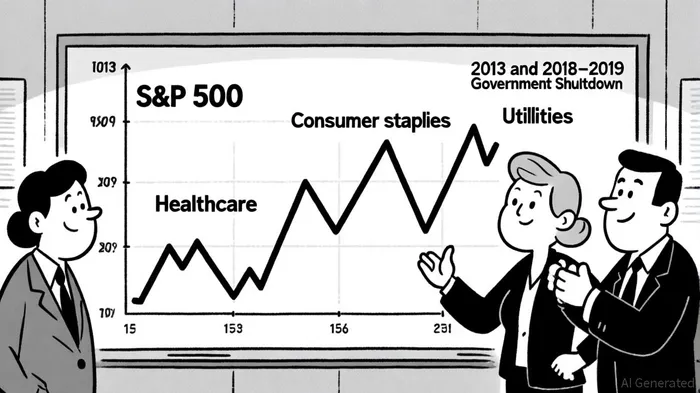
Government shutdowns have historically introduced political uncertainty, but their impact on equity markets has been mixed. During the 16-day 2013 shutdown, the S&P 500 advanced by 3.1%, and the index gained nearly 20% in the following year[1]. Similarly, the 35-day 2018–2019 shutdown coincided with a 26.2% gain in the S&P 500 over the subsequent 12 months[1]. These trends underscore the market's tendency to treat shutdowns as temporary disruptions rather than existential threats. However, prolonged or repeated shutdowns can erode investor confidence, as seen in the 2018–2019 event, where the S&P 500 corrected by 13% amid broader economic headwinds[2].
Economic Impact: GDP, Employment, and Data Gaps
Shutdowns disrupt federal operations, directly affecting GDP growth and employment. The 2013 shutdown reduced GDP by an estimated $20 billion, while the 2018–2019 shutdown shaved $11 billion from economic output, with $3 billion in permanent losses[3]. Federal workers furloughed during these events—up to 737,000 in 2023—face income shocks that ripple through consumer spending[3]. Additionally, delayed economic data releases (e.g., employment reports) complicate Federal Reserve decision-making, exacerbating uncertainty in a fragile labor market[3].
Defensive Sectors: Pillars of Stability
During periods of political uncertainty, defensive sectors like healthcare, consumer staples, and utilities have historically outperformed. These sectors offer steady earnings and inelastic demand, making them less sensitive to economic contractions. For example, during the 2008 financial crisis, consumer staples lost only 14% compared to the S&P 500's 37% decline[4]. Similarly, in the 2018–2019 shutdown, companies like Procter & Gamble (NYSE: PG) and Johnson & Johnson (NYSE: JNJ) maintained stable demand for essential goods and services[5]. Utilities, such as NextEra Energy (NYSE: NEE), also benefit from the inelastic demand for electricity and gas[5].
Sector Rotation Strategies: Tactical Adjustments
Sector rotation is a critical tool for aligning portfolios with shifting market conditions. During shutdowns or policy-driven uncertainty, investors should overweight defensive sectors while reducing exposure to cyclical areas like technology and financials[5]. For instance, defensive sectors saw significant inflows in 2025 amid tariff disputes and central bank policy shifts[5]. Tactical allocations to ultrashort bond ETFs and high-quality fixed-income instruments can further enhance liquidity and downside protection[5]. Active monitoring of ETF fund flows and momentum indicators can help refine these strategies in real time[5].
Conclusion: Preparing for the Unpredictable
While government shutdowns are inherently disruptive, their economic and market impacts are often short-lived. By leveraging defensive investing and sector rotation strategies, investors can navigate policy-driven uncertainty while positioning for recovery. Historical data reaffirms the resilience of healthcare, consumer staples, and utilities, offering a roadmap for preserving capital in turbulent times. As the political landscape evolves, proactive portfolio adjustments remain essential to weathering the storm.







Comentarios
Aún no hay comentarios