
Navigating Political Turbulence: The Shifting Landscape of Public Trust and Institutional Capital Reallocation
Political instability has long been a double-edged sword for investors, eroding public trust while simultaneously reshaping capital flows. The period from 2023 to 2025, marked by the re-election of Donald Trump and the subsequent restructuring of the federal government, has underscored this dynamic. As public sector employment and institutional legitimacy face unprecedented scrutiny, institutional investors are recalibrating their strategies to mitigate risks and capitalize on emerging opportunities.
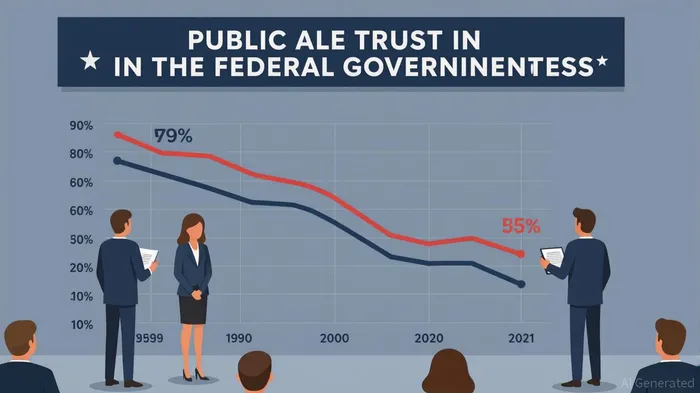
The Erosion of Public Trust and Its Implications
By early 2025, only 33% of Americans trusted the federal government—a figure that, while slightly improved from 23% in 2024, remains alarmingly low. This decline is not uniform: Republicans under 50 saw a dramatic 32-point surge in trust (from 10% to 42%), while Democrats' trust plummeted to 31% from 39%. Such polarization reflects a broader crisis of legitimacy, where government actions are increasingly viewed through a partisan lens.
The Trump administration's aggressive restructuring of federal agencies—via initiatives like the Department of Government Efficiency (DOGE)—has further destabilized public confidence. While these efforts reduced perceived waste (from 85% to 61% of Americans believing the government is wasteful), they also sparked debates over the politicization of civil service. The administration's push to expand presidential control over hiring and firing—supported by 60% of Republicans in 2025—has deepened fears of a nonpartisan civil service eroding.
Federal Agency Investment Risks
For institutional investors, the implications are clear: federal agencies are becoming riskier propositions. The politicization of public sector employment and the potential for abrupt policy shifts (e.g., program cuts or reorganizations) create operational and reputational risks. For example, the DOGE's focus on reducing the federal workforce by 15% by 2026 could lead to talent attrition and operational inefficiencies, undermining long-term agency performance.
Moreover, the erosion of public trust may indirectly impact federal spending. If citizens perceive government programs as ineffective or corrupt (67% of Americans still hold this view), political pressure to reduce funding could intensify. This could rippleXRP-- into sectors reliant on federal contracts, such as defense, healthcare, and infrastructure, where budget uncertainty could stifle growth.
The Rise of Stable Alternatives
Amid this instability, institutional capital is flowing toward sectors perceived as more resilient. Two stand out: low-cost ETFs and private credit.
- ETFs: Liquidity and Diversification in Turbulent Times
Exchange-traded funds (ETFs) have attracted over $3.0 trillion in net inflows since 2020, driven by their low expense ratios and transparency. In 2025, actively managed ETFs accounted for 23% of all inflows—a jump from 9% in 2020. This trend reflects a shift toward agile, data-driven strategies that prioritize flexibility. For example, reveal a consistent upward trajectory, with 2024–2025 seeing a surge as investors sought refuge from volatile equity markets.
ETFs also offer indirect exposure to private credit through hybrid structures. These vehicles democratize access to alternative assets, allowing non-institutional investors to participate in high-yield, long-duration credit markets. The growth of private credit ETFs—now a $1.05 trillion market—has been fueled by their ability to provide stable cash flows and downside protection during political uncertainty.
- Private Credit: A Pillar of Resilience
Private credit has emerged as a stabilizing force in capital markets. With assets under management (AUM) exceeding $2.1 trillion by 2023, the sector has demonstrated resilience during crises, including the 2020 pandemic and the 2024 economic volatility. Unlike traditional banks, private credit funds are backed by long-term capital (e.g., pension funds, endowments), reducing liquidity risks. This structure allows them to maintain lending during downturns, making them attractive to investors seeking consistent returns.
Strategic partnerships between private credit managers and traditional banks have further enhanced stability. For instance, hybrid deals where banks hold senior tranches and private credit funds retain junior positions mitigate systemic risks. highlights a 94% increase in dry powder and unrealized value, underscoring the sector's capacity to deploy capital even in uncertain environments.
Strategic Reallocation for Institutional Investors
The data suggests a clear path for institutional capital: reallocate toward sectors with structural advantages. Here's how:
- Increase ETF Exposure: Prioritize ETFs with low expense ratios and diversified holdings, particularly those with private credit components. These vehicles offer liquidity and access to alternative assets, which are critical during political instability.
- Double Down on Private Credit: Allocate capital to private credit funds with strong risk management frameworks. Focus on managers with expertise in niche markets (e.g., infrastructure, small business lending) to diversify risk.
- Leverage Hybrid Structures: Interval funds and business development companies (BDCs) provide a balance of liquidity and alternative exposure. For example, BDCs have historically outperformed during periods of rising interest rates, a scenario likely in 2025 as the Federal Reserve adjusts policy.
Conclusion
Political instability is reshaping the investment landscape, with public sector trust and employment metrics signaling long-term risks. While federal agencies face operational and reputational challenges, institutional investors are finding stability in ETFs and private credit. By reallocating capital to these resilient sectors, investors can hedge against uncertainty while capturing growth opportunities. As the 2025–2026 period unfolds, the ability to adapt to shifting political dynamics will be key to preserving capital and achieving long-term returns.






Comentarios
Aún no hay comentarios