
Navigating Political Risk: U.S. Government Shutdowns and Market Resilience as Investment Catalysts
The U.S. government shutdown has long been a recurring feature of American politics, with 21 such events occurring since 1976. These closures, often driven by partisan disputes over budgets, healthcare, or immigration, have historically triggered economic disruptions and market volatility. Yet, as data from past episodes reveals, shutdowns also create unique investment opportunities for those who understand how to navigate political risk. By analyzing historical patterns, sectoral performance, and policy outcomes, investors can transform uncertainty into a strategic advantage.
Historical Patterns and Economic Impact
Government shutdowns typically arise from gridlock between Congress and the executive branch over appropriations. The longest shutdown, from December 2018 to January 2019, was fueled by a dispute over border wall funding and lasted 35 days. It cost the economy $24 billion and reduced GDP growth by 0.6% in the following quarters, according to a Moody's Analytics estimate. Similarly, the 2013 shutdown, sparked by opposition to the Affordable Care Act, shaved $20 billion off GDP, per a PolitiFact analysis. These events underscore how political brinkmanship can disrupt federal operations, furlough nonessential workers, and delay critical services like research and tax processing, as documented in a YCharts analysis.
However, the economic toll is often temporary. The Congressional Budget Office estimates that most GDP losses are recovered once the government reopens, aided by back pay for furloughed workers and catch-up spending, a point highlighted in the PolitiFact analysis. This resilience suggests that while shutdowns create short-term pain, their long-term impact on the broader economy remains limited.
Market Resilience and Investor Behavior
Financial markets have historically shown remarkable resilience during shutdowns. For instance, the S&P 500 gained 10% during the 35-day 2018–2019 shutdown, defying expectations of a downturn, according to the PolitiFact analysis. This pattern is not unique: since 1976, the index has averaged a 0.3% gain during shutdowns and a 13% rise in the 12 months afterward, as reported by PolitiFact. The market's ability to absorb short-term disruptions reflects confidence in the eventual resolution of political conflicts and the self-correcting nature of the U.S. economy.
Investor behavior, however, shifts during shutdowns. Political uncertainty often triggers a "risk-off" approach, with capital flowing into safe-haven assets like gold and U.S. Treasuries. During the 2025 shutdown, gold prices hit record highs, while the 10-year Treasury yield fell as traders sought stability, trends covered in the YCharts analysis. Similarly, the VIX volatility index, though not explicitly linked to recent shutdowns in the data, typically rises modestly, indicating caution without panic, according to a Benzinga column.
Sector Rotation and Political Risk Management
Political risk acts as a catalyst for sector rotation, with defensive industries outperforming during shutdowns. Utilities, consumer staples, and healthcare have historically provided refuge for investors. For example, healthcare stocks surged 3.09% on the first day of a recent shutdown, buoyed by the continuity of Medicare and Medicaid funding-an outcome noted in the PolitiFact analysis. Companies like UnitedHealth Group (UNH) and Johnson & Johnson (JNJ) benefit from stable government-backed revenue streams, making them attractive during periods of uncertainty.
Conversely, cyclical sectors like financials and technology tend to underperform. Financials face headwinds from delayed economic data, which complicates monetary policy decisions, while tech companies grapple with disrupted government contracts and heightened interest rate sensitivity, as discussed in the Benzinga column. Defense contractors, however, present a nuanced case: while firms like CACI International (CACI) may see short-term gains from catch-up spending post-shutdown, traditional defense manufacturers like Lockheed Martin (LMT) remain insulated due to the perceived inviolability of defense budgets, according to the YCharts analysis.
Investors can also hedge against prolonged shutdowns by allocating to safe-haven currencies (e.g., Japanese Yen, Swiss Franc) and gold ETFs, a strategy recommended in a JDR Securities note. These strategies mitigate exposure to currency volatility and inflation risks that may arise from delayed fiscal and monetary policy adjustments.
Policy Outcomes and Long-Term Implications
Post-shutdown policy outcomes often reinforce market resilience. The 2018–2019 shutdown, for instance, ultimately led to a bipartisan agreement on border security, demonstrating that even contentious issues can be resolved. Similarly, the 2025 shutdown over healthcare subsidies, while disruptive, is unlikely to derail the Fed's inflation-fighting agenda, as essential services like Social Security and Medicare remain operational, according to the YCharts analysis.
The Federal Reserve's response to past shutdowns further underscores market stability. While delayed economic data complicates monetary policy, the Fed has historically maintained a dovish stance during prolonged closures to cushion economic fallout, a pattern summarized on Wikipedia. This adaptability ensures that policy errors are minimized, preserving investor confidence.
Conclusion
U.S. government shutdowns, though politically charged, are not insurmountable for investors. Historical data reveals that markets recover swiftly, defensive sectors outperform, and policy outcomes often resolve conflicts. By treating political risk as a catalyst rather than a deterrent, investors can capitalize on sector rotation, safe-haven assets, and long-term market trends. As shutdowns remain a fixture of American governance, the ability to navigate their uncertainties will be a defining skill for forward-thinking investors.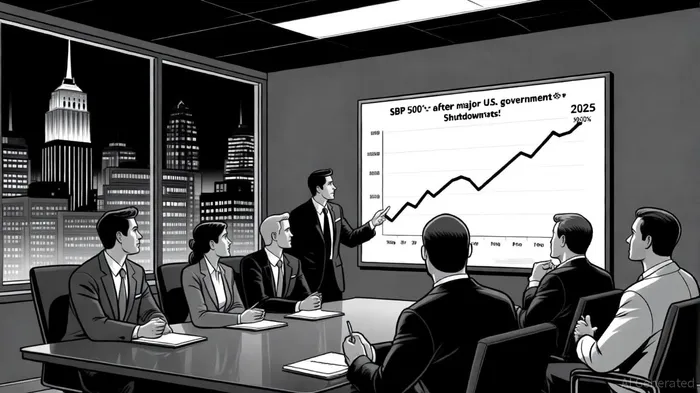





Comentarios
Aún no hay comentarios