
Navigating the Perfect Storm: U.S. Debt and Political Risks in Long-Term Investment Strategies
The U.S. fiscal landscape in 2025 is marked by a confluence of unsustainable debt growth, political gridlock, and eroding investor confidence. With public debt exceeding $37 trillion and a debt-to-GDP ratio of 123%, according to a GAO report, the nation's fiscal trajectory is increasingly precarious. Projections indicate that by 2054, the debt-to-GDP ratio could surpass 172%, while annual interest payments on federal debt are expected to exceed $1.8 trillion-overtaking defense spending and threatening critical social programs, as detailed in Goldman Sachs research. These dynamics, compounded by political fragmentation and a lack of consensus on fiscal reform, have triggered downgrades from major credit agencies like Fitch and Moody'sMCO--, signaling a deepening crisis of governance in a CSIS analysis.
The Debt-Serviceability Dilemma
The U.S. debt burden is no longer a distant concern but a present-day challenge. According to the Congressional Budget Office (CBO), gross federal debt will reach $54 trillion by 2034 under current policies, a level highlighted in a GovFacts analysis. Rising interest rates, which have already tripled net interest spending since 2017, further compound the problem, as shown in a Wellington analysis. For investors, the risk lies not in an immediate default-which remains unlikely due to the dollar's global dominance-but in the long-term erosion of purchasing power, higher borrowing costs, and geopolitical instability.
Political dysfunction further amplifies these risks. The recent One Big Beautiful Bill Act (OBBBA), which adds $3 trillion to the deficit over a decade, serves as an example noted in a Pictet report. Without structural reforms to entitlement programs like Medicare and Social Security, or meaningful tax code modernization, the U.S. faces a self-reinforcing cycle of debt accumulation and declining economic competitiveness, a point discussed in a Hoover Institution analysis.
Hedging Strategies for a Fractured Future
To mitigate these risks, investors must adopt a multi-layered approach to asset allocation. Traditional 60/40 portfolios-reliant on U.S. equities and bonds-are increasingly inadequate in a world of divergent macroeconomic regimes. Instead, the focus should shift to diversification across real assets, global equities, and alternative investments.
Real Assets as Inflation Hedges
Gold, commodities, and real estate have historically served as bulwarks against currency devaluation and fiscal uncertainty. In 2025, gold surged 25% year-to-date, outperforming both U.S. and international equities, according to a BlackRock insight, underscoring its role as a safe haven during periods of policy-driven volatility. Similarly, commodities like oil and copper, which are tied to global demand cycles, offer protection against inflationary shocks. Treasury Inflation-Protected Securities (TIPS), while less effective in volatile environments as noted in an Auspice note, remain a foundational tool for inflation-linked returns.Global Equities for Diversification
International equities provide exposure to markets less correlated with U.S. fiscal policy. In 2025, non-U.S. stocks outperformed their domestic counterparts by the largest margin since 1993, driven by weaker dollar dynamics and stronger earnings growth in Asia and Europe, according to a J.P. Morgan note. This trend is likely to continue as investors seek to reduce reliance on a single currency and economy.Alternatives and Currency Diversification
Alternative assets-such as private equity, hedge funds, and managed futures-offer uncorrelated returns and downside protection. Currency diversification, meanwhile, can hedge against dollar depreciation. For instance, allocations to eurozone bonds or emerging-market equities can balance portfolios amid geopolitical tensions and shifting trade dynamics, as recommended in an InvestWithCarl guide.
Historical Lessons and Forward-Looking Adjustments
History provides instructive parallels. During the 2008 financial crisis, gold and commodities outperformed equities, while TIPS provided modest inflation protection. However, the 2020–2023 period revealed the limitations of traditional hedges: the 60/40 portfolio's equity-bond correlation turned positive, eroding diversification benefits, as examined in a MarketClutch analysis. This underscores the need for dynamic, multi-asset strategies.
For 2025 and beyond, investors should prioritize:
- Duration Shortening: Shifting fixed-income allocations to the 3- to 7-year segment of the yield curve to capture income while limiting interest rate risk, consistent with BlackRock's fall directions.
- Quality Over Quantity: Favoring high-grade international bonds and dividend-paying global equities over overvalued domestic growth stocks, as suggested in an LPL perspective.
- Active Risk Management: Using derivatives and currency forwards to hedge against dollar weakness and geopolitical shocks, a strategy outlined in a Fidelity commentary.
Conclusion
The U.S. debt and political crisis is not a binary event but a gradual erosion of fiscal health that demands proactive, strategic responses. While the dollar's reserve status and robust economy provide a buffer, investors cannot ignore the long-term risks of rising debt, political brinkmanship, and structural inefficiencies. By diversifying into real assets, global equities, and alternatives, investors can navigate this perfect storm while positioning portfolios for resilience in an uncertain future.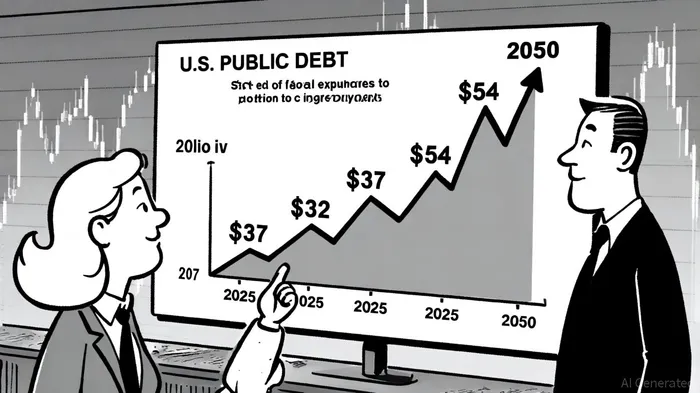





Comentarios
Aún no hay comentarios