
Navigating the Opioid Sector's Pivotal Shift: Opportunities in Regulation and Innovation
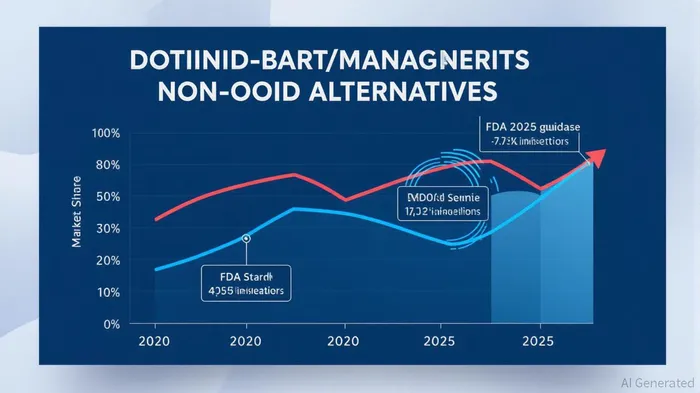
The opioid pharmaceutical sector is undergoing a seismic shift, driven by regulatory headwinds and a cultural reevaluation of pain management. While the absence of recent product discontinuations or DEA actions in 2025 might initially seem uneventful, the FDA's bold new guidance on non-opioid alternatives signals a tectonic shift in the industry's trajectory. Investors who recognize this pivot can position themselves to capitalize on emerging opportunities in innovation and compliance.
According to the U.S. Food and Drug Administration, the agency has issued updated guidance in September 2025 emphasizing the accelerated approval of non-opioid therapies for chronic pain management[1]. This move, while not directly altering DEA regulations, underscores a strategic alignment between public health priorities and market demands. The FDA's focus on alternatives like cannabinoids, nerve modulators, and regenerative therapies is creating a vacuum in traditional opioid markets—and a goldmine for companies pioneering next-gen solutions.
For instance, firms like GrifolsGRFS-- (GRFS) and Collegium PharmaceuticalCOLL-- (COLL) are already leveraging their R&D pipelines to address this regulatory tailwind. Grifols' expansion into biosimilar pain management products and Collegium's focus on abuse-deterrent formulations position them as beneficiaries of the FDA's new framework. Meanwhile, smaller biotechs developing non-addictive analgesics—such as Xenon PharmaceuticalsXENE-- (XENE) and Cara Therapeutics (CARA)—are seeing renewed investor interest as the sector pivots away from opioids[2].
The lack of recent product discontinuations in 2025 shouldn't be interpreted as stagnation. Instead, it reflects the industry's proactive adaptation to regulatory expectations. Major players like Purdue Pharma and Mallinckrodt have already exited or scaled back opioid production in prior years, leaving room for niche players to fill gaps in the market. This consolidation creates a unique opportunity for investors to target companies with agile supply chains and diversified portfolios.
However, the absence of DEA regulatory updates in 2025 introduces uncertainty. While the FDA's guidance is a strong signal, investors must remain cautious until the DEA clarifies its stance on opioid manufacturing quotas and distribution controls. A potential tightening of DEA regulations could further erode margins for traditional opioid producers, amplifying the sector's bifurcation between legacy players and innovators.
In conclusion, the opioid sector's strategic realignment is not a death knell for the industry but a call to reinvent. The FDA's 2025 guidance is a clarion call for investors to redirect capital toward companies that align with the future of pain management. By prioritizing firms with robust non-opioid pipelines and regulatory agility, investors can navigate this transition with confidence—and reap the rewards of a sector in transformation.





Comentarios
Aún no hay comentarios