
Navigating Oil's Tectonic Shifts: OPEC+, Geopolitics, and the Case for Energy Resilience
The oil market in June 2025 is a study in contrasts: OPEC+ has begun unwinding its self-imposed production cuts, aiming to stabilize prices at $75–85 per barrel, while Iran-Israel tensions threaten to upend supply dynamics entirely. For investors, this volatile landscape demands a dual strategy: embracing energy equities for their upside potential while hedging against geopolitical shocks.
OPEC+'s Adaptive Dance: Balancing Discipline and Flexibility
OPEC+'s June production adjustment—adding 411,000 barrels per day (bpd) to global supply—reflects its cautious approach to market stability. By phasing out 2.2 million bpd of cuts over five months, the alliance seeks to counter rising non-OPEC output (notably from the U.S., Brazil, and Guyana) without triggering a price collapse. The June quotas reveal a calibrated balancing act:
- Saudi Arabia and Russia, each producing ~9.2 million bpd, remain the linchpins of compliance, though Russia's output is hamstrung by sanctions.
- Iraq and Kazakhstan, historically non-compliant, have been granted quota adjustments to legitimize past overproduction, shoring up collective discipline.
This flexibility is critical. OPEC+'s monthly meetings allow it to pivot if markets sour. As of June 1, Brent crude traded at $76.43/bbl, a precarious midpoint between surplus-driven declines and geopolitical-driven spikes.
Russia's Dilemma: Fiscal Lifeline vs. Sanctioned Constraints
Russia's oil strategy is a microcosm of OPEC+'s challenges. With oil funding ~40% of its federal budget, Moscow aims to maximize revenue despite Western sanctions. Its baseline production of 10.5 million bpd is now constrained by price caps and logistical hurdles, forcing reliance on Asian markets. Yet, its participation in OPEC+ underscores a strategic calculus: higher global prices benefit Russia's state coffers, even if its own export volumes are limited.
Iran-Israel: The $10 Risk Premium and the Strait of Hormuz
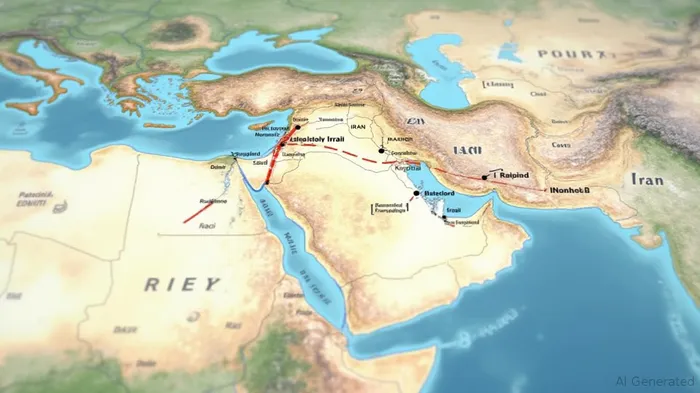
The most immediate threat to oil markets is the Iran-Israel conflict. Analysts now factor a $10 “risk premium” into oil prices due to the potential for supply disruptions. The stakes are existential:
- Strait of Hormuz: A closure could halt 25% of global oil supply, pushing prices above $100/bbl. Extreme scenarios envision $160/bbl if Persian Gulf exports are disrupted.
- Infrastructure Damage: Israeli strikes on Iran's South Pars gas field and Shahran oil depot, alongside damage to Israel's Haifa refinery, have already disrupted regional output.
The U.S. military's presence in the region acts as a deterrent, but escalation risks remain. JPMorgan warns that prolonged instability could mirror historical crises, such as the 1990 Iraq-Kuwait invasion, which briefly doubled oil prices.
Data-Driven Insights: Oil Prices and Energy Equities
Oil prices have oscillated between $65 and $75/bbl since early 2024, with spikes to $74 in June 2025 driven by geopolitical fears. Meanwhile, energy equities—such as ExxonMobil (XOM), Chevron (CVX), and the Energy Select Sector SPDR Fund (XLE)—have underperformed broader markets this year. However, their valuations now reflect discounted downside risks, making them attractive entry points.
Investment Strategy: Hedging with Energy Exposure
The combination of OPEC+'s supply management and geopolitical volatility creates a “high-beta” environment for energy assets. Investors should:
1. Increase exposure to energy equities: Names like XOM and CVX offer dividends and balance sheet strength, while ETFs like XLE provide diversified access.
2. Leverage downside protection: Consider ETFs with options-based hedging (e.g., ProShares UltraShort Oil & Gas ETF (DRO) for tactical bearish positions) or inverse futures-based products (e.g., United States Oil Fund (USO)).
3. Diversify into geopolitical hedges: Gold (GLD) and defense stocks (e.g., Raytheon (RTX)) can offset oil-driven volatility if conflict escalates.
Conclusion: Resilience in a Volatile Era
OPEC+'s adaptive mechanisms and Iran-Israel tensions have created a market where both supply discipline and geopolitical risk are pricing forces. Investors ignoring this duality risk missing the upside of energy equities or being blindsided by sudden shocks. By combining exposure to oil stocks with hedging tools, portfolios can navigate this landscape with a balance of opportunity and protection.
In an era where $10/bbl swings are routine, resilience is no longer optional—it's essential.







Comentarios
Aún no hay comentarios