
Navigating Oil Market Volatility: Geopolitics vs. Oversupply in 2025
The 2025 oil market is a study in contradictions. On one hand, geopolitical tensions-from U.S.-Venezuela standoffs to renewed sanctions on Russian oil companies-have periodically jolted prices upward, creating pockets of volatility. On the other, a persistent global supply surplus and sluggish demand growth have anchored prices in a long-term bearish trend. For investors, this duality presents a complex puzzle: how to balance the short-term risks of geopolitical shocks with the structural headwinds of oversupply and decarbonization.
The Dual Forces at Play
According to a report by the IEA, global oil supply is projected to outpace demand by 2.7 million barrels per day (mb/d) in Q3 2025, driven by OPEC+ production hikes and rising output from non-OPEC+ producers like the U.S. and Brazil. This surplus is expected to widen to 4.0 mb/d by 2026, a level not seen since the 2020 pandemic-driven crash according to World Bank data. Meanwhile, demand growth remains anemic, with advanced economies stabilizing and China's consumption softening due to the rapid adoption of electric vehicles as World Bank analysis shows.
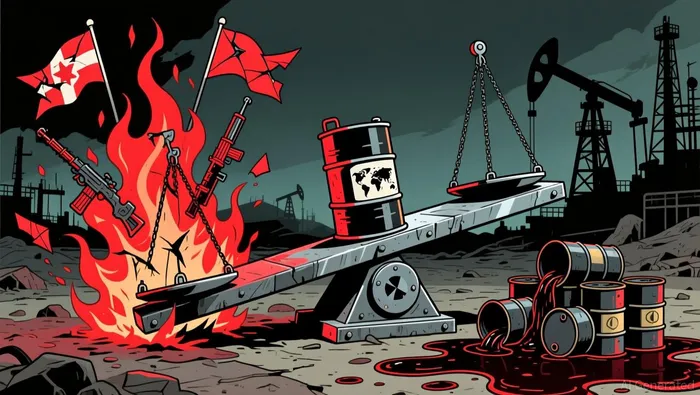
Yet geopolitical risks continue to inject uncertainty. For instance, U.S. sanctions on Russian oil companies and supply disruptions in Venezuela briefly pushed prices higher in late 2025. Similarly, the targeting of Russian-flagged vessels in the Caspian Sea has raised risk premiums, even as broader market fundamentals remain weak. These events underscore a key truth: while oversupply dominates the long-term outlook, short-term geopolitical shocks can still create sharp price swings.
The Oversupply Conundrum
The structural bear case for oil is reinforced by the IEA's projection that global supply capacity will reach 114.7 mb/d by 2030, far exceeding the anticipated demand plateau of 105.5 mb/d. This imbalance is compounded by OPEC+'s decision to increase production targets, which has drawn criticism from market analysts. "The cartel's strategy seems to prioritize short-term revenue over market stability," notes a Principal Asset Management report, highlighting how oversupply risks are overshadowing geopolitical-driven price spikes.
Non-OPEC+ producers are also contributing to the surplus. U.S. shale output, for example, has rebounded to pre-pandemic levels, while Brazil and Canada have expanded offshore and oil sands projects, respectively according to World Bank analysis. These developments suggest that even if geopolitical tensions escalate, the market's structural weaknesses will likely dominate.
Geopolitical Risks: A Double-Edged Sword
While geopolitical events can temporarily lift prices, their impact is often muted by the broader oversupply context. For example, the U.S.-Venezuela standoff in late 2025 caused a brief spike in oil prices, but the effect was short-lived as inventories continued to rise and demand growth faltered. Similarly, the Russia-Ukraine peace process has introduced volatility into energy markets, with investors bracing for potential disruptions in transit routes for Russian oil.
However, a McKinsey analysis warns that any escalation in conflicts-such as the ongoing Israel-Iran tensions-could disrupt supply chains and trigger sudden price spikes, even in a structurally weak market. This duality creates a challenging environment for investors, who must hedge against both persistent bearish trends and the unpredictable nature of geopolitical shocks.
Investment Strategies for a Fractured Market
Given these dynamics, investors should adopt a nuanced approach. First, prioritize energy companies with strong operational resilience and disciplined capital management. Firms that can generate free cash flow despite low oil prices-such as those with integrated operations or low production costs-are better positioned to weather the oversupply-driven downturn according to Principal Asset Management analysis.
Second, diversify exposure to mitigate geopolitical risks. While short-term volatility can be lucrative, over-reliance on oil beta (price sensitivity) is perilous in a market where geopolitical events often fail to offset structural weaknesses. Instead, consider energy transition plays or companies with diversified revenue streams, such as those investing in renewable energy or hydrogen infrastructure as IEA reports show.
Third, monitor inventory levels and OPEC+ policy shifts. The IEA's forecast of a growing surplus underscores the importance of tracking production cuts or extensions to the cartel's output agreements. A surprise extension of production cuts could temporarily stabilize prices, offering a tactical entry point for investors.
Conclusion
The 2025 oil market is a battleground between geopolitical volatility and structural oversupply. While short-term shocks can create trading opportunities, the long-term outlook remains bearish. Investors who focus on operational efficiency, diversification, and macroeconomic signals will be best positioned to navigate this fractured landscape. As the IEA and market analysts repeatedly emphasize, the key to success lies in balancing the unpredictable with the inevitable.







Comentarios
Aún no hay comentarios