
Navigating Nike's Turnaround Amid Tariff Pressures and Regional Divergence
Nike Inc. (NKE) finds itself at a crossroads in 2025, grappling with the dual challenges of escalating U.S. tariffs and uneven regional performance. While the company's North American market shows signs of resilience, its Chinese operations continue to struggle amid fierce competition and shifting consumer preferences. For investors, the question is whether Nike's strategic shifts-ranging from supply chain reconfigurations to product innovation-can offset these headwinds and unlock long-term value.
Tariff Pressures: A Persistent Margin Drag
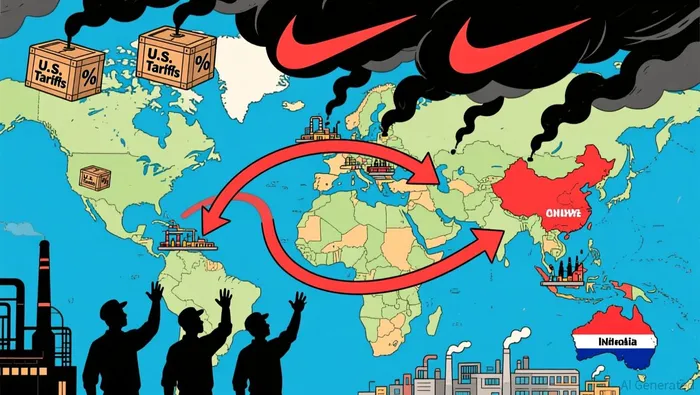
The most immediate threat to Nike's profitability remains the U.S. tariffs on imports from China and Vietnam, which are now projected to cost the company $1.5 billion annually. This has led to a sharp decline in gross margins, with the Q4 2025 report showing a 300-basis-point drop, consistent with the prior quarter. The impact is particularly acute for footwear production, as nearly half of Nike's shoes are still manufactured in Vietnam, a country now subject to higher tariffs.
To mitigate these costs, NikeNKE-- has accelerated a shift in its manufacturing footprint, aiming to reduce U.S.-bound footwear imports from China to the "high single-digit range" by fiscal 2026. This involves diversifying production to lower-cost, lower-tariff regions like Indonesia and Cambodia. Additionally, the company has announced a "surgical price increase" in the U.S., beginning in fall 2025, to pass on some of these costs to consumers without eroding brand equity.
Regional Divergence: North America's Resilience vs. China's Struggles
Nike's regional performance has diverged sharply. North America, its largest market, reported a 9% revenue increase in Q2 2026, driven by strong demand in running, basketball, and training categories. This growth is partly attributed to a strategic realignment with wholesale partners, reducing reliance on deep discounting and stabilizing full-price sales.
In contrast, Greater China remains a persistent drag, with sales declining 17% year-over-year in Q2 2026. Local competitors like Anta and Li-Ning have gained market share, while economic headwinds and a saturated retail landscape have weakened consumer demand. Nike's CEO, Elliott Hill, has acknowledged that progress in China is "not happening at the desired pace," signaling a long-term challenge. The company is now focusing on refining product assortments in key cities like Beijing and Shanghai and reducing inventory of slow-moving items.
Supply Chain and Operational Shifts: Building Resilience
Nike's response to these challenges extends beyond tariffs and regional strategies. The company is investing heavily in supply chain resilience, leveraging AI-powered forecasting and enterprise resource planning (ERP) systems to improve inventory management. It has also expanded regional service centers to shorten delivery times and reduce transportation costs.
Inventory management remains a priority, particularly in North America, where Nike has accelerated the clearance of older styles like Air Force 1 and Air Jordan 1. This has helped reduce inventory levels but has also contributed to margin compression in the short term.
Long-Term Strategic Initiatives: Innovation and Rebranding
Nike's "Sports Offense" model, which reorganizes product teams by sport rather than by demographic, has shown early promise. The running category, for instance, saw over 20% growth in the latest quarter. This approach aims to deepen connections with athletes and sports communities, a departure from the brand's previous focus on lifestyle and gender-specific lines.
The company is also revitalizing its wholesale relationships, including the launch of a Nike Brand store on Amazon and refreshed in-store experiences. These efforts are designed to reengage consumers while maintaining premium pricing. However, the transition to a more sports-centric brand requires significant investment and time, as management has warned.
Assessing Long-Term Value
For investors, the key question is whether Nike's current strategies can overcome its short-term margin pressures and regional imbalances. The North American market's recovery and the potential for a marketing boost during the 2026 World Cup offer optimism. However, the path to sustained profitability remains uncertain, particularly in China, where structural market issues persist.
Nike's ability to absorb tariff costs through pricing and supply chain shifts will be critical. While the company's gross margin is expected to remain under pressure in the near term, its long-term investments in innovation, operational efficiency, and regional diversification could position it for a more resilient future.
In the end, Nike's turnaround hinges on its capacity to balance immediate challenges with strategic reinvention-a test of its ability to adapt in an increasingly fragmented global market.





Comentarios
Aún no hay comentarios