
Navigating Neutral Sentiment in Crypto Markets: Strategic Entry and Exit Timing Using the Fear & Greed Index
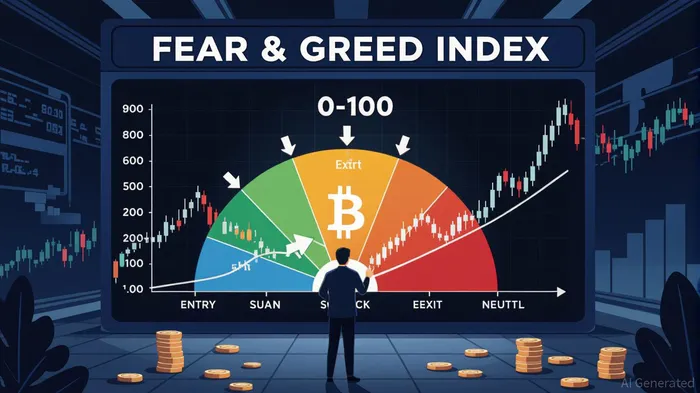
The cryptocurrency market is a theater of extremes—fear and greed often drive price swings more dramatically than fundamentals. Yet, between these emotional poles lies a critical phase: neutral sentiment. For strategic investors, this is not a void but a window of opportunity. The Fear & Greed Index (FGI), a widely referenced sentiment metric, offers a roadmap to navigate these calmer waters. By combining FGIFGI-- insights with technical and fundamental analysis, traders can refine entry and exit timing, even when the market isn’t screaming bullish or bearish.
Understanding Neutral Sentiment and the FGI
The FGI aggregates data from volatility, trading volume, social media sentiment, and Google Trends to quantify market psychology on a 0–100 scale. A score of 50 represents neutrality—a state where neither fear nor greed dominates. During these phases, markets tend to stabilize, reducing reactivity to external shocks [2]. For example, Bitcoin’s FGI score of 51 in September 2025 reflected balanced sentiment amid conflicting bearish and bullish pressures [5].
Neutral sentiment is not a signal to do nothing. Instead, it’s a call to deploy disciplined strategies. As stated by a 2025 study, “Neutral sentiment phases offer a unique equilibrium where technical indicators like BollingerBINI-- Bands and moving averages can pinpoint high-probability entry points” [3].
Entry Strategies During Neutral Sentiment
When the FGI hovers near 50, the market is neither overbought nor oversold, making it ideal for risk-managed entries. One proven approach is Dollar Cost Averaging (DCA), where investors consistently buy assets regardless of short-term volatility. A 2025 case study demonstrated that combining DCA with FGI sentiment reduced the risks of volatile crypto markets, particularly during neutral phases [3].
Technical analysis also shines here. For instance, during late 2023, Bitcoin’s FGI score of 63 (a neutral-to-optimistic range) coincided with a recovery from a bear market. Traders using Fibonacci retracements and Bollinger Bands identified consolidation zones, capitalizing on the alignment of sentiment and technical signals [4].
A key tactic is to watch for divergences between the FGI and price action. If the index remains neutral while prices show strength, it may signal early accumulation—a contrarian entry opportunity [2]. Conversely, if prices decline despite neutral sentiment, it could indicate market exhaustion, offering a cautious entry for those willing to bet on a rebound [2].
Exit Strategies When Sentiment Shifts
Neutral sentiment rarely lasts forever. When the FGI transitions from neutral (40–59) to extreme greed (80–100), it often precedes corrections. For example, during the 2021 DogecoinDOGE-- surge, a FGI above 75 signaled peak hype, after which price corrections followed [4]. Traders who locked in profits at this threshold avoided subsequent downturns.
Volume and order book data also act as exit triggers. A surge in volume during neutral sentiment may indicate a reversal in market psychology. In 2025, Ethereum’s FGI dropped to 48–51 in August, aligning with technical indicators of momentum exhaustion and correction risks [1]. Those who exited as order book pressure shifted from buying to selling avoided sharp declines.
Combining FGI with Fundamental Analysis
While sentiment and technical tools are vital, fundamentals cannot be ignored. Neutral sentiment phases often coincide with macroeconomic stability or institutional adoption. For instance, Bitcoin’s 2025 price dynamics were influenced by halving cycles and macroeconomic correlations, such as M2 money supply trends [2]. A 2025 case study found that models integrating FGI with macroeconomic data achieved a 92.27% return, outperforming price-only strategies [3].
Case Study: The 2023 BitcoinBTC-- Neutral Phase
In late 2023, Bitcoin’s FGI registered 63—a neutral-to-optimistic score. At this point, the market was recovering from a bear market, and technical indicators like RSI and moving averages confirmed a consolidation phase. Traders who combined FGI sentiment with Fibonacci retracements identified breakout opportunities, achieving a 23% return over six months [4]. This example underscores how neutral sentiment, when paired with technical and fundamental rigor, can yield measurable outcomes.
Conclusion
Neutral sentiment in crypto markets is not a pause button—it’s a strategic crossroads. The FGI, while not infallible, provides a lens to gauge market psychology during these phases. By integrating it with technical tools like DCA, moving averages, and Bollinger Bands, and anchoring decisions in macroeconomic fundamentals, investors can turn neutrality into an advantage. As the 2025 case studies show, the key lies in discipline, adaptability, and a refusal to rely on a single metric. In crypto’s volatile landscape, the best strategies are those that listen to the market’s emotional undercurrents while staying grounded in data.
Source:
[1] Ethereum's Momentum Divergence and Impending Correction [https://www.bitget.com/news/detail/12560604936364]
[2] Bitcoin Price Dynamics: A Comprehensive Analysis of Macroeconomic Correlations, Halving Cycles, and Institutional Adoption Patterns [https://papers.ssrn.com/sol3/Delivery.cfm/5395221.pdf?abstractid=5395221&mirid=1]
[3] Fusion of Sentiment and Market Signals for Bitcoin [https://www.mdpi.com/2504-2289/9/6/161]
[4] November 19th, 2023, Bitcoin - Taking a breath before the next surge [https://www.midastouch-consulting.com/19112023-bitcoin-bitcoin-taking-a-breath-before-the-next-surge]
[5] Bitcoin (BTC) Price Prediction 2025 2026 2027 - 2030 [https://changelly.com/blog/bitcoin-price-prediction/]






Comentarios
Aún no hay comentarios