
Navigating the U.S. Natural Gas Market: Short-Term Opportunities Amid Production and Inventory Shifts
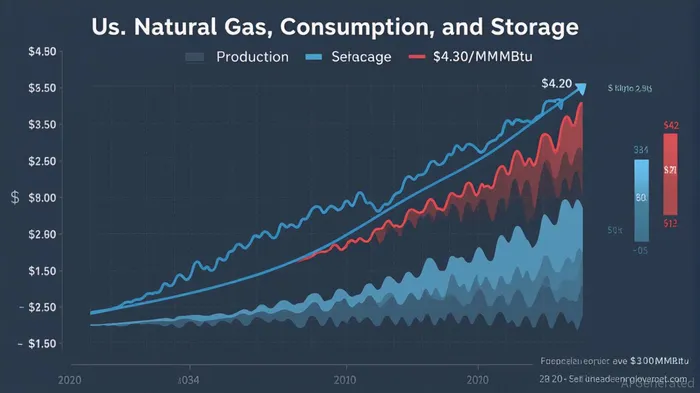
The U.S. natural gas market is at a pivotal juncture, shaped by a confluence of record production, shifting consumption patterns, and inventory dynamics that are creating both volatility and opportunity for short-term traders. As the Energy Information Administration (EIA) forecasts 2025 consumption to hit a record 91.4 billion cubic feet per day (Bcf/d)—driven by a polar vortex in early 2025 and a surge in industrial demand—investors must parse the interplay between supply resilience and demand elasticity to identify actionable trades [1].
Production Resilience and the LNG Export Tailwind
U.S. natural gas production in Q2 2025 averaged 108 Bcf/d, a record high fueled by output growth in the Permian, Haynesville, and Appalachia basins [2]. Despite this, prices at the Henry Hub averaged just $3.20 per million British thermal units (MMBtu), reflecting oversupply concerns. However, the EIA now forecasts a tightening of market balances in the second half of 2025, with prices climbing to $3.90/MMBtu by Q4 and $4.30/MMBtu in 2026. This upward trajectory is underpinned by two key factors: flat production growth and a surge in liquefied natural gas (LNG) exports.
Rising LNG demand from Europe and Asia—amid geopolitical tensions and energy transition pressures—has become a critical tailwind. According to a report by S&P Global Commodity Insights, U.S. LNG exports are tightening global market balances, with emerging demand from data centers and AI infrastructure in Texas and Virginia further boosting electricity generation needs [5]. This dual demand driver—traditional industrial use and digital infrastructure—creates a compelling case for short-term traders to position for price resilience, particularly as production growth slows due to operator focus on capital efficiency [2].
Inventory Dynamics: A Buffer or a Liability?
Natural gas storage levels in the Lower 48 states reached 2,953 billion cubic feet (Bcf) by late June 2025, 6% above the five-year average but 176 Bcf below the same period in 2024 [4]. This “comfortable buffer” has historically provided a cushion against price spikes, but traders must now weigh the risk of a rapid drawdown as summer heatwaves strain electricity grids. By August 22, 2025, storage levels had climbed to 18 Bcf—a 38.46% weekly increase—though this remains 48.57% below 2024 levels [4].
The EIA’s revised Q3 2025 Henry Hub price forecast of $4.01/MMBtu—down from earlier estimates—reflects the tension between record production and seasonal demand volatility [3]. Traders could exploit this dislocation by hedging against short-term price dips, particularly if production remains near record highs while storage injections slow ahead of winter.
Strategic Entry Points for Short-Term Traders
- LNG Export-Driven Arbitrage: With U.S. LNG terminals operating at near-capacity utilization, traders could capitalize on price differentials between Henry Hub and global hubs like TTF (TTF) in Europe. A 30% year-over-year increase in U.S. LNG exports to Europe, as noted by the EIA, suggests a window for cross-border arbitrage [5].
- Inventory-Linked Options: Given the EIA’s projection of a 1% consumption decline in 2026 due to milder winters, short-term options on storage levels could hedge against overbought conditions. Traders might also target calendar spreads, betting on a Q4 2025 price surge as storage buffers deplete [1].
- Demand-Sector Bets: The shift in electric power generation from natural gas to renewables has reduced its sectoral share, but emerging demand from AI infrastructure—particularly in Texas—offers a new growth vector. Traders could overweight regional futures in hubs like Houston, where data center expansion is accelerating [4].
Conclusion: A Market in Transition
The U.S. natural gas market is navigating a delicate balance between production resilience and demand diversification. While record output has kept prices anchored in the short term, the interplay of LNG exports, AI-driven electricity demand, and seasonal inventory fluctuations creates a fertile ground for tactical trading. As the EIA’s forecasts suggest, the path to $4.30/MMBtu in 2026 hinges on disciplined production and a sustained export boom—factors that traders can now begin to price in with confidence.
Source:
[1] EIA expects record U.S. natural gas consumption in 2025 [https://www.eia.gov/todayinenergy/detail.php?id=65984]
[2] Short-Term Energy Outlook: Natural Gas [https://www.eia.gov/outlooks/steo/report/natgas.php]
[3] Nat-Gas Prices Climb On Forecasts For Hotter US Weather [https://www.barchart.com/story/news/34577810/nat-gas-prices-climb-on-forecasts-for-hotter-us-weather]
[4] US Natural Gas - Overview as of 07/03/2025 [https://www.energycentral.com/fossil-thermal/post/us-natural-gas---overview-as-of-07-03-2025-FYlz1vY7fxrvUU2]
[5] US EIA's short-term outlook finds that natural gas demand is outpacing supply [https://www.spglobal.com/commodity-insights/en/news-research/latest-news/natural-gas/061025-us-eias-short-term-outlook-finds-that-natural-gas-demand-is-outpacing-supply]







Comentarios
Aún no hay comentarios