
Navigating the Nasdaq 100's Elliott Wave Dynamics Amid the Fed's December Rate Decision
The Nasdaq 100 (NDX) is at a critical juncture as it navigates a sub-minuette Wave 4 correction within a broader Elliott Wave structure, while the Federal Reserve's December 2025 rate decision looms as a pivotal macroeconomic catalyst. This analysis synthesizes technical Elliott Wave dynamics, Fibonacci retracement levels, and monetary policy expectations to identify strategic entry points for near-term positioning, emphasizing risk-reward balance and volatility-driven opportunities.
Elliott Wave Structure and Fibonacci Levels: A Technical Framework
According to a report by FXStreet, the NDX is currently in a sub-minuette Wave 4 correction following a five-wave impulse move upward, peaking at 26,182 on October 29, 2025. The index has since fallen below the critical level of 24,652, signaling the potential start of a larger W-4 correction. The ideal target zone for this correction is estimated at 23,000–24,000, with a weekly close below 24,000 increasing the probability of a prolonged decline to 20,500–22,800.
The corrective phase has unfolded as a double three structure-a complex pattern in Elliott Wave theory-comprising waves ((a)), ((b)), and ((c)). Notably, the index has held key Fibonacci support at 24,200/24,000, aligning with the 38.2% and 61.8% retracement levels of the prior move. This area has become a critical battleground for bulls, with the 50-day moving average at 24,761.72 providing additional support.
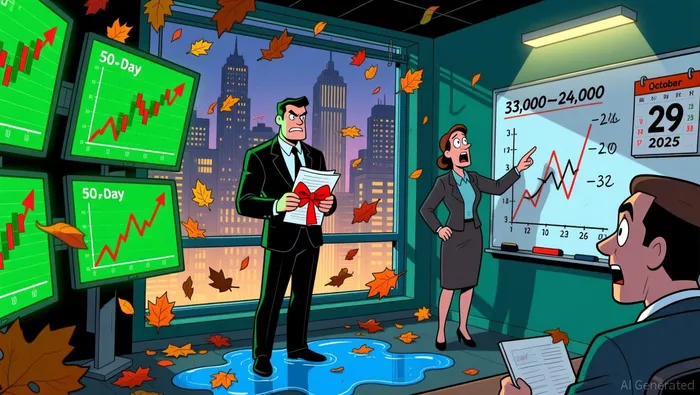
Elliott Wave Theory dictates that Wave 4 typically retraces less than 38.2% of Wave 3 and must not overlap with Wave 1's price territory. The current pullback, characterized by a zigzag pattern, adheres to this rule, suggesting a potential resolution to the upside if the index stabilizes above 24,000. Traders are advised to monitor this level closely, as a rebound could confirm the completion of Wave 4 and initiate Wave 5, targeting the 26,700 level-a key Fibonacci extension of the broader uptrend. This analysis supports this view.
Fed Policy and Macroeconomic Timing: A Catalyst for Volatility
The Federal Reserve's December 2025 rate decision is poised to amplify market volatility, with investors pricing in an 89.6% probability of a 25-basis-point rate cut, bringing the federal funds rate to 3.50%-3.75%. This decision, driven by dovish FOMC members like John Williams and Christopher Waller, aims to address labor market concerns while hawkish voices like Susan Collins advocate caution.
According to market analysis, a rate cut would likely bolster the Nasdaq 100, as lower interest rates reduce borrowing costs and enhance valuations for growth-oriented tech stocks. However, the ultimate impact hinges on the Fed's forward guidance. A dovish tilt signaling additional cuts could propel the NDX toward 26,700, aligning with the 161.8% Fibonacci extension of the October uptrend. Conversely, a hawkish surprise-such as a delay in rate cuts could deepen the correction, testing the 23,000–24,000 support zone.
Strategic Entry Points: Balancing Technical and Macro Signals
The interplay of Elliott Wave dynamics and Fed policy expectations creates high-probability entry points for near-term positioning. If the NDX holds above 24,000, it could signal the end of Wave 4, with Wave 5 targeting 26,700. A low-risk entry for swing traders emerges around 23,854, where the index recently bottomed within the 23,000–24,000 target range.
Key resistance levels at 25,720 and 25,890 should be monitored, as a breakout above these could accelerate the final leg of Wave 5. Conversely, a close below 24,000 would increase the likelihood of a deeper correction to 20,500–22,800, offering contrarian entry opportunities for long-term investors.
The December Fed meeting adds a layer of volatility, with the VIX index already spiking 10% ahead of the decision. Traders should prioritize risk management by using stop-loss orders below 24,000 and scaling into positions as the index tests key Fibonacci levels.
Conclusion: A Confluence of Technical and Macro Forces
The Nasdaq 100's trajectory in December 2025 hinges on the resolution of its sub-minuette Wave 4 correction and the Fed's policy response. A technical setup favoring a rebound above 24,000, combined with a dovish rate cut, could catalyze a surge toward 26,700. Conversely, a hawkish Fed or a breakdown below 24,000 may prolong the correction. By aligning Elliott Wave analysis with macroeconomic timing, investors can navigate this pivotal period with a disciplined, high-probability strategy.







Comentarios
Aún no hay comentarios