
Navigating Mortgage Rate Volatility: Real Estate's Resurgence as a Yield Powerhouse
The U.S. housing market is in the throes of a seismic shift. Mortgage rates have swung like a pendulum between 6% and 7% in 2025, driven by a cocktail of inflation, geopolitical tensions, and the Federal Reserve's cautious dance with rate cuts. For investors, this volatility isn't just noise—it's a signal. The Fed's messaging, combined with shifting investor psychology, is reshaping real estate as a compelling alternative to traditional fixed-income assets. Let's break it down.
Central Bank Signaling: The Unseen Hand in Housing
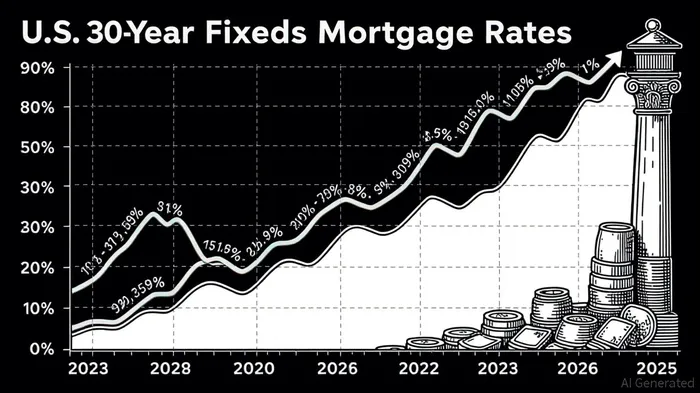
The Federal Reserve's 2025 playbook has been one of restraint. Despite projecting four 25-basis-point cuts by year-end, the Fed has kept the 10-year Treasury yield stubbornly above 3.9%, ensuring mortgage rates remain anchored in the 6.5%–7% range. reveals a pattern: rates peaked at 7.79% in October 2023, dipped to 6.2% in September 2024, and rebounded to 7% in early 2025. This volatility isn't random—it's a reflection of the Fed's dual mandate to balance inflation control with economic growth.
Here's the kicker: the Fed doesn't set mortgage rates. It influences them. By signaling its intent to cut rates, the Fed has created a tug-of-war between long-term bond yields and short-term policy. Investors are reading the tea leaves. When the Fed hints at easing, Treasury yields dip, and mortgage rates follow—briefly. But when inflation data surprises to the upside or Trump's tariff threats resurface, rates spike again. This uncertainty has made real estate a magnet for capital seeking stability.
Investor Psychology: From Panic to Prudence
The housing market's “lock-in effect” is a textbook case of behavioral economics. With 80% of homeowners underwater on their mortgages, selling is a nonstarter. This has starved the market of inventory, pushing home prices up 3% in 2025 despite high rates. tells a different story: while Treasuries yield 3.9%, multifamily real estate funds like the IncomePlus Fund are delivering 6.5% pre-tax distributions.
Investors are catching on. Deloitte's 2025 survey shows 88% of real estate executives now expect revenue growth—a 180-degree turn from 2023 pessimism. Why? The Fed's pause on rate hikes has given commercial real estate a breather. Cap rates have stabilized, and sectors like industrial, auto service, and convenience retail are thriving. For example, car washes are growing at 5.7% annually, fueled by subscription models and digital payments.
Real Estate as the New Yield Play
The math is simple: real estate outperforms bonds. Take the IncomePlus Fund, which targets Sunbelt multifamily markets. Its 6.5% yield, after tax advantages and depreciation shielding, translates to a real return of 4.27%—versus 0.42% for Treasuries. shows why. During the Great Recession, multifamily occupancy stayed above 90%, while the S&P 500 cratered. Today's environment, with projected rate cuts and supply chain bottlenecks, is a mirror image.
But it's not just about yield. Real estate is a hedge against inflation and a buffer against bond market fragility. As the Fed tightens, corporate bonds are underperforming. The MSACBY index yields 5.25%, but after taxes, it's a paltry 3.3%. Meanwhile, multifamily properties in high-growth Sunbelt cities are appreciating at 4%–5% annually. For investors, this is a no-brainer.
The Road Ahead: Strategy and Caution
So, what's the takeaway? First, real estate—particularly multifamily—is a must-have in any yield-focused portfolio. Second, private equity and REITs are staging a comeback. J.P. Morgan notes that REITs deployed $180 billion in Q4 2024, a sign of confidence. Third, don't ignore the risks. Trump's immigration policies could dampen demand, and construction delays from tariffs might prolong supply constraints.
For the average investor, the path is clear:
1. Diversify into high-quality multifamily assets in Sunbelt markets (e.g., Austin, Phoenix, Raleigh).
2. Leverage tax-advantaged structures like the IncomePlus Fund to maximize after-tax returns.
3. Stay nimble—monitor Fed signals and regional housing trends.
The housing market isn't just surviving mortgage rate volatility—it's thriving. As the Fed's playbook evolves and investor psychology shifts, real estate is proving to be the ultimate alternative yield play. The question isn't whether to invest—it's how to do it smartly.







Comentarios
Aún no hay comentarios