
Navigating Metal Market Volatility Amid US Data Delays and Fed Uncertainty
The Data Delay Dilemma
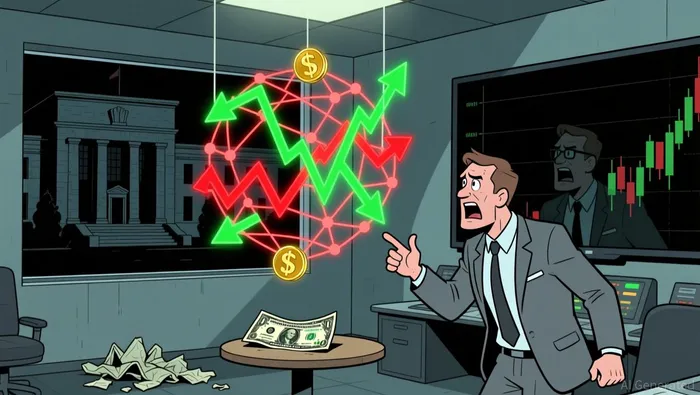
The recent government reopening briefly reignited hopes of fresh economic data that might justify a Federal Reserve rate cut in December 2025 according to energy news sources. However, the optimism was short-lived. Fed officials, including Cleveland President Beth Hammack, have doubled down on a "somewhat restrictive" policy stance, arguing that inflation remains stubbornly above the 2% target at 3%. This hawkish pivot, coupled with delayed data releases, has left markets in a state of flux.
The consequences are palpable. Gold, for instance, surged to over $4,200 per ounce midweek before retreating to $4,080 by the close of the week. Silver, meanwhile, saw a 10% spike driven by a "gamma squeeze" in thin markets according to market analysis. These sharp swings underscore how delayed data erodes clarity, amplifying volatility in assets perceived as safe havens.
Strategic Positioning in Precious Metals
Investors are recalibrating their strategies to account for this volatility. Gold, long a barometer of systemic risk, has become a cornerstone for portfolios seeking protection against currency devaluation and geopolitical tensions. Central banks, too, are playing a role: their net purchasing of gold has bolstered long-term price resilience.
Yet the calculus is not one-dimensional. Silver's performance highlights the interplay between speculative trading and macroeconomic expectations. As Daniel Ghali of TD Securities notes, reduced liquidity and over-the-counter trading volumes have created "sharp price movements" in silver. This dynamic suggests that while gold remains a strategic asset, silver's volatility demands a more nuanced approach.
Risk Management in a Policy Vacuum
The Federal Reserve's admission of uncertainty-under Chair Jerome Powell-has forced investors to adopt diversified strategies. Diversification here means more than spreading capital across gold and silver; it involves hedging against the dollar's strength, which often inversely correlates with gold prices.
Dollar-cost averaging and strategic allocation across time horizons are increasingly recommended to mitigate the risks of market timing according to financial analysts. For instance, a Gold IRA offers tax advantages and professional storage, making it a compelling option for long-term wealth preservation. These tools help investors navigate the unpredictability of Fed policy while maintaining exposure to hard assets.
The Road Ahead
The Federal Reserve's standing repo facility discussions with Wall Street firms reveal its ongoing efforts to manage liquidity amid tighter financial conditions. Yet, as Cleveland Fed's Hammack emphasized, policy must remain "barely restrictive" to curb inflation according to Fed officials. This balancing act will likely prolong the uncertainty that drives precious metals demand.
For investors, the lesson is clear: in an era of fiscal dominance and policy ambiguity, precious metals are not just hedges-they are strategic assets. As one expert put it, "The debasement trade is broadening across metals" according to market insights. The challenge lies in navigating the volatility while staying positioned for the inevitable recalibration of global markets.







Comentarios
Aún no hay comentarios