
Navigating the Merz-Trump Trade Truce: Opportunities in a Volatile Cross-Atlantic Landscape
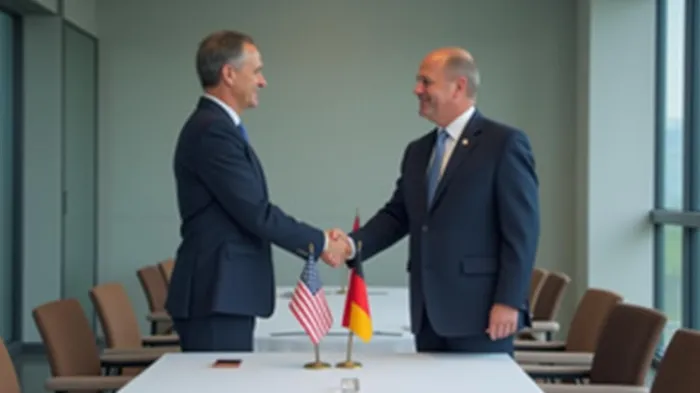
The transatlantic trade relationship between Germany and the U.S. has long been a cornerstone of global economic stability. Now, as German Chancellor Friedrich Merz and U.S. President Donald Trump signal a rare alignment on de-escalating trade tensions, investors face a critical question: Can this fragile truce translate into tangible opportunities—or is it a fleeting pause before the next storm?
The Stakes: A Recession-Strained Economy and a July Deadline
Germany’s economy, driven by exports, has been in recession for over two years, with U.S. tariffs on automotive and industrial goods compounding the pain. The July 9, 2025, deadline looms large: if tariffs on European goods (including Germany) are reinstated after this date, baseline rates of 20% could surge to 25% for autos, 200% for alcohol, and 20% for general goods. The reflects this anxiety, dropping 18% as tariffs on its $30 billion-a-year U.S. market loomed. Meanwhile, the broader German DAX index has stagnated, underscoring investor uncertainty.
Sectors in the Crosshairs
- Automotive & Manufacturing: U.S. tariffs on non-USMCA-compliant vehicles (e.g., German-made BMWs, Mercedes) are already at 25%, squeezing margins. A successful trade deal could lift these stocks, but failure could trigger a downward spiral.
- Steel & Aluminum: U.S. Section 232 tariffs (25%) on EU imports remain in force, with U.S. producers like NucorNUE-- (NUE) benefiting. A free trade deal might erode this advantage, but short-term relief could stabilize European steel stocks like ThyssenKrupp.
- Technology & Electronics: Exemptions for critical minerals and semiconductors under recent tariff rules offer a lifeline. However, U.S. threats over digital services taxes (DSTs) could reignite tensions—keep an eye on .
The Geopolitical Undercurrents
While Merz seeks a free trade agreement to stabilize growth, his coalition’s 52% parliamentary majority leaves little room for maneuver. Domestic far-right gains, amplified by Trump’s support for Germany’s AfD party, threaten to derail negotiations. Meanwhile, Trump’s unilateralism—such as sidelining Germany in Ukraine peace talks—has spurred Merz’s push for European defense autonomy. This could boost defense stocks like Rheinmetall (RIAGF) or Airbus (AIR.PA), as Europe invests in military self-reliance.
Investment Takeaways
- Buy the Dip, but Set Alerts: Short-term trade truces may lift automotive and industrial stocks. However, monitor the July 9 tariff deadline closely— show how quickly penalties can escalate.
- Hedge with U.S. Producers: If tariffs persist, U.S. firms like Nucor (NUE) or Ford (F) (exposed to Canadian/Mexican supply chains) could outperform.
- Look Beyond the Auto Sector: Germany’s tech firms (e.g., SAP, Siemens) and renewable energy plays (NextEra Energy, Vestas) offer diversification against trade volatility.
Conclusion: A Delicate Balancing Act
The Merz-Trump trade talks are a high-stakes game of geopolitical poker. If the July 9 deadline passes without renewed tariffs, equity markets could rebound—Germany’s GDP growth hinge on this outcome. However, the path to a lasting deal is fraught with Merz’s domestic instability and Trump’s protectionist instincts. Investors should prioritize agility: overweight defensive sectors (healthcare, utilities) while positioning for a rebound in autos and industrials if a deal emerges. As history shows, trade wars are rarely won—they’re often just paused. Stay vigilant, and let data—not headlines—guide your bets.







Comentarios
Aún no hay comentarios