
Navigating Market Volatility and Positioning for Rebound: Strategic Insights Ahead of Key U.S. Employment Data
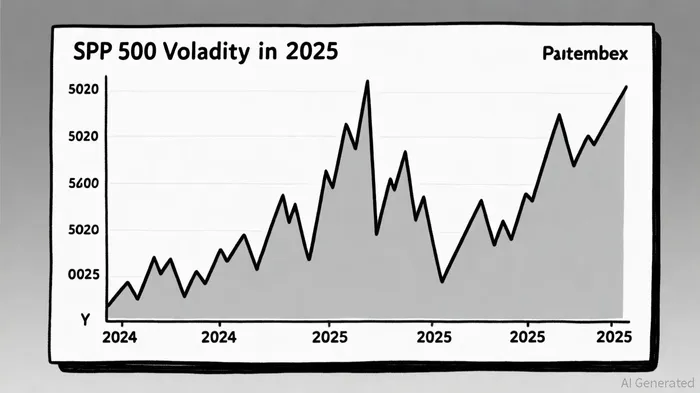
The U.S. equity market in 2025 has been a study in contrasts. Major indices like the S&P 500, Dow Jones, and Nasdaq have alternated between record-breaking rallies and sharp corrections, reflecting a tug-of-war between optimism over artificial intelligence (AI) and economic uncertainty. From late 2024 through September 2025, the S&P 500 notched 28 record closes, with all three indices achieving three consecutive days of all-time highs by late September 2025[1]. However, this momentum was disrupted by a 4.1% plunge on April 1, 2025, and a 14.4% correction in the Nasdaq from its peak[3]. These swings underscore the fragility of market sentiment amid conflicting signals from corporate earnings, monetary policy, and valuation concerns.
The Interplay of Drivers: AI, Earnings, and Policy
The recent volatility has been fueled by a potent mix of factors. Optimism around AI-driven productivity gains and strong corporate earnings—particularly in technology and healthcare—has driven inflows into growth stocks[1]. Meanwhile, the Federal Reserve's rate-cut cycle, initiated in late 2024, has provided a tailwind for equities. Yet, these positives are counterbalanced by profit-taking, elevated valuations, and lingering fears of a U.S. recession[5]. For instance, the S&P 500's 3.2% single-session drop in February 2025 reflected anxieties over trade policy shifts and economic slowdowns[5].
The labor market, a critical barometer for both equity valuations and macroeconomic health, has added another layer of complexity. By December 2024, the unemployment rate stabilized at 4.1%, with labor force participation rising to 62.7%[1]. Sectors like technology, healthcare, and renewable energy have seen robust hiring, driven by demand for AI/ML engineers, cybersecurity specialists, and ESG professionals[1]. However, this strength has not been uniform. The July 2025 employment report, which showed a mere 73,000 jobs added, hinted at a softening labor market, raising questions about the sustainability of corporate earnings and consumer spending[1].
Positioning for Rebound: Lessons from History and Strategy
Investors seeking to position for a potential rebound ahead of key employment data releases must balance caution with opportunity. Historical patterns suggest that market corrections often precede rebounds when fundamentals align. For example, the 1987 Black Monday crash was followed by a swift recovery as central banks injected liquidity[3]. Similarly, the 2020 pandemic-induced selloff gave way to a rapid rebound fueled by fiscal stimulus and monetary easing[3].
In 2025, the upcoming April employment data release on May 2, 2025, will be pivotal. A strong report could reinforce the case for continued Fed rate cuts, while a weak one might accelerate policy easing. Investors should consider strategies that hedge against both scenarios. Defensive sectors like utilities and consumer staples, which historically perform well during uncertainty, could offer downside protection[1]. Conversely, sectors poised to benefit from AI adoption—such as cloud computing and semiconductors—remain compelling long-term plays[1].
Risk management must also account for the interplay between labor market data and broader economic indicators. For instance, wage growth of 3.9% year-over-year in July 2025, while modest, suggests inflationary pressures that could delay rate cuts[1]. Similarly, Trump-era tariff policies have introduced volatility into trade relations, affecting supply chains and corporate margins[1]. Diversification across geographies and asset classes—such as Treasury bonds or gold—can mitigate these risks[4].
The Path Forward: Balancing Caution and Opportunity
The current environment demands a nuanced approach. While the S&P 500's valuation multiples remain elevated, the resilience of the labor market and AI-driven productivity gains provide a foundation for long-term optimism. However, short-term volatility is likely to persist, particularly as investors digest upcoming employment data and assess the trajectory of Fed policy.
For those positioning for a rebound, a phased entry into equities—using pullbacks as buying opportunities—could be prudent. Additionally, leveraging tools like AI-driven analytics to monitor labor market trends and sector-specific demand shifts can enhance decision-making[2]. As history shows, markets often rebound when pessimism overshoots fundamentals, but timing requires discipline and a clear-eyed assessment of risks.
In conclusion, the path to navigating 2025's market volatility lies in aligning strategic positioning with macroeconomic signals. By combining defensive positioning, sectoral selectivity, and proactive risk management, investors can weather near-term turbulence while capitalizing on the next phase of growth.







Comentarios
Aún no hay comentarios