
Navigating Market Volatility: Lessons from October 2025's Wall Street Whiplash
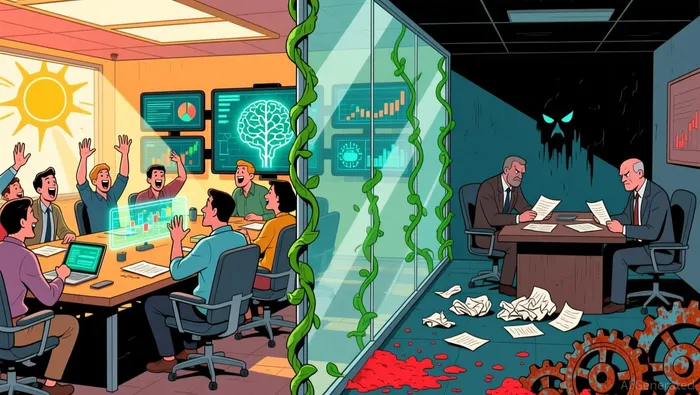
October 2025 will be remembered as a month of extremes for Wall Street, where optimism about artificial intelligence and corporate earnings collided with geopolitical tensions and liquidity strains. The S&P 500 reached record highs amid a 25-basis-point Federal Reserve rate cut, yet the Dow Jones Industrial Average plummeted 3% in response to President Trump's threat of "massive" tariffs on China. This volatility underscored the fragility of markets in an era of unpredictable macroeconomic crosswinds. For investors, the lesson is clear: strategic positioning must now account for a mosaic of risks and opportunities that defy traditional correlations.
The Dual Forces of AI Optimism and Geopolitical Risk
The month began with a sharp selloff triggered by Trump's tariff threats, which sent the VIX volatility index surging 32%. However, the market's resilience emerged as a truce between the U.S. and China-reducing tariffs on semiconductors and energy-spurred a rebound. Meanwhile, AI-driven optimism fueled a rally in tech stocks, with 86.2% of S&P 500 firms exceeding earnings expectations. This duality-geopolitical uncertainty and technological euphoria-created a market environment where megacap stocks and AI names dominated, while industrials and financials lagged.
Goldman Sachs highlighted the Fed's role in shaping this landscape, noting that its "data-dependent" approach and delayed economic data due to a government shutdown heightened uncertainty. The central bank's cautious stance, combined with the U.S.-China trade truce, illustrates how policy and geopolitical developments can rapidly shift market sentiment.
Investor Strategies: Quality, Liquidity, and Hedging
In such an environment, institutional investors and hedge funds adopted defensive strategies. Modern Capital advised a focus on "quality assets with strong balance sheets" and hedging against downside risks. Hedge funds, in particular, demonstrated adaptability: equity-focused funds gained 1.75% in October, with Citadel Tactical Trading and Rokos Capital Management outperforming due to macro strategies according to market analysis. However, systematic funds faced losses in early October from crowded positions and leverage, underscoring the perils of rigid strategies in volatile markets according to recent reports.
 BlackRock and Vanguard emphasized the need to rethink diversification. BlackRock recommended liquid alternatives, digital assets, and short-dated TIPS to navigate unpredictable correlations between stocks and bonds. Vanguard, meanwhile, urged investors to adopt a probabilistic lens, acknowledging that valuations are poor short-term predictors in a low-return environment. These insights reflect a broader shift toward active portfolio management and non-traditional assets.
The Role of Institutional Wisdom
Goldman Sachs and Morgan Stanley provided complementary guidance. GoldmanGS-- stressed the importance of liquidity management amid policy uncertainty, while Morgan Stanley highlighted the growing appeal of municipal bonds for after-tax yield advantages according to market analysis. Hedge funds, too, adapted: multi-strategy platforms outperformed, with Citadel and Rokos leveraging macroeconomic insights to capitalize on volatility according to market analysis.
For individual investors, the takeaway is to prioritize flexibility. As Vanguard noted, "most asset classes are expected to deliver lower returns over the next 10 years compared to previous forecasts," necessitating a focus on downside protection and asymmetric outcomes.
Conclusion: Preparing for the Unpredictable
October 2025's volatility serves as a case study in the new normal: markets are increasingly shaped by AI-driven momentum, geopolitical brinkmanship, and policy ambiguity. Strategic positioning now requires a blend of defensive positioning, liquidity, and active diversification. As BlackRock advised, investors must embrace "alternative and non-traditional assets" to manage risk effectively. In a world where traditional correlations falter, adaptability-rather than rigid adherence to past paradigms-will define long-term success.





Comentarios
Aún no hay comentarios