
Navigating Market Volatility and Investor Psychology Around U.S. Holidays: A Focus on Thanksgiving and Black Friday
Investor Psychology: Behavioral Biases and Market Volatility
The closure of the U.S. stock market on Thanksgiving and the abbreviated session on Black Friday reduce liquidity, often amplifying price swings in thinly traded securities. Behavioral finance research underscores how investor psychology during these periods is shaped by biases such as loss aversion, herd behavior, and overconfidence. For instance, the anticipation of Black Friday sales figures-often viewed as a barometer of consumer spending-can trigger herd behavior, with investors flocking to retail stocks like AmazonAMZN-- (AMZN) or WalmartWMT-- (WMT) in hopes of capitalizing on perceived momentum. Conversely, unmet sales expectations can lead to rapid sell-offs, reflecting loss aversion as investors react to perceived downside risks.
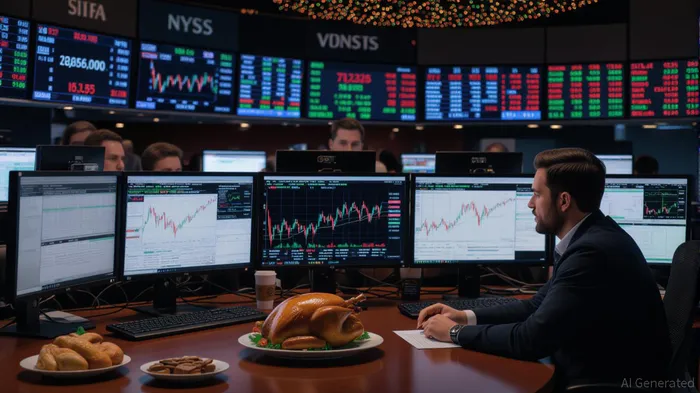
Studies also highlight abnormal volatility during holiday windows, with reduced trading volume exacerbating price fluctuations. This is particularly evident in the consumer discretionary sector, where Black Friday and Cyber Monday spending directly correlate with stock performance. For example, the SPDR S&P Retail ETF (XRT) has historically seen heightened activity during this period, driven by retail investors and algorithmic traders exploiting short-term anomalies.
Strategic Portfolio Adjustments: Leveraging Seasonal Patterns
Historical patterns suggest that Thanksgiving week can offer strategic opportunities for investors. Data from 1928 to 2023 indicates that the S&P 500 has been positive about 60% of the time during the Tuesday-through-Friday period of the holiday week, with the Wednesday before and the half-session on Black Friday showing positive returns over 70% of the time. A backtested strategy of entering a position at the close of Tuesday and exiting at the close of Black Friday has yielded an average gain of 0.51%, while retail stocks have historically outperformed with an average gain of 1.26% during the same period according to analysis.
However, the post-Black Friday period introduces caution. Cyber Monday has historically been a weak day for the Dow, with 63% of instances recording declines and an average drop of 0.40% according to data. Investors may thus prioritize defensive positioning or short-term hedging strategies during this phase. Additionally, the week after Thanksgiving has shown an average gain of 0.66% for the S&P 500, with 69% of post-Black Friday weeks ending positively according to research. This trend aligns with the "Santa Claus rally," suggesting that strong performance during the holiday week can serve as a precursor to year-end optimism.
External Factors: Tariffs, Inflation, and the K-Shaped Recovery
Recent years have introduced new complexities to this seasonal framework. Elevated tariffs and supply chain disruptions have dampened consumer spending, particularly among lower-income households, creating a "K-shaped" economic recovery where wealthier consumers continue to drive retail sales. For example, 2025 has seen the S&P 500 slump amid concerns about tariffs and inflation, despite record-breaking holiday spending projections according to analysis. This divergence highlights the importance of sector-specific adjustments, as investors may overweight stocks in resilient industries (e.g., e-commerce) while underweighting those exposed to discretionary spending.
Conclusion: Balancing Psychology and Strategy
The Thanksgiving and Black Friday period encapsulates the dual forces of investor psychology and strategic adaptability. While historical patterns suggest a modest positive bias for the S&P 500 and retail stocks, external factors like tariffs and inflation necessitate a nuanced approach. Investors must remain cognizant of behavioral biases that amplify volatility while leveraging historical seasonality to refine entry and exit points. As the 2025 holiday season unfolds, the interplay of these dynamics will likely shape both short-term market movements and year-end positioning.







Comentarios
Aún no hay comentarios