
Navigating Market Uncertainty: The Strategic Case for Rebalancing Toward Defensive Assets
In an era marked by geopolitical volatility, inflationary pressures, and shifting monetary policy, investors are increasingly reevaluating their portfolio allocations. The interplay between the S&P 500's recent underperformance and gold's historic surge underscores a critical shift in asset dynamics. From 2023 to 2025, these two assets have exhibited divergent trajectories, offering valuable insights into how market uncertainty reshapes risk management strategies.
The S&P 500 and Gold: A Tale of Two Assets
The S&P 500 and gold have long been viewed as contrasting pillars of investment portfolios. Historically, the S&P 500 has delivered higher average returns over the long term, with $100 invested in 1971 growing to $36,104.55 by 2025 compared to gold's $7,023.46, according to Monetary Metals. However, gold's role as a safe-haven asset becomes pronounced during periods of economic stress. From 1971 to 2024, gold outperformed the S&P 500 in 23 out of 54 years, including eight of the nine years when the index posted negative returns, according to a T. Rowe Price report.
Recent trends amplify this dynamic. In 2024, both assets delivered strong returns-25% for the S&P 500 and 27% for gold-a rare convergence, as the T. Rowe Price report notes. Yet, 2025 has seen a stark divergence: gold surged 14% year-to-date, breaking the $3,000-per-ounce barrier, while the S&P 500 declined by 3.5%, as observed in the T. Rowe Price report. This shift reflects gold's growing appeal as a hedge against inflation, currency devaluation, and geopolitical instability, particularly amid a prolonged U.S. government shutdown and escalating Middle East tensions, the T. Rowe Price report also argues.
Investor Sentiment and the Rise of Safe-Haven Assets
The 2025 surge in gold prices is driven by a complex interplay of factors. Central bank activity has been pivotal: emerging market nations, including China and Russia, have aggressively increased gold reserves to diversify away from the U.S. dollar, per Monetary Metals. Meanwhile, U.S. Treasuries-a traditional safe-haven asset-have lost some of their luster as fiscal policy uncertainty and debt sustainability concerns weigh on their reliability, according to the T. Rowe Price report.
Retail and institutional investors have mirrored this trend. In September 2025 alone, U.S. retail investors poured $247 million into gold ETFs, the largest inflows since 2013, according to T. Rowe Price data. The SPDR Gold Trust (GLD) alone recorded $12.9 billion in inflows for the year, reflecting a broader flight to safety, as noted by Monetary Metals. Silver, too, has benefited, hitting a 14-year high of $48.59 per ounce in 2025, driven by both monetary and industrial demand, according to a Discovery Alert article.
Strategic Rebalancing: Lessons from Institutional Portfolios
The case for rebalancing toward defensive assets is further strengthened by institutional strategies. A 2025 case study by the CFA Institute highlights how a large university endowment adjusted its allocation to maintain a risk profile aligned with long-term goals amid market drift. By incorporating derivatives and tactical overlays, the portfolio preserved liquidity while reducing exposure to volatile equities, as the T. Rowe Price report describes.
Similarly, the Norwegian Sovereign Wealth Fund's approach illustrates the importance of adaptive rebalancing. During recessions, a buy-and-hold strategy outperformed periodic rebalancing, whereas the latter proved more effective in growth phases, according to the T. Rowe Price piece. These examples underscore the need for flexibility in portfolio management, particularly in a risk-averse environment.
Building Resilience: A Framework for Defensive Allocation
For individual investors, systematic rebalancing strategies offer a disciplined approach. T. Rowe Price recommends using tolerance bands-either fixed or relative-to maintain target allocations without overreacting to short-term volatility, as explained in the T. Rowe Price data. For instance, a conservative defensive portfolio might allocate 60% to bonds, 30% to low-beta stocks, and 10% to gold or cash equivalents, a structure that mitigates downside risk while preserving liquidity, per the Discovery Alert article.
Moreover, diversification across geographies and asset classes is critical. J.P. Morgan's 3Q 2025 asset allocation favors ex-U.S. duration (e.g., Italian BTPs, UK Gilts) and high-yield bonds, reflecting a nuanced approach to harvesting relative value amid extended valuations, as observed in the T. Rowe Price report.
Conclusion: A New Paradigm for Risk Management
The 2023–2025 period has redefined the role of defensive assets in portfolio construction. Gold's outperformance, coupled with waning confidence in traditional safe havens like the U.S. dollar, signals a structural shift in investor behavior. As geopolitical tensions and economic fragmentation persist, rebalancing toward assets with low correlation to equities-such as gold, silver, and diversified bonds-will be essential for managing risk.
In this evolving landscape, the strategic case for defensive allocations is not merely about preserving capital but about positioning portfolios to withstand-and potentially benefit from-uncertainty. 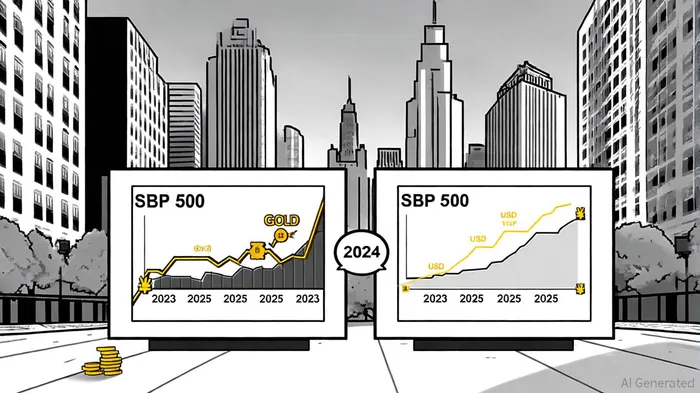







Comentarios
Aún no hay comentarios