
Navigating Market Resilience Amidst Tariff Volatility: A Strategic Rebalance for Q3 2025
The third quarter of 2025 has emerged as a pivotal period for global markets, with the U.S.-China tariff truce and evolving macroeconomic dynamics reshaping investment landscapes. While the 90-day tariff reduction agreement between the two nations has alleviated near-term risks, the interplay of layered tariffs (averaging 51.1% on Chinese goods) and geopolitical uncertainty continues to drive sector-specific volatility. Investors must now adopt a tactical rebalance, prioritizing low-correlation assets and dynamic hedging strategies to navigate this volatile environment.
Declining Implied Volatility: A Fragile Calm
The temporary tariff reprieve has led to a measurable contraction in equity and credit volatility. Implied volatility metrics, such as the CBOE Volatility Index (VIX), have dipped to pre-April 2025 levels, reflecting reduced short-term market anxiety. Meanwhile, Treasury volatility has surged as investors price in fiscal deficits and Federal Reserve policy uncertainty.
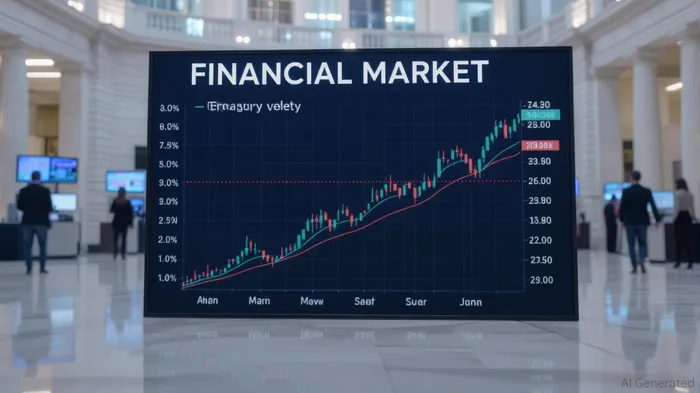
This divergence highlights a market caught between short-term optimism (driven by tariff truce optimism) and long-term fragility (stemming from unresolved trade disputes and global supply-chain risks).
Sector Rotation: Favoring Resilience Over Risk
Overweight Low-Correlation Sectors
The volatility environment demands a focus on defensive sectors with stable cash flows and minimal exposure to trade wars:
- Energy (XLE):
- Benefits from higher oil prices and U.S. production advantages.
Key plays: ExxonMobil (XOM) and ChevronCVX-- (CVX), which have leveraged domestic shale and refining capacity.
Utilities (XLU):
- Defensive anchor with dividend yields averaging 3.5%.
Prioritize regulated utilities like Xcel EnergyXEL-- (XEL) and NextEra EnergyNEE-- (NEE).
Healthcare (XLV):
- Insulated from trade tensions, with demand stability in pharma and healthcare services861198--.
- Top picks: MerckMRK-- (MRK) and UnitedHealthUNH-- (UNH), which have outperformed the broader market by 15% YTD.
Underweight High-Beta Tech & Consumer Discretionary
- Tech (XLK):
- Margins pressured by 34% tariffs on laptops and 69% on video game consoles.
Avoid semiconductor ETFs (SMH) until trade clarity emerges; favor firms like NVIDIANVDA-- (NVDA) with pricing power.
Consumer Discretionary (XLY):
- Suffers from input cost inflation (steel tariffs at 50%) and retaliatory measures.
- Tesla's Q2 deliveries dropped 12% as price-sensitive buyers retreated.
Hedging Strategies: Tactical Call Buying vs. Long-Term Skew
Tactical Call Buying: Capitalizing on Volatility Contraction
With implied volatility low, investors can deploy bull call spreads on low-correlation sectors. For example, buying calls on the Utilities ETF (XLU) with a 10% premium while selling higher-strike calls limits downside risk while capturing upside potential.
Long-Term Hedging: Using VIXTLT and SPX Skew
VIX Term Structure (VIXTLT):
The steepening VIX term structure (long-dated options more expensive than near-term) signals persistent tail risks. Investors should allocate 5-10% of portfolios to long-dated puts on the S&P 500 (SPX) to hedge against a tariff stalemate post-August 12.SPX Skew:
Monitor the S&P 500 Put-Call Skew to gauge tail risk pricing. A widening skew (puts overpriced vs. calls) suggests increased demand for downside protection—a signal to reduce equity exposure.
Fixed Income and International Equities: Opportunities in Chaos
Fixed Income Resilience
Despite Treasury volatility, high-quality bonds (e.g., iShares Core U.S. Aggregate Bond ETF, AGG) offer ballast to portfolios. Focus on short-duration maturities to mitigate yield curve risks.
International Equities: A Contrarian Play
Emerging markets (EEM) and European equities (FEZ) have underperformed due to dollar strength and trade spillover risks. However, their valuations (EEM trades at 12x P/E vs. S&P's 25x) present a contrarian opportunity if the U.S.-China deal extends beyond August 12.
Conclusion: Position for a Volatile but Resilient Q3
Markets are balancing optimism over tariff truces with anxiety over unresolved trade wars. Investors should:
1. Rotate into low-correlation sectors (energy, utilities, healthcare).
2. Hedge dynamically using VIXTLT and SPX skew.
3. Underweight high-beta tech/consumer discretionary until trade clarity emerges.
4. Monitor the August 12 deadline—a missed agreement could trigger a 10% correction in cyclicals, while a deal might spark a cyclical rally.
In this environment, resilience—both in portfolio construction and risk management—will define outperformance.





Comentarios
Aún no hay comentarios