
Navigating Market Downtime: How Crypto Fills the Gap When U.S. Markets Close for Thanksgiving
The U.S. stock market's annual closure for Thanksgiving has long left investors in a lull, with traditional equities and bonds inaccessible for trading. However, the rise of cryptocurrency markets-operating 24/7, 365 days a year-has transformed this downtime into an opportunity. For investors seeking strategic diversification and exposure to alternative assets, crypto's round-the-clock liquidity offers a compelling solution. This analysis explores how cryptocurrency markets function during U.S. market holidays, the historical patterns observed during Thanksgiving, and the nuanced risks and rewards of leveraging crypto for diversification.
The 24/7 Edge: Crypto's Unmatched Liquidity
Traditional markets like the NYSE and Nasdaq close at 4:15 PM ET on Thanksgiving, leaving investors unable to react to global events or rebalance portfolios. In contrast, cryptocurrency markets remain open, enabling traders to capitalize on price movements driven by macroeconomic shifts, geopolitical developments, or sector-specific news. According to a report, the total crypto market cap surged from $832 billion to $1.72 trillion in 2023, with BitcoinBTC-- and EthereumETH-- leading the charge. This growth underscores crypto's maturation as a financial asset class, even as its 24/7 nature continues to differentiate it from traditional markets.
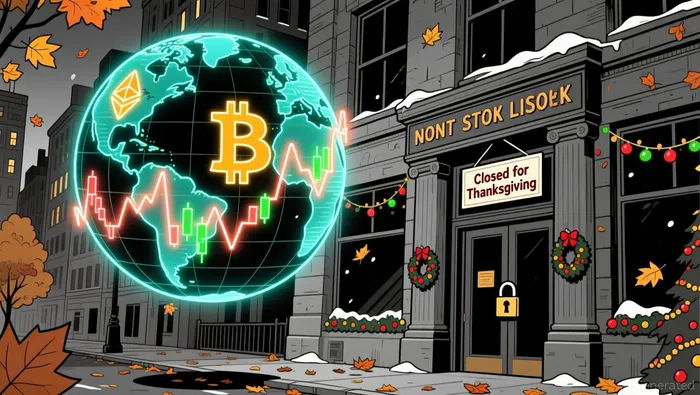
However, this constant availability comes with caveats. Data from Investopedia reveals that weekend trading volumes for Bitcoin are typically 47.65% lower than weekday volumes, yet price volatility remains consistent. This suggests that while liquidity is reduced during holidays, crypto's inherent volatility ensures that price swings can still be significant. For instance, during the 2022 Thanksgiving holiday, Bitcoin plummeted 13.3% amid the broader crypto market turmoil following the FTX collapse. Such events highlight the dual-edged nature of 24/7 trading: opportunities for profit coexist with heightened risk.
Strategic Diversification: Crypto's Role in Holiday Portfolios
The 24/7 nature of crypto markets introduces unique diversification benefits during U.S. market closures. A study published by OneSafe.io notes that the pre-holiday momentum strategy-buying cryptocurrencies the day before a holiday-has historically shown promise, particularly for Bitcoin. This strategy leverages the "holiday drift" phenomenon, where asset prices often trend upward in the days leading up to market closures. When combined with technical indicators like short-term price highs, the strategy's returns can be amplified.
Yet diversification in crypto is not without complexity. Research from Springer highlights that cryptocurrencies are increasingly correlated with traditional assets, especially during periods of low liquidity. For example, during U.S. market holidays, shifts in sentiment toward tech stocks or risk-on/risk-off trades often spill over into crypto markets. This interplay was evident in 2023, when Bitcoin's 0.1% gain on Thanksgiving aligned with a broader market rebound fueled by optimism over AI-driven growth and potential Fed rate cuts.
Risk Management: Navigating Volatility and Liquidity Gaps
While crypto's 24/7 operation offers strategic advantages, it also demands rigorous risk management. Quantified Strategies reports that Bitcoin and Ethereum generate an average of +48 basis points in overnight returns, compared to -2 basis points during intraday trading. This anomaly is amplified during weekends and holidays, when liquidity is thinnest. Traders must account for the fact that even small trades can disproportionately impact prices, as seen in 2021's 1.5% Thanksgiving decline.
Moreover, the psychological toll of constant monitoring cannot be ignored. Forbes highlights that 24/7 trading can lead to burnout, sleep disruption, and impaired decision-making. Automated tools for rebalancing and position sizing are critical to mitigate these risks, particularly for investors using crypto to hedge traditional portfolios during market closures.
Conclusion: Balancing Opportunity and Caution
Cryptocurrency's 24/7 trading model fills a critical gap during U.S. market holidays, offering investors a dynamic tool for diversification and strategic positioning. Historical data from Thanksgiving 2020–2023 demonstrates both the potential for gains and the risks of volatility. While crypto's correlation with traditional assets has tightened in recent years according to research, its unique liquidity profile and return patterns remain unmatched. For investors willing to navigate the challenges of round-the-clock trading, crypto presents a compelling complement to traditional portfolios-provided they approach it with discipline, technical rigor, and a clear understanding of the risks.







Comentarios
Aún no hay comentarios