
Navigating the New Maritime Order: Gulf Logistics and Suez Canal Recovery in 2025
The Suez Canal, a linchpin of global trade for over a century, has faced unprecedented challenges in 2025. A confluence of geopolitical tensions-including Houthi attacks in the Red Sea and the Gaza conflict-has forced over 90% of container traffic to reroute around the Cape of Good Hope, adding 10–14 days to transit times and inflating freight costs by 30–40%, according to a Sino-Shipping report. By early 2025, daily traffic through the canal had plummeted to 32 ships, a 57.5% decline from pre-crisis levels, causing Egypt to lose $6–7 billion in revenue from tolls alone, according to a UNCTAD analysis. This crisis has exposed the fragility of global supply chains and accelerated strategic shifts in Gulf maritime logistics.
Suez Canal's Fragile Recovery
The Suez Canal Authority (SCA) has projected a return to normal traffic by mid-2025, contingent on the continuation of the Gaza ceasefire and reduced Houthi aggression, as reported by Sino-Shipping. While traffic has shown a modest rebound-rising to 47 ships per day in February 2025-large oil tankers remain restricted, and nearly half of maritime traffic continues to bypass the canal, according to a MeObserver piece. The economic toll on Egypt is severe: canal tolls account for 15% of its foreign currency income and 10% of GDP, per UNCTAD. To mitigate losses, the SCA has introduced discounted transit fees and infrastructure upgrades, including the expansion of the southern sector of the canal, as reported by MeObserver.
However, full recovery remains uncertain. Renewed tensions, such as recent exchanges between Israel and Iran, could reverse progress, according to an Africa Supply Chain report. The European Union's Emissions Trading System (ETS) has further compounded costs, as rerouted ships burn 15–20% more fuel, increasing emissions and compliance expenses, in line with findings from a Modern Diplomacy analysis.
Gulf Strategic Adaptations: The Rise of IMEC
Faced with Suez instability, Gulf states are pivoting to alternative infrastructure and trade routes. The India-Middle East-Europe Economic Corridor (IMEC), announced in 2023, is emerging as a critical response. This $100+ billion initiative aims to create a modern Silk Road, connecting Indian ports to Europe via Gulf hubs, overland rail, and Mediterranean crossings, according to a Logistics Middle East article.
The UAE and Saudi Arabia are leading the charge. Jebel Ali Port, the UAE's flagship maritime hub, is undergoing automation upgrades to handle 20% more cargo volume, positioning it as a key node for IMEC, per Logistics Middle East. Saudi Arabia, meanwhile, is investing $40 billion in rail and logistics projects under Vision 2030, aiming to transform the kingdom into a land bridge for the corridor, according to Logistics Middle East. These efforts are supported by digital innovations, including smart trade platforms and digital customs systems, to streamline cross-border logistics, as noted by Logistics Middle East.
Another notable project is the UAE's Development Road, a land-sea corridor linking the UAE, Iraq, and Turkey. This route promises to reduce shipping times by 40% compared to the Suez Canal, offering a faster and more secure alternative, according to UNCTAD.
Investment Implications and Regional Stability
The Gulf's infrastructure investments present both risks and opportunities. For investors, the IMEC corridor offers long-term growth potential, with projections of 1.5% annual GDP boosts for India and 2 million new jobs in logistics and infrastructure by 2030, as reported by Modern Diplomacy. However, geopolitical risks persist. The stalled normalization of Saudi-Israel relations, for instance, could delay full integration of the corridor, according to Logistics Middle East.
Regionalization of supply chains is also gaining traction. Gulf Cooperation Council (GCC) firms are increasingly sourcing regionally, with 34% of executives prioritizing local suppliers-a 12% jump from global averages, per Sino-Shipping. While this reduces dependency on volatile routes, it also exposes companies to regional economic and political risks, such as over-reliance on politically unstable markets, as noted by Sino-Shipping.
The Path Forward
The Suez Canal's recovery hinges on sustained regional stability. A prolonged ceasefire in Gaza and de-escalation in the Red Sea are critical to restoring the canal's role as a trade artery. Meanwhile, Gulf states are betting on IMEC and other projects to future-proof their economies. For investors, the key lies in balancing short-term volatility with long-term resilience.
As the world grapples with the fragility of global supply chains, the Gulf's strategic investments underscore a broader shift: from reliance on single chokepoints to diversified, technology-driven networks. Whether these efforts succeed will depend not only on infrastructure but also on the region's ability to navigate geopolitical currents and foster cooperation. 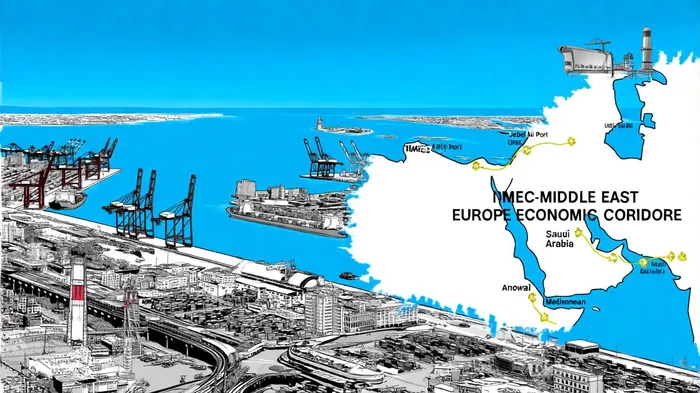







Comentarios
Aún no hay comentarios