
Navigating Major Token Unlocks in Layer 2 and DeFi Markets: Risk Mitigation and Strategic Opportunities
The DeFi and Layer 2 ecosystems have evolved from experimental frontiers to critical components of the global financial infrastructure. As token unlocks-events where previously restricted tokens become tradable-gain prominence in 2025, their impact on liquidity dynamics and investor sentiment demands rigorous analysis. This article examines how strategic liquidity management and evolving market psychology are reshaping opportunities and risks in this space, drawing on recent developments in projects like ArbitrumARB--, OptimismOP--, and UniswapUNI--.
The Liquidity Imperative: From Dencun to Unichain
Ethereum's Dencun upgrade in March 2024 marked a turning point for Layer 2 scalability, reducing transaction costs and enabling sub-second execution times. This shift has made on-chain liquidity more accessible, particularly for institutional investors who now integrate DeFi liquidity into their trading workflows. For example, Uniswap's launch of Unichain, a Layer 2 network built on the OP Stack, processed $2.613 billion in trading volume by June 2025, capturing 75% of Uniswap's total activity. Such advancements highlight how Layer 2 solutions are not only improving efficiency but also redefining liquidity as a competitive advantage.
However, liquidity management remains a double-edged sword. Projects like JUP on Solana demonstrate how utility-driven tokenomics - where tokens incentivize ecosystem usage - can stabilize demand and mitigate sell pressure. Conversely, poorly structured unlocks, such as the phased SUI token releases in Q3 2025 risk triggering volatility as seen in prior unlocks.
Investor Sentiment: From Speculation to Fundamentals
Market psychology around token unlocks has matured. In 2024, Euler's 17.4% TVL growth and Morpho's 24.89% 30-day TVL increase underscored how DeFi protocols are transitioning from speculative assets to infrastructure with measurable utility. By 2025, investor sentiment is increasingly tied to fundamentals such as fee revenue, treasury health, and active user metrics. For instance, Uniswap's decision to allocate 65% of net fees to $UNI stakers has created a structural value proposition, aligning token holder incentives with protocol growth.
Yet, sentiment remains fragile. The anticipated unlock of tokens on projects like LINEA and MOVE has 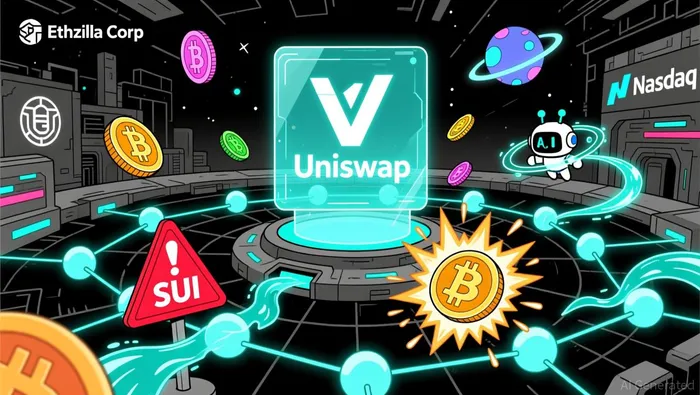 generated both excitement and caution, as liquidity providers weigh potential sell-offs against yield opportunities. This duality is amplified by macroeconomic factors, such as the expected drop in U.S. federal funds rates, which could drive capital into DeFi's higher-yield environments.
Risk Mitigation: AI Agents and Structured Airdrops
2025 has seen a surge in tools to mitigate unlock-related risks. AI crypto agents now optimize yield strategies by dynamically reallocating assets across liquidity pools and assessing protocol risks in real time. These systems reduce manual oversight and enhance resilience against volatility.
Structured airdrop strategies also play a critical role. Projects like ENS and Celestia have adopted phased distributions to prevent early dumping, ensuring sustained community engagement. Similarly, Optimism's completion of its token unlock in 2025 reduced selling pressure and bolstered investor confidence.
Strategic Opportunities: Superchains and Real-World Assets
The rise of Superchains - ecosystems where a single chain's token powers multiple applications - offers new opportunities. Optimism's Superchain narrative has attracted developers and liquidity providers seeking scalable, cross-chain solutions. Meanwhile, real-world asset (RWA) platforms like AaveAAVE-- are expanding TVL by tokenizing traditional assets, creating hybrid markets that blend DeFi efficiency with real-world collateral according to Nasdaq.
Institutional adoption further amplifies these trends. Ethzilla Corp's pivot to digital asset management in Q3 2025 - purchasing 102,000 ETHETH-- and planning RWA tokenization - signals growing confidence in DeFi's infrastructure. Such moves are likely to drive liquidity into protocols with robust tokenomics and governance frameworks.
Conclusion: A New Paradigm for DeFi Investing
The 2025 DeFi landscape is defined by a delicate balance between innovation and risk. While token unlocks continue to testTST-- liquidity and sentiment, they also create opportunities for protocols that prioritize utility, transparency, and institutional-grade infrastructure. Investors must now apply traditional financial analysis to DeFi, evaluating metrics like fee generation and treasury value alongside on-chain activity according to a new study. As AI tools and structured tokenomics become standard, the sector's maturation will likely attract a new wave of capital, cementing DeFi's role in the global financial ecosystem.






Comentarios
Aún no hay comentarios