
Navigating Leveraged Semiconductor ETF Volatility Post-AMD's Surge: A Risk Management Perspective
The semiconductor sector's Q3 2025 volatility, catalyzed by Advanced Micro Devices' (AMD) 93% YTD surge, has reignited debates about the risks and rewards of leveraged ETFs. While AMD's landmark OpenAI partnership and AI roadmap have driven sector-wide optimism, investors in leveraged products like Direxion's SOXL (3x leveraged) and Defiance's AMDU (150–200% leveraged) face a precarious balancing act between amplified gains and compounding decay risks.
AMD's Surge: Catalyst and Consequences
AMD's stock price reached a 52-week high of $233 in Q3 2025, fueled by a $6 billion AI chip deal with OpenAI and a 32% year-on-year revenue jump to $7.7 billion, according to the TS2 report. This outperformance has elevated AMDAMD-- to a $300+ billion market cap, challenging rivals like NVIDIA and Intel. However, the TS2 piece also notes a 90× earnings valuation and an $800 million inventory charge for AI chips that highlight structural risks. For leveraged ETFs, AMD's volatility-exacerbated by U.S. export restrictions on MI308 GPUs to China (projected to erase $1.5 billion in 2025 revenue)-creates a double-edged sword, as a CGAA article examines.
Leveraged ETFs: Amplified Gains, Accelerated Decay
Direxion's SOXL, which aims to deliver 3x daily returns of the NYSE Semiconductor Index (SOXX), exemplifies the sector's volatility. In Q3 2025, SOXL saw a 23% single-day drop following semiconductor equipment firm disruptions, while AMD's rally pushed the ETF to a 25% quarterly gain, according to reporting by CGAA. However, daily compounding mechanisms inherent to leveraged ETFs create decay risks; for instance, a 10% intraday swing in SOXX could erode 30% of SOXL's value over two days due to rebalancing, as an ETF.com explainer notes.
The Defiance AMDU ETF, designed to deliver 150–200% daily exposure to AMD, further illustrates this dynamic. While AMD's 38% Q3 surge could theoretically translate to 57–76% gains for AMDU, the fund's performance diverges from its stated leverage due to market fluctuations and income-generating strategies like credit call spreads, a divergence highlighted in the CGAA analysis. This deviation underscores the importance of short-term trading discipline for leveraged ETF holders.
Wall Street's Risk Appetite: Caution Amid Optimism
Despite decay risks, Wall Street's appetite for leveraged semiconductor ETFs remains robust. Analysts at Jefferies and UBS have raised AMD's price targets to $190–$250, and algorithmic projections suggest a $249–$292 range by 2030, per the TS2 coverage. This bullish outlook has driven inflows into leveraged products, with SOXL averaging 74.9 million shares traded daily in 2024, as ETF.com documents. However, caution persists. The SMCI Leveraged ETF, for example, posted an 18.9% loss in January 2025, reflecting the sector's susceptibility to sudden reversals noted by CGAA.
Strategic Positioning: Balancing Leverage and Discipline
Investors in leveraged semiconductor ETFs must adopt disciplined risk management strategies. Key considerations include:
1. Short-Term Horizons: Leveraged ETFs are designed for daily rebalancing, making them unsuitable for long-term holdings. For example, SOXL's 3x leverage compounds decay over extended periods, eroding returns even in trending markets, as ETF.com explains.
2. Position Sizing: Given AMD's 69.4% institutional ownership, a point raised in CGAA's coverage, leveraged ETFs may amplify systemic risks during sector-wide corrections. Traders should limit exposure to 5–10% of a portfolio to mitigate drawdowns.
3. Diversification: Pairing leveraged ETFs with non-leveraged options like SMH (39.69% one-year return as of January 2025, per the TS2 article) can balance volatility. SMH's 0.35% expense ratio and broad semiconductor exposure offer a safer alternative for long-term investors, as noted in the TS2 piece.
Conclusion: Navigating the Semiconductor Volatility Cycle
AMD's Q3 2025 surge has underscored the semiconductor sector's potential-and its perils. While leveraged ETFs like SOXL and AMDU offer amplified access to AI-driven growth, their structural risks demand rigorous risk management. As Wall Street continues to rotate into semiconductor stocks ahead of the Fed's rate cut cycle, a trend explored by CGAA, investors must weigh the allure of leverage against the realities of decay. In this high-stakes environment, strategic positioning-rooted in short-term discipline and diversified exposure-remains paramount.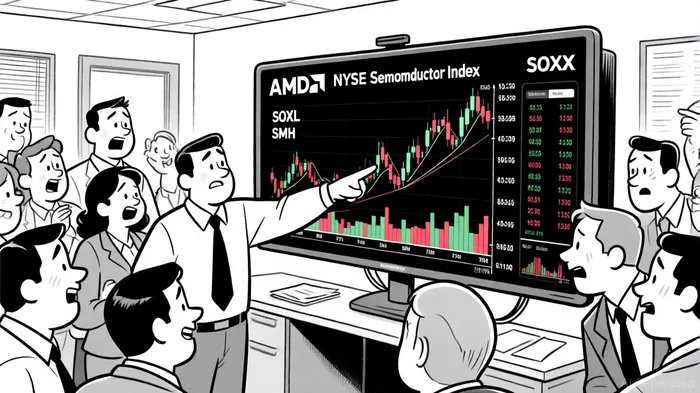





Comentarios
Aún no hay comentarios